
Ytterbium metastable states measured for quantum computers and clocks
Researchers measured long-lived states in ytterbium ions, a finding that could aid trapped-ion quantum computers and atomic clocks.
By Tom Brennan · Health & Medicine Correspondent
3 min read
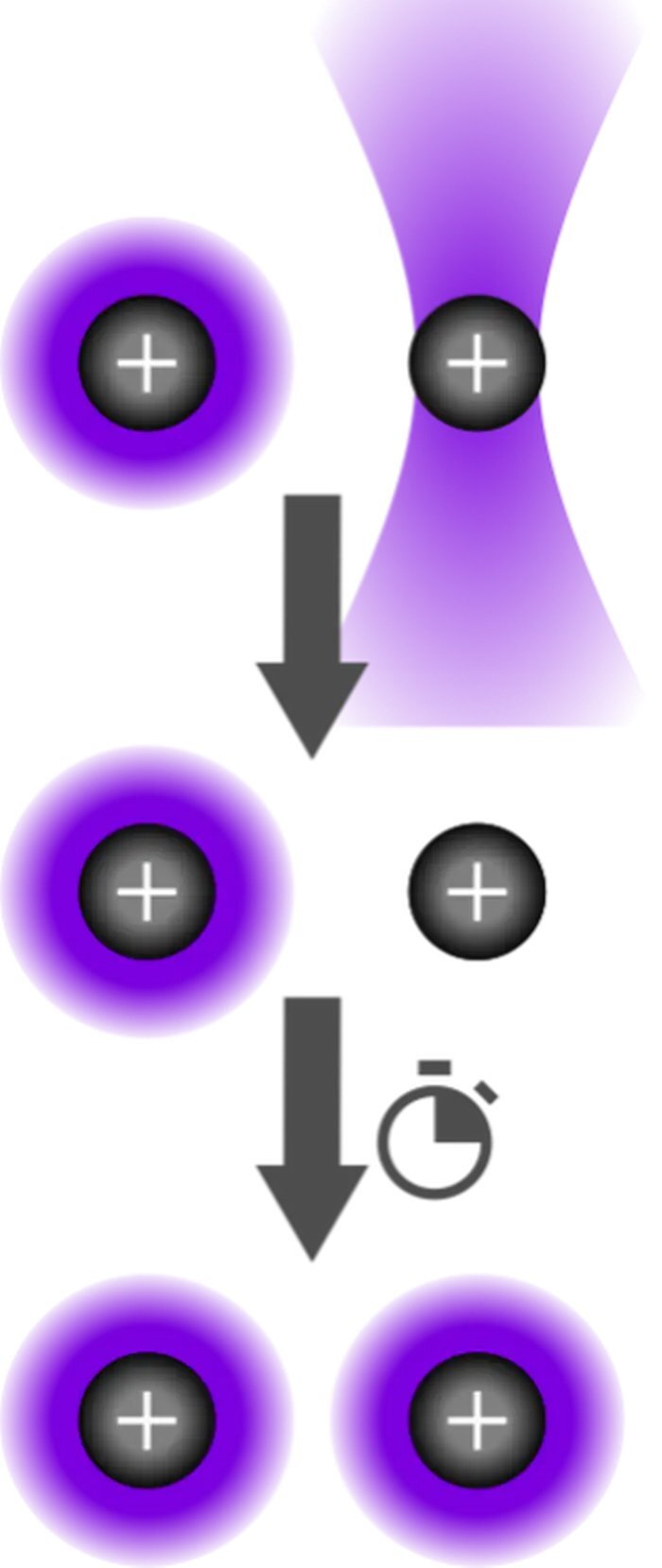
Researchers at the University of Amsterdam and the University of New South Wales have measured ytterbium metastable states that can keep charged ytterbium atoms out of their ground state for seconds. The finding matters because ytterbium ions are a leading candidate for trapped-ion quantum computers and atomic clocks, technologies that depend on precise control of atomic energy states.
The team reported the results in Physical Review A. According to the researchers, they measured decay signals corresponding to lifetimes of about 1 second and 10 seconds, and found evidence for another state lasting more than 30 seconds.
What are ytterbium metastable states?
Metastable states are nearly stable energy states in which an atom or ion can remain for an unusually long time before dropping back to a lower-energy state. In trapped-ion systems, that timing can be useful because clocks and quantum devices work by preparing, controlling and detecting specific atomic states.
Ions are atoms with an electric charge. Because of that charge, researchers can hold them in empty space with electromagnetic fields, then use lasers to change or probe their energy states.
How the experiment worked
In Rene Gerritsma’s lab at the University of Amsterdam Institute of Physics, the group used lasers to excite a single Yb⁺ ion to a high-energy level. As the ion decayed toward lower-energy levels, some of the states it entered proved to be long-lived, according to the University of Amsterdam.
The experiment did not rely on one ion alone. Zeger Ackerman, the study’s first author and a Ph.D. student, said the group trapped two ions together: one for spectroscopy and another to cool and stabilize the setup without disrupting the metastable state being measured.
That method let the researchers observe when the ion stopped fluorescing in a long-lived state and when it began fluorescing again after decaying. The team then used atomic-structure calculations to check the measurements, according to the university.
Why the 1-second state stands out
The researchers said the state with a lifetime of about 1 second is especially promising. Their calculations indicate it may be reachable from the ground state with a single laser pulse.
That combination of lifetime and transition strength could improve how ytterbium-ion systems detect the states of qubits and qudits, according to the researchers. A qubit is the basic unit of quantum information; a qudit is a higher-dimensional version that can represent more than two states.
The work also addresses a prediction made 35 years ago by theoretical physicists Fawcett and Wilson, according to the University of Amsterdam. They had estimated a 5.2-second lifetime for the same state and called for experimental confirmation; the new measurement puts the lifetime on the same seconds-scale despite the complex energy structure of Yb⁺.
The paper, by Z. E. D. Ackerman and co-authors, is titled “Long-lived metastable states in the 4𝑓135𝑑6𝑠 configuration of Yb+.” It was published in Physical Review A, with a related version available through arXiv.
This story draws on original reporting from Phys.org.