
Quantum birthmarks preserve traces of a system’s past, theorists report
A theoretical study finds chaotic isolated quantum systems retain an origin-dependent memory signal in long-time averages.
By Lucas Ferreira · Science & Environment Writer
3 min read
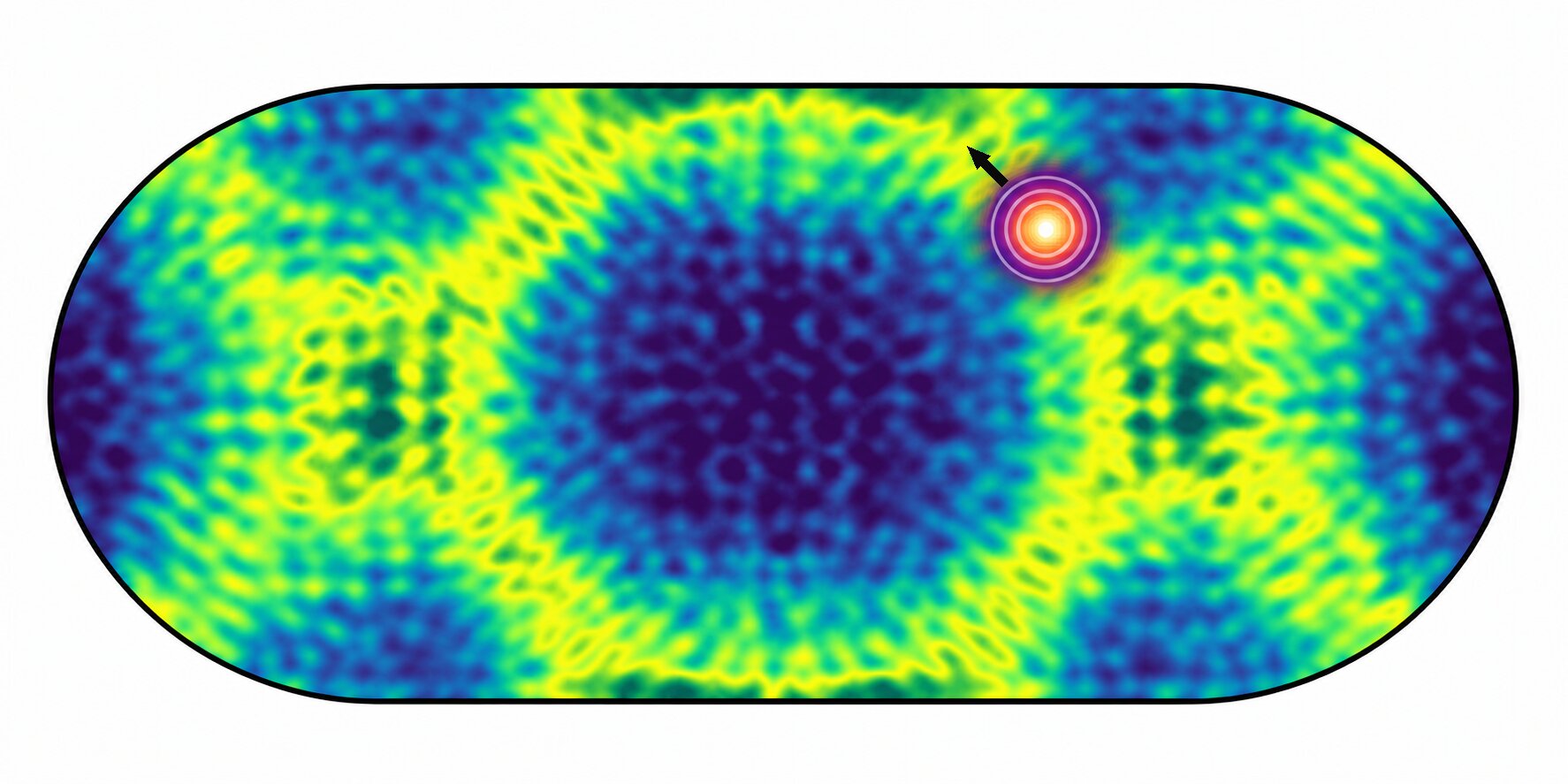
Researchers have described “quantum birthmarks,” a statistical signal that can preserve traces of an isolated quantum system’s starting point even after its evolution appears chaotic. The work matters for how physicists compare quantum behavior with classical ergodicity, where a system’s long-term behavior is expected to lose usable memory of its initial conditions.
Anton Graf of Harvard University and colleagues analyzed the effect in theoretical work and computer simulations, according to an APS Physics Viewpoint. Phys.org reported that the researchers’ framework calls these persistent traces quantum birthmarks and links them to quantum chaos and ergodicity.
What are quantum birthmarks?
A quantum birthmark is a long-time statistical preference for a quantum system to return to a state tied to its origin, rather than to an unrelated state. It is not necessarily visible in a single late-time image of the system: APS Physics said a quantum wave packet can look scrambled at a particular instant while its time-averaged probability still carries the memory signal.
Classical ergodicity describes a system exploring its available configurations over time. In the standard classical picture, that exploration erases evidence of where the system began. The reported quantum result instead concerns isolated systems and a time-averaged measurement, not a claim that every late-time quantum state visibly retains its initial shape.
What did the analysis find?
The researchers used a quantity called the time-averaged occupation probability, which compares the chance that an initial state evolves into a specified later state. APS Physics reported that the probability of returning to the initial state was at least twice the probability associated with an unrelated state: Paa/Pba is at least 2 in the setting considered.
APS Physics attributed that difference to quantum interference. A state can be expressed through steady single-energy waves, or eigenstates. For states connected by time evolution, the relevant eigenstate weights are correlated, increasing the time-averaged return probability relative to unrelated states with uncorrelated weights.
How do quantum scars affect the result?
The team illustrated the idea with computer simulations of a particle in a stadium-shaped quantum billiard, a two-dimensional enclosure with a racetrack-like boundary. For generic initial wave packets, APS Physics reported an enhancement of about two; for wave packets launched along periodic paths, it reported an enhancement of about eight.
Those larger cases connect to quantum scars, patterns in which quantum behavior is concentrated near short, unstable repeating paths from the classical version of a system. Phys.org reported that the researchers divide the birthmark effect into a universal memory contribution for evolving states and a revival contribution from early recurrences. Such recurrences can strengthen the effect, the researchers said.
The result is a mathematical and computational finding, not an experimental observation or a demonstrated application. APS Physics said the work offers a perspective in which thermalization is not fully complete in principle, while stressing that the birthmark is tied to the initial state’s spectral decomposition rather than being a visible property of the late-time state alone.
This story draws on original reporting from Phys.org.