
Why Jupiter has giant moons may come down to its early magnetic field
Kyoto University-led simulations suggest young Jupiter protected multiple large moons, while Saturn lacked a similar safe zone.
By Priya Raghavan · Science Reporter
3 min read
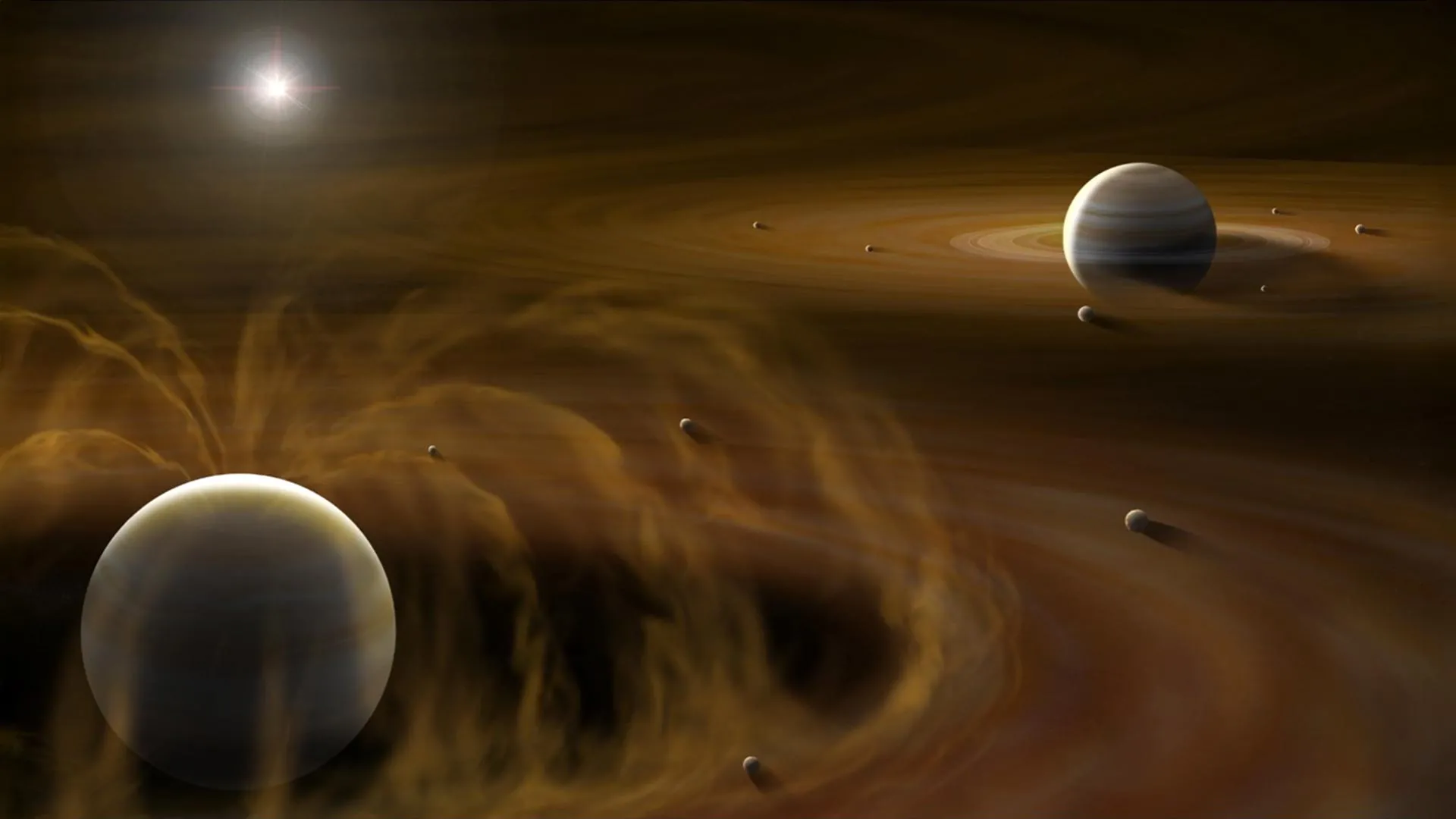
Why Jupiter has giant moons while Saturn is dominated by Titan may be tied to how strong each planet’s magnetic field was in its youth, according to research reported by Kyoto University. The study offers a possible answer to a long-running puzzle: two gas giants formed very different systems of major moons.
Jupiter has more than 100 reported moons, including four especially large ones. Ganymede is the largest moon in the Solar System. Saturn has more than 280 moons and a prominent ring system, but Titan, the Solar System’s second-largest moon, dominates its satellite system, Kyoto University said.
The new work, published in Nature Astronomy, argues that the split may have started in the disks of gas and dust that once surrounded the young planets. Those disks, known as circumplanetary disks, are the rotating material around forming planets from which moons can grow.
Why do Jupiter and Saturn have different moons?
Researchers led by Yuri I. Fujii modeled the early interiors and heat histories of Jupiter and Saturn to estimate how their magnetic fields evolved. They then simulated the disks around both planets and used N-body calculations to follow how moons formed and shifted their orbits, according to Kyoto University.
The team found that young Jupiter’s stronger magnetic field could have carved out a cavity in the inner part of its circumplanetary disk. That empty region would have acted as a protected zone where migrating moons could avoid being lost, helping Io, Europa and Ganymede survive, the researchers reported.
Saturn’s early magnetic field, by contrast, was not strong enough in the model to form the same kind of cavity. Without that inner gap, moons moving through Saturn’s disk would have had a harder time lasting, leaving a system in which Titan stands out as the dominant large survivor, Kyoto University said.
Scientists have proposed multiple explanations for the difference between the Jupiter and Saturn moon systems. The new study focuses on magnetic accretion, a process in which magnetic fields influence how material flows through a disk surrounding a young planet.
Fujii said, according to Kyoto University, that planet formation theories are difficult to test because scientists have only the Solar System as a direct reference. Nearby satellite systems, however, provide detailed examples that can be compared against models.
What could this mean for exomoons?
The researchers say the model could help guide searches for moons around planets beyond the Solar System. In their simulations, Jupiter-size or larger gas planets tend to form compact systems with several moons, while planets closer to Saturn’s size may be more likely to end up with only one or two.
The team plans to test the same idea against other moons and possible exomoon systems, Kyoto University said. If future observations find similar patterns around young gas giants, magnetic cavities could become a key clue in explaining how large moons survive.
This story draws on original reporting from ScienceDaily.