
Universe faster than light expansion fits Einstein’s rules
Universe Today explains how cosmic expansion can carry galaxies away faster than light without violating relativity.
By Lucas Ferreira · Science & Environment Writer
3 min read
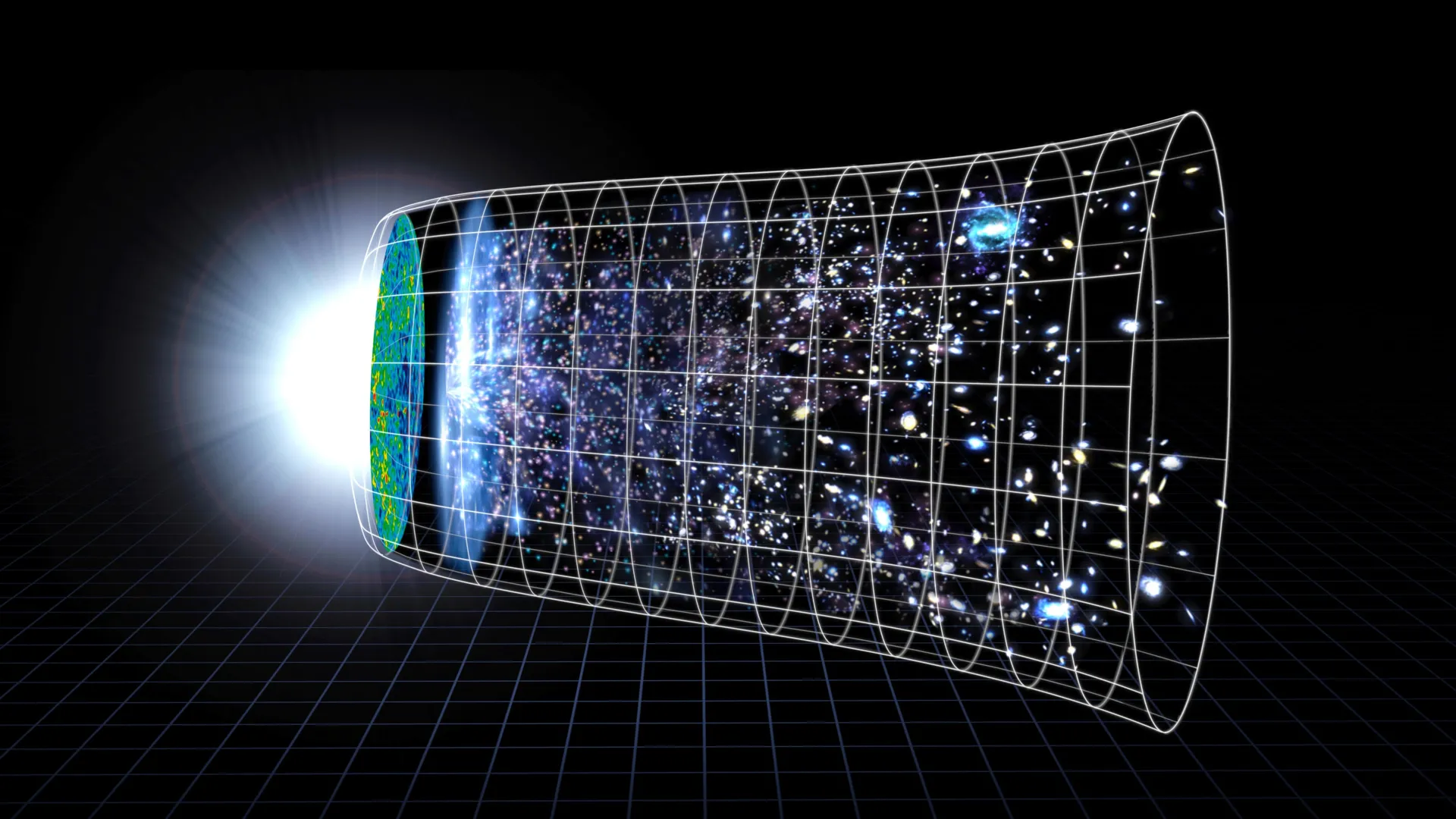
The universe faster than light puzzle comes down to the difference between motion through space and the expansion of space itself. Universe Today, in an explainer by Paul Sutter published via ScienceDaily, says distant galaxies can recede from us faster than light while still obeying Einstein’s rules.
The point matters for how astronomers read the deep universe. A telescope image of a faraway galaxy shows the galaxy as it was when its light began the trip, not where that galaxy is now, because space kept expanding while the light traveled, Universe Today says.
To estimate a galaxy’s current distance, astronomers use a cosmological model that includes the universe’s expansion history. Universe Today identifies the leading model as LCDM, which incorporates dark matter and dark energy, and says alternative models do not greatly change the broad picture described in the explainer.
How can the universe expand faster than light?
Einstein’s speed limit applies locally: an object such as a nearby spacecraft cannot pass an observer at faster than light speed, Universe Today says. Cosmic expansion is different because the distance between faraway galaxies grows as space itself stretches.
That distinction lets the separation between very distant objects increase faster than light without requiring those objects to race through their local space at that speed. Universe Today says the effect becomes larger with distance because more space lies between the observer and the galaxy, giving more space room to expand.
Astronomers measure recession through redshift, the stretching of light toward redder wavelengths as a galaxy moves away. Universe Today notes that Edwin Hubble used this effect as evidence that the universe is expanding.
Why can we still see galaxies receding that fast?
The universe is about 13.77 billion years old, yet the farthest regions visible today are now roughly 45 billion light-years away, according to Universe Today. That outer boundary is called the particle horizon, cosmological horizon or comoving horizon, and it marks the limit of today’s observable universe.
We can see beyond the distance where galaxies are now receding faster than light because the arriving light left them when they were closer, Universe Today says. The threshold where recession reaches light speed is called the Hubble distance, and Universe Today places it at about 13.77 billion light-years.
Some light from even more distant galaxies may still arrive in the future if it began heading toward us when those galaxies were nearer. Universe Today says there is also a harder boundary, the cosmological event horizon, now about 17 billion light-years away.
Light emitted today from beyond that event horizon will not reach us, according to Universe Today, because expansion will keep increasing the gap faster than the light can cross it. This cosmological event horizon is distinct from the event horizon around a black hole.
What happens to distant galaxies in the far future?
Universe Today says dark energy is driving accelerated expansion, making the separation from remote galaxies more severe over time. The cosmological event horizon will continue to grow, the explainer says, but it will approach a maximum distance of about 60 billion light-years.
That does not mean future observers will see everything inside that range. Universe Today says light from the most distant galaxies will be stretched to such long wavelengths that those galaxies will effectively vanish from view.
In about 100 billion years, every galaxy outside the Local Group will have faded from sight, according to Universe Today. The result, Sutter writes, is a future universe that would look far smaller and emptier than the one astronomers can observe now.
This story draws on original reporting from ScienceDaily.