
Twisted laser light identifies chiral molecules by fragment counts
Researchers used shaped ultrashort pulses and mass spectrometry to tell R- and S-camphor apart from ion fragment counts.
By Tom Brennan · Health & Medicine Correspondent
3 min read
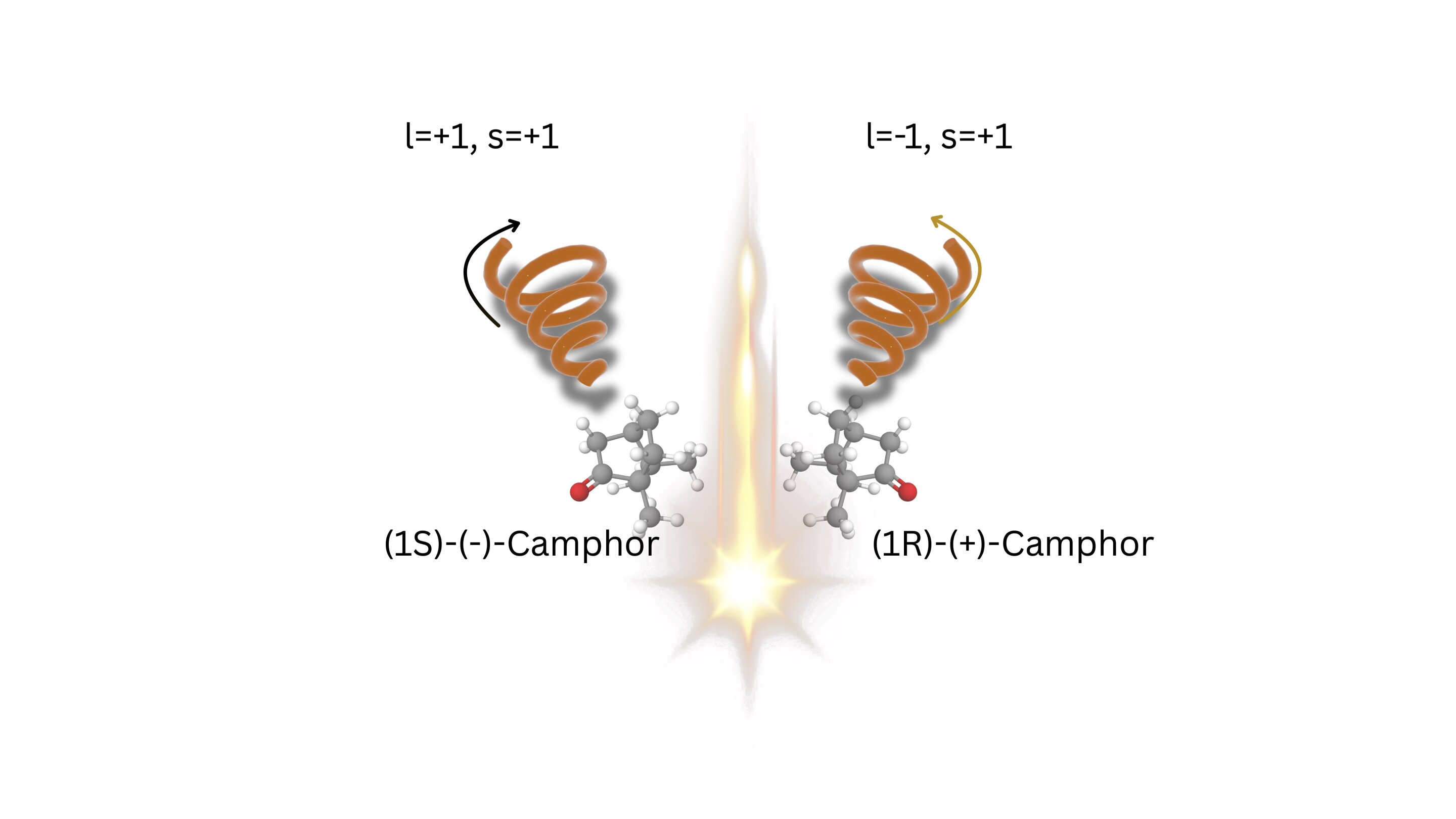
Researchers say twisted laser light can distinguish chiral molecules by changing how many charged fragments they produce. The finding matters because mirror-image molecules can act differently in biological systems and drugs, making reliable identification important in chemistry and pharmaceutical work.
The work, by scientists from the Tata Institute of Fundamental Research, Indian Institute of Technology Bombay and Indian Institute of Technology Hyderabad, was published in Science Advances. According to the Tata Institute of Fundamental Research, the study shows that light can be shaped so that its spin and its twist affect how it interacts with molecules of different handedness.
Chiral molecules, also called enantiomers, come in two forms that are mirror images of each other, like left and right hands. They may look nearly identical in structure, but the Tata Institute of Fundamental Research said they can behave differently, especially in biological and pharmaceutical settings.
How does twisted laser light identify chiral molecules?
The researchers used ultrashort laser pulses whose spin and twist could be controlled, then aimed them at gaseous R-camphor or S-camphor at the laser facility in TIFR Hyderabad. Camphor is a known chiral molecule, making it a useful test case for telling left- and right-handed molecular forms apart.
When the laser pulses hit the gas-phase molecules, the molecules broke into charged fragments. The team then measured those ions with a time-of-flight mass spectrometer, an instrument that identifies ion masses by recording how long they take to reach a detector; lighter ions arrive sooner.
According to the researchers, the key result was that fragment counts changed depending on the pairing between the light’s twist and the molecule’s handedness. By comparing those counts, the team could distinguish the mirror-image forms of camphor.
Why fragment counts could simplify chirality tests
The Tata Institute of Fundamental Research said many established chirality measurements rely on detecting small differences in light absorption or on mapping the angles of emitted electrons. Those approaches can require more complex equipment and precise alignment.
The method reported in Science Advances instead reads chirality from ion signals in a mass spectrometer. According to the researchers, it does not require angular measurements or coincidence detection, which reduces the experimental demands while improving sensitivity in their setup.
The experiments also examined molecules in the gas phase. The Tata Institute of Fundamental Research said that lets researchers study isolated molecules without outside effects from solvents or surfaces, giving a more direct view of how molecular structure and structured light interact.
What the study could be used for
The researchers describe the method as a way to match the handedness of structured light with the handedness of matter. Their results suggest that twisted laser beams could become probes for molecular handedness in chemistry, biology and pharmaceutical science.
The publication lists the study as “Enhanced chiral discrimination in mass spectrometry with orbital angular momentum beams,” by Haritha Venugopal and colleagues. It appeared in Science Advances with the DOI 10.1126/sciadv.aec6549.
This story draws on original reporting from Phys.org.