
Tropical snails heat tolerance nears a ceiling as shore rocks warm
Researchers found some Hong Kong and Singapore shore rocks now reach temperatures close to snails’ physiological limits.
By Priya Raghavan · Science Reporter
3 min read
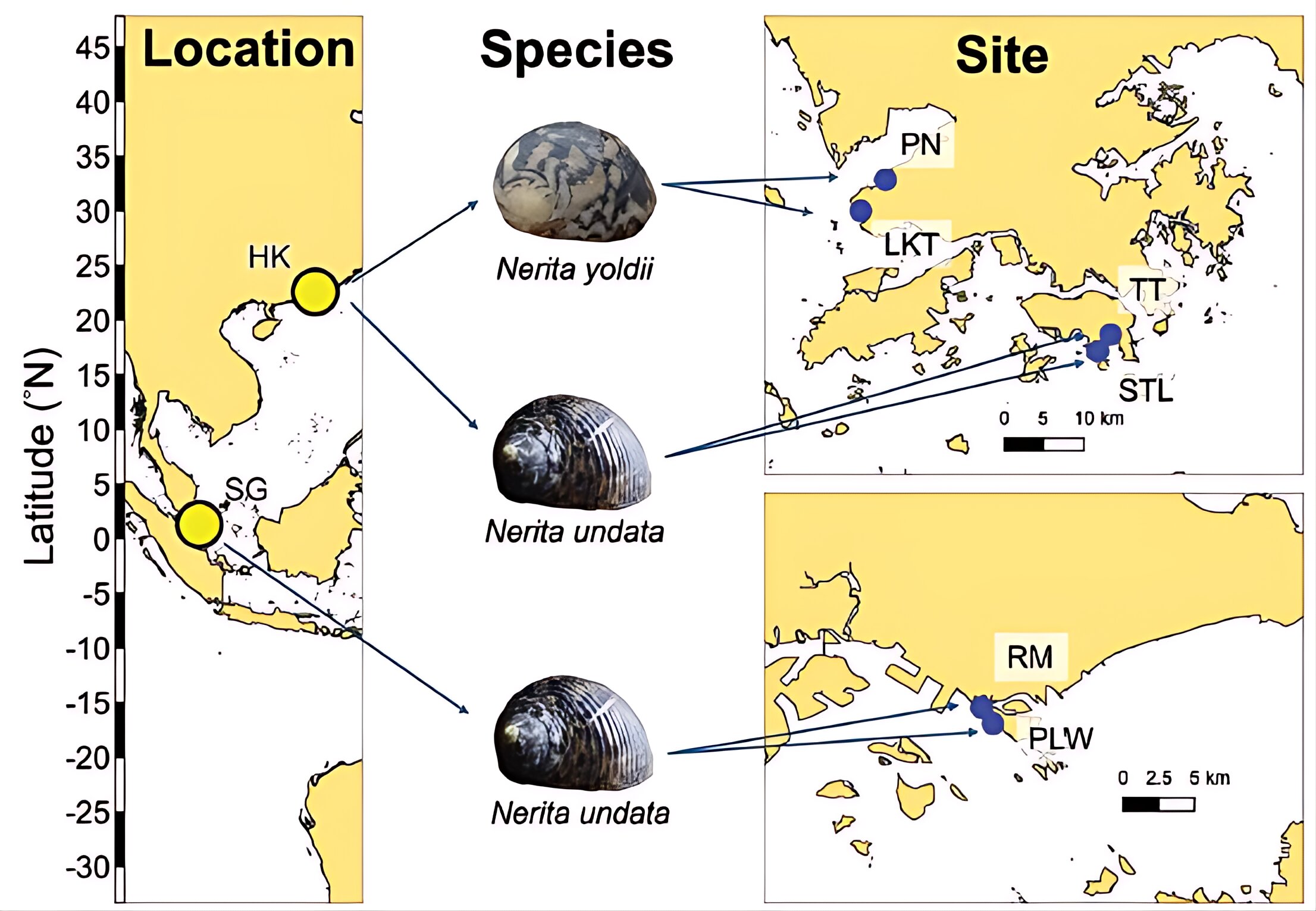
Tropical snails heat tolerance may be approaching a hard limit on some rocky shores, according to a study led by Lingnan University researchers and international collaborators. The finding matters because hotter rock surfaces could leave these animals with less room to survive future heat waves.
The research team studied Nerita snails on exposed tropical coasts in Hong Kong and Singapore, where animals can spend low-tide periods on rocks heated by direct sun. The findings were published in The Biological Bulletin.
How close are tropical snails to their thermal limits?
The team found that some measured shore temperatures were near the point at which the snails’ hearts stopped during laboratory tests. In the experiments, the snails’ heart rates rose as their bodies warmed, then dropped sharply once body temperatures reached about 40–45°C, according to the researchers.
When body temperatures rose to about 47.7–51.4°C, the snails’ hearts stopped beating, the team reported. The researchers described that range as close to the animals’ upper physiological thermal limit.
Physiological thermal tolerance means the body temperature an organism can withstand before normal functions fail. In this study, the researchers used heart activity and body temperature to estimate where heat stress became life-threatening for the snails.
What the researchers measured
The study involved scientists from Lingnan University’s Division of Science, the University at Buffalo, the National University of Singapore and the University of Hong Kong. The team selected six rocky shore sites: Tai Tam, Stanley, Lung Kwu Tan and Pak Nai in Hong Kong, plus Palawan Beach and the Rimau coast in Singapore.
Researchers placed temperature loggers on rocks for about a month to track surface heat. They also collected 126 adult snails of similar size: 62 Nerita undata and 64 Nerita yoldii, both in the family Neritidae.
In the laboratory, the team used a programmable water bath to recreate warming conditions on coastal rocks during low tide. Infrared photocoupler sensors attached to the snails’ shells let the scientists monitor heart rates as body temperatures changed.
Singapore shores showed a narrower buffer
The researchers reported that maximum rock temperatures in Hong Kong reached about 50°C. Crevices and shaded spots there were generally below 42°C, giving snails cooler places to shelter, according to the team.
Singapore’s sites were hotter. The team recorded rock surface temperatures up to 57°C, while crevices and shaded shelters exceeded 55°C, temperatures the researchers said were comparable to the upper physiological limits measured in the snails.
The Singapore snails showed higher overall heat tolerance than the Hong Kong population, according to the study. But the team said that tolerance did not keep rising in the hotter habitat, suggesting some tropical organisms may already be close to their physiological ceiling.
Heat can also cut feeding time
Tommy Hui Tin-yan, first author of the paper and an assistant professor at Lingnan University, said tropical intertidal snails usually avoid the hottest exposed rock surfaces by moving into shelters during low tide. The researchers said stronger and more frequent heat could force them to spend more time hiding.
That behavior can reduce time available to graze on microalgae and biofilms, according to Hui. The team said the animals may then face higher energy demands to maintain basic functions while taking in less food.
Hui said the study challenges the assumption that organisms can keep adjusting as the climate warms. He also linked the pattern to human heat avoidance, noting that longer periods spent cooling indoor spaces can raise power use and affect sectors such as agriculture, construction and logistics.
This story draws on original reporting from Phys.org.