
Superconducting qubit readout gets faster with simpler hardware
EPFL-led researchers report a qubit measurement design that hit 99.4% accuracy in 68 nanoseconds while cutting key readout hardware.
By Priya Raghavan · Science Reporter
3 min read
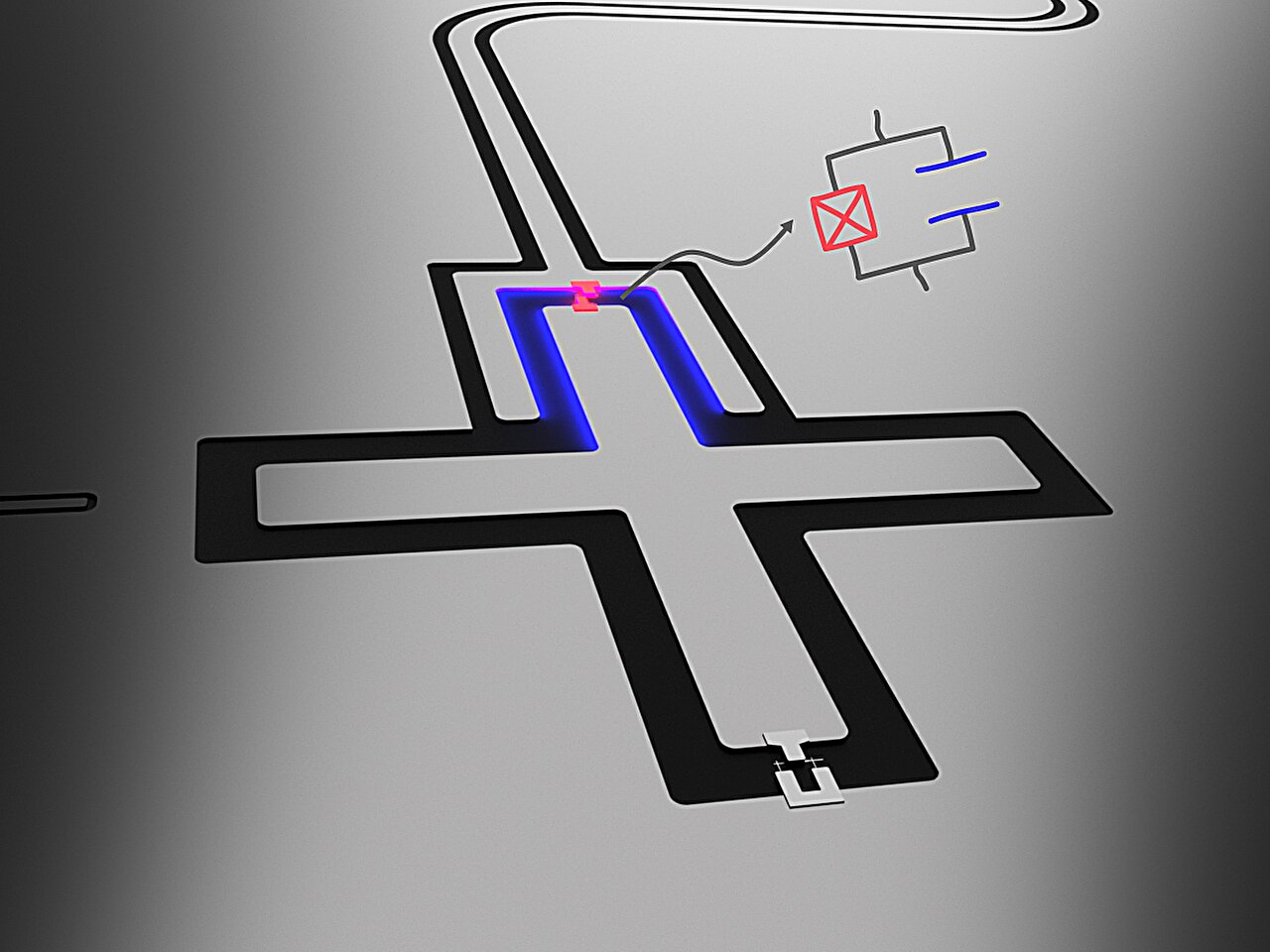
An EPFL-led team has demonstrated a superconducting qubit readout architecture that measures quantum bits quickly and accurately while using fewer added components. The result matters because reading out qubits remains a key obstacle in turning quantum processors into useful machines, according to EPFL.
The work, published in PRX Quantum, was led by Pasquale Scarlino at the Ecole Polytechnique Federale de Lausanne in collaboration with Alexander Blais' group at the University of Sherbrooke. EPFL said the experiments matched theory developed with the Sherbrooke researchers.
Quantum computers use qubits, which can hold quantum states in ways that differ from the bits used in ordinary computers. EPFL said that capability could help researchers study materials and address complex optimization problems, but only if the state of each qubit can be measured reliably.
How does the new superconducting qubit readout work?
In many superconducting quantum computers, a qubit connects to a microwave resonator through a capacitor so the qubit state can be inferred from a microwave signal. EPFL said that connection can also let the qubit and resonator partly mix, raising the risk that the qubit loses information or changes during measurement.
The new design adds a Josephson junction beside the capacitor between a transmon qubit and its readout resonator. A Josephson junction is a thin barrier between superconducting materials that allows current to tunnel through under quantum mechanics, producing a nonlinear circuit element used widely in quantum devices.
According to EPFL, the junction changes the interaction between the qubit and resonator and gives the circuit built-in protection against a major information-loss pathway during measurement. That protection lets the system use a stronger measurement signal, making the difference between a logical zero and one easier to detect.
The researchers reported that the device identified the qubit state correctly 99.4% of the time with a 68-nanosecond integration time. They also measured a quantum nondemolition fidelity of 98.4%, meaning the measurement usually left the qubit state intact, according to the paper.
Why fewer components could matter
EPFL said the design reached fast, high-fidelity measurements without two pieces often used in advanced superconducting readout systems: Purcell filters and near-quantum-limited amplifiers. Removing those parts can shrink the hardware footprint and reduce the number of components that researchers must fabricate and calibrate.
The architecture also works with multiplexed readout, where multiple qubits are measured through shared hardware, according to EPFL. That compatibility is important for systems that need to read many qubits without multiplying every piece of supporting equipment.
The team also said the same approach could be adapted to more conventional linear readout schemes by changing resonator properties, though that step was left for later device versions. EPFL presented the work as a possible alternative for future superconducting qubit readout designs that need speed, fidelity and simpler hardware.
The paper is titled "Fast, High-Fidelity Transmon Readout with Intrinsic Purcell Protection via Nonperturbative Cross-Kerr Coupling." Its authors include Guillaume Beaulieu and colleagues, with publication details listed by PRX Quantum.
This story draws on original reporting from Phys.org.