
Spinning active particles pressure follows new thermodynamic model
Physicists report a thermodynamic framework for chiral active gases, linking wall pressure to higher effective temperature and edge currents.
By Tom Brennan · Health & Medicine Correspondent
3 min read
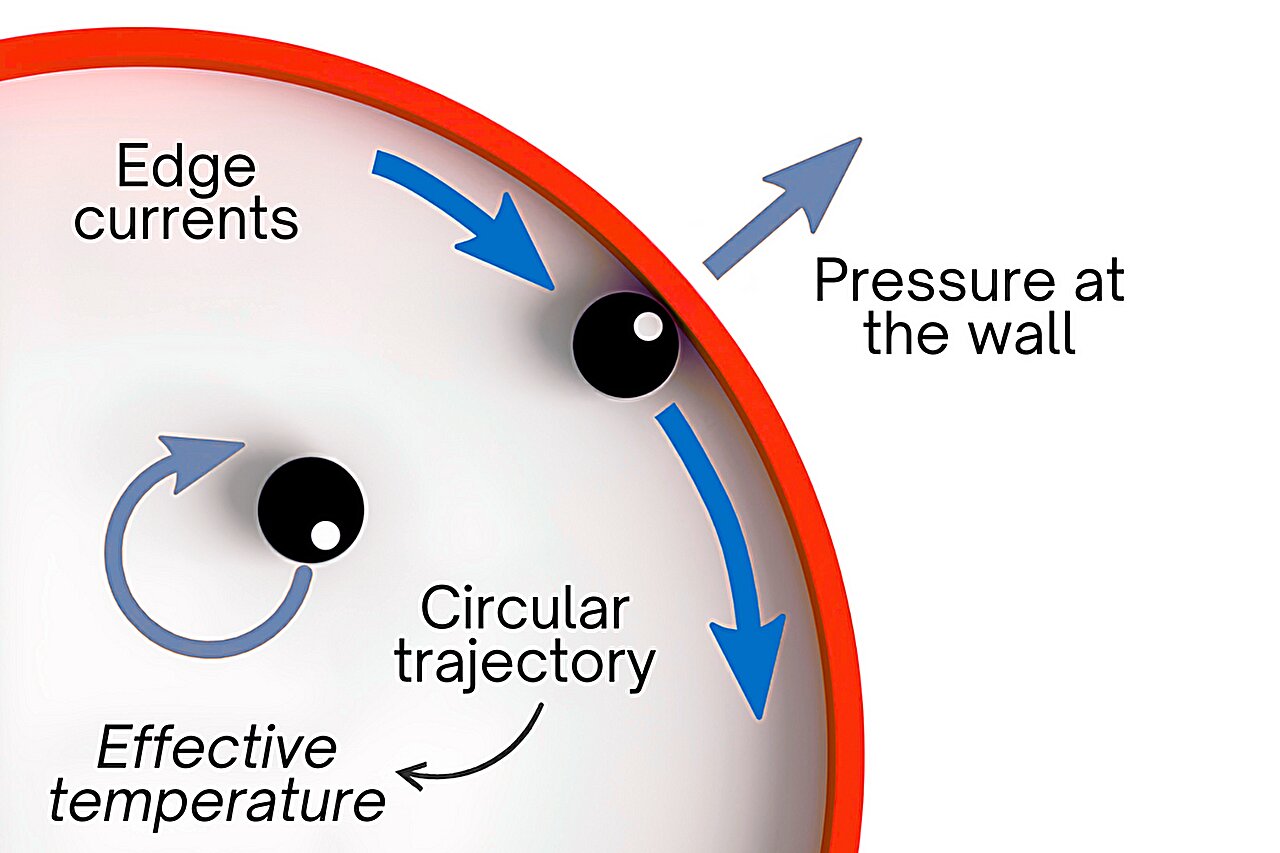
Spinning active particles pressure can be described with a thermodynamic framework that resembles an ideal gas at a higher effective temperature, according to physicists reporting in Proceedings of the National Academy of Sciences. The result matters because these nonequilibrium particles also generate directed flows along boundaries, a behavior the researchers say could help guide particle transport at system edges.
The study was carried out by researchers from Heinrich Heine University Düsseldorf, the Technical University of Darmstadt, Sapienza University in Rome and the University of Camerino. Heinrich Heine University Düsseldorf said the work calculates basic thermodynamic laws for a gas made of self-propelled spinning particles.
In an ordinary gas, the ideal gas law links pressure to density and temperature. Microscopically, that pressure comes from particles striking and rebounding from a surface; faster particles, associated with higher temperature, push harder on the wall.
How does pressure work in spinning active particles?
The team studied chiral active particles, meaning self-propelled objects that move in curved or circular paths rather than straight lines. Heinrich Heine University Düsseldorf said examples occur in nature, including algae and rotating acacia seeds, and in technology, including magnetically driven colloidal particles.
According to the researchers, the usual ideal gas law does not apply directly to this kind of active gas. Hartmut Löwen of Heinrich Heine University Düsseldorf said the findings can still be read as showing an effectively higher temperature in the nonequilibrium state.
When a rotating active particle reaches a wall, the researchers found two effects beyond ordinary collision and reflection. Its self-propelled motion raises the pressure through active swim pressure, while its rotation makes it move along the wall, reducing that swim pressure.
Löwen said the resulting expression looks mathematically similar to the ideal gas law because it contains an activity-dependent effective temperature. He also said the study finds an equation of state for a nonequilibrium system, meaning pressure depends on a limited set of parameters rather than on the detailed properties of the wall.
What are edge currents in this system?
Edge currents are directed particle flows that occur along the boundary of the system. In this study, the researchers attributed those currents to the tangential motion of spinning particles as they interact with the wall.
Lorenzo Caprini of Sapienza University, the study’s lead author, said the wall motion produces a boundary flow that can be calculated quantitatively. He compared the behavior to topological insulators, materials known for carrying current on their surfaces.
Theoretical predictions were also tested with chiral mini-robots at Heinrich Heine University Düsseldorf. Doctoral researcher Marco Musacchio, who was largely responsible for the experiment, said the setup reproduced the rotating systems and allowed a quantitative comparison with the theory.
Benno Liebchen of the Technical University of Darmstadt said the findings provide a basis for nonequilibrium thermodynamics of chiral microswimmers. He said the work may also support future applications such as creating flow fields that act only at edges, with possible use in efficient drug transport.
The paper, “Active thermodynamics of inertial chiral active gases: Equation of state and edge currents,” was published in PNAS in 2026. The study lists Lorenzo Caprini and colleagues as authors and is also available through arXiv.
This story draws on original reporting from Phys.org.