
Solar cycle signal may extend storm forecasts by seven years
Researchers say a newly identified phase in the Sun’s cycle could give earlier warnings of how active the next cycle will be.
By Lucas Ferreira · Science & Environment Writer
3 min read
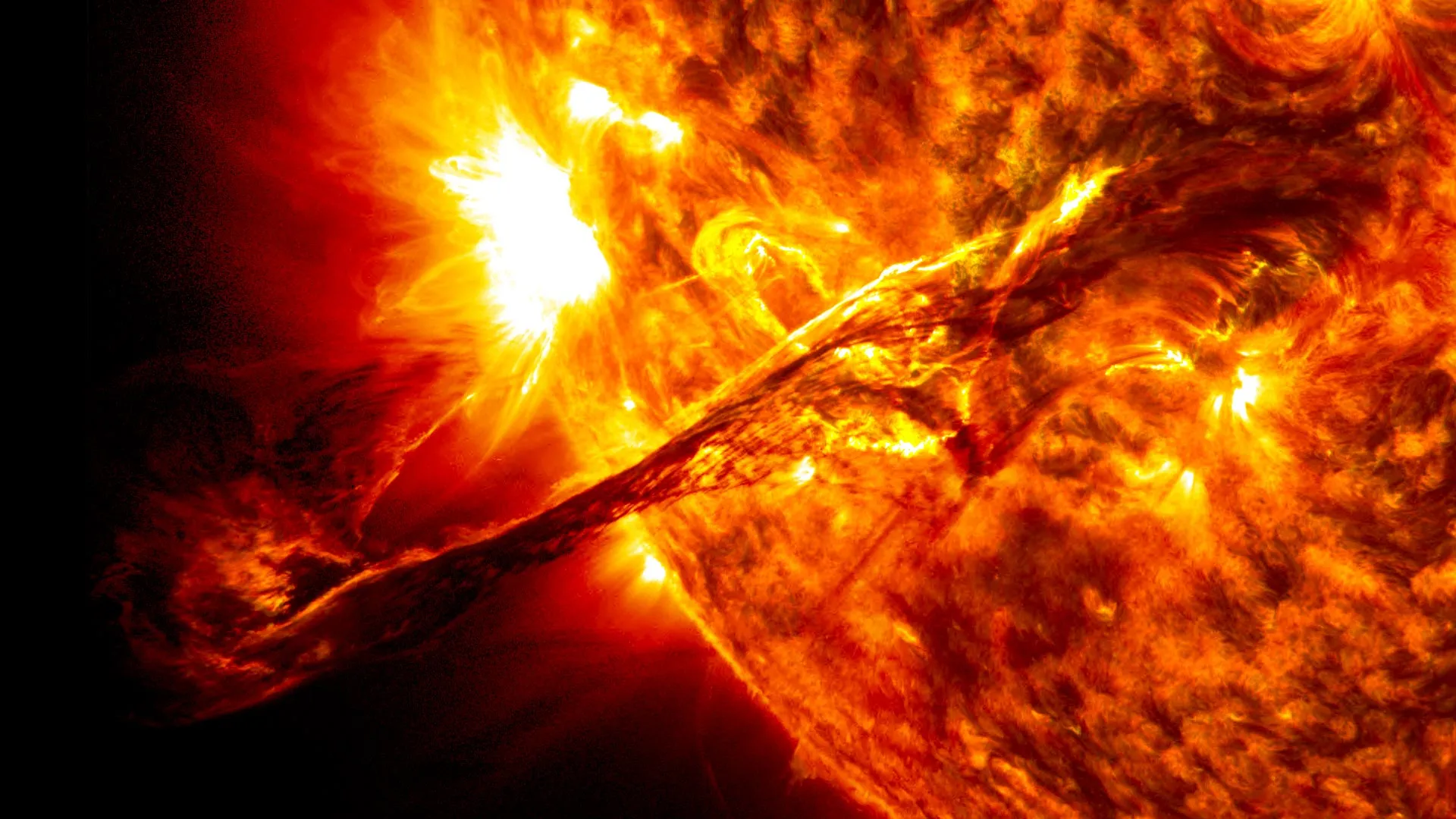
Scientists have identified a point in the Sun’s activity cycle that may allow forecasts of future solar storm strength up to seven years before the cycle peaks. The Royal Astronomical Society said the method could improve warnings for space weather that can affect satellites, radio links, navigation systems and power grids on Earth.
The findings, being presented at the Royal Astronomical Society’s National Astronomy Meeting in Birmingham, center on the number of sunspots visible when the Sun reaches a newly defined “switch-off” phase. According to Sandra Chapman, a physics professor at the University of Warwick and director of its Centre for Fusion, Space and Astrophysics, the most intense space weather appears to stop sharply at that stage of each solar cycle.
The Sun’s activity rises and falls over a cycle of about 11 years, during which its magnetic field flips polarity and sunspot numbers increase and then drop, the Royal Astronomical Society said. Sunspots are magnetically active areas on the solar surface and can produce solar flares and coronal mass ejections, which send charged particles and energy into space.
Early outlook for the next cycle
Using the method, Chapman and colleagues have made an initial estimate for Solar Cycle 26, the cycle after the current one. The Royal Astronomical Society said early projections point to a moderate cycle, with a sunspot number of about 100 to 120.
That would put Cycle 26 in the same broad range as Solar Cycle 25, or possibly below it, according to the society. Chapman said a firmer forecast should be possible in about two years, when Cycle 25 is expected to reach the switch-off point and researchers can use observed data rather than estimates of where that point will fall.
The approach builds on Chapman’s earlier “sunclock,” which maps the Sun’s uneven cycles onto a standard cycle phase, the Royal Astronomical Society said. That work indicated that extreme space weather does not fade gradually late in a cycle, but ends at a specific phase.
Chapman’s team found that the sunspot count at that phase is closely linked to the peak sunspot count in the following cycle, according to the society. That relationship could give scientists a forecast six to seven years before the next solar maximum, earlier than methods that rely on waiting for solar minimum, the quietest point in the cycle.
Why the storms may shut down
The switch-off phase appears to occur when active sunspot regions move below roughly 15 degrees of solar latitude, the Royal Astronomical Society said. Over a cycle, sunspots form a “butterfly” pattern, appearing first at higher latitudes and then shifting toward the equator.
Chapman argues that the strongest coronal mass ejections may be powered by differential rotation, in which parts of the Sun at different latitudes rotate at different speeds, the society said. Once active regions move inside about 15 degrees of the equator, the difference in rotation weakens, reducing the twisting of magnetic fields that can drive severe eruptions.
To test the idea, Chapman studied the 27-day average solar rotation signal in the aa index, a measure of geomagnetic activity at Earth, and compared it with recorded space weather events, according to the Royal Astronomical Society. After the switch-off point, storms were less extreme and followed a 27-day pattern, suggesting they were likely caused by co-rotating streams rather than coronal mass ejections.
The method had earlier pointed to Solar Cycle 25 being more active than many forecasts expected, the society said. During the cycle’s approach to solar maximum, storms from May 10 to 13, 2024, produced widespread auroras over the UK, with northern lights reported as far south as Devon and Cornwall.
This story draws on original reporting from ScienceDaily.