
Sea worm jaws point to a new class of natural bio-metals
Researchers say the jaws of Perinereis cultrifera mix proteins and metal ions in a way that resembles metals while keeping distinct biological behavior.
By Tom Brennan · Health & Medicine Correspondent
3 min read
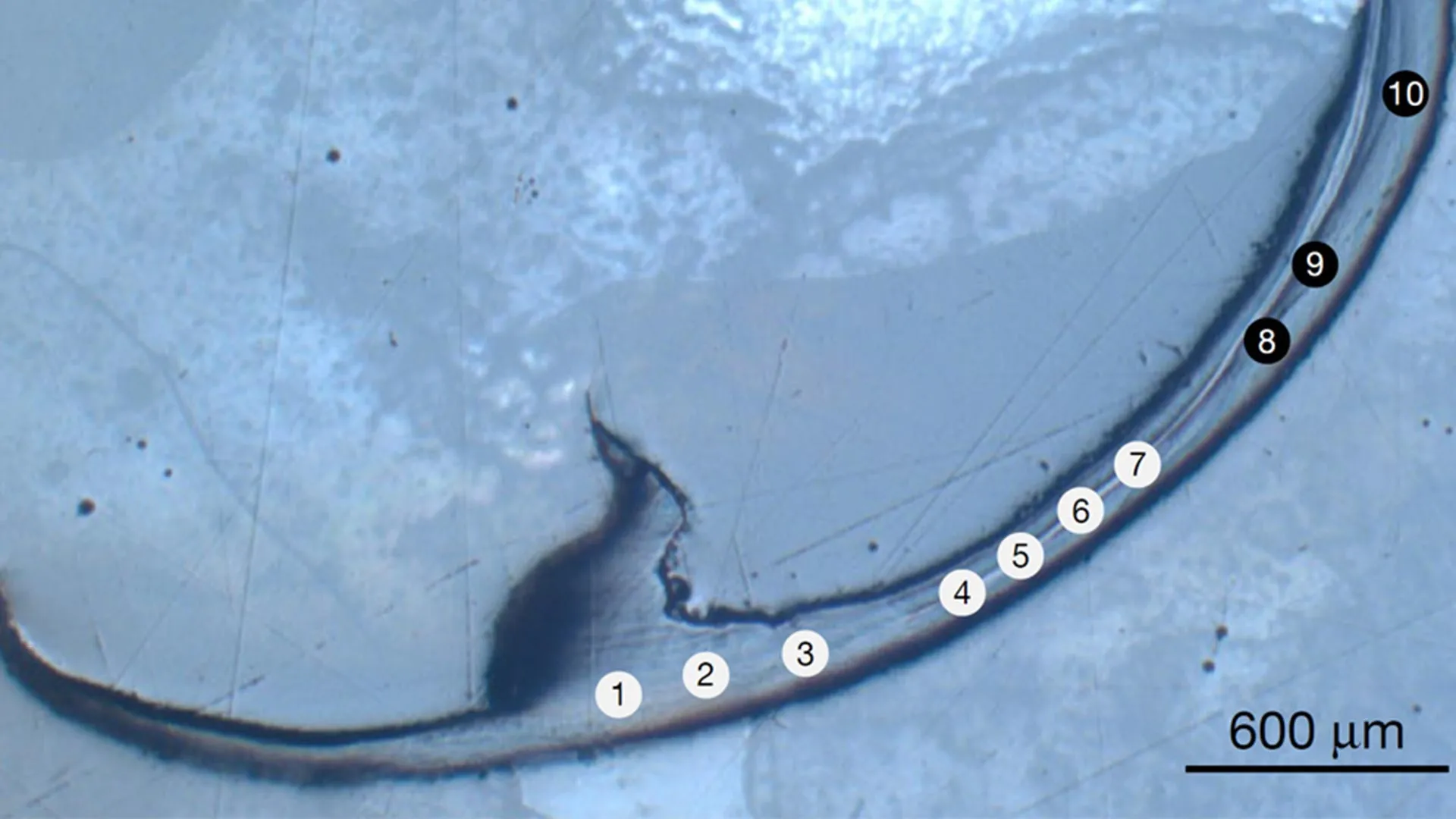
Scientists studying a predatory bristle worm say its jaws may represent a distinct category of natural material, one that blends biological proteins with metal-like performance. The finding matters because such “bio-metals” could help researchers define new material designs found in living organisms, according to the American Institute of Physics.
The work focused on Perinereis cultrifera, an ancient sea worm species that still exists today, according to the American Institute of Physics. Like other predatory bristle worms, it uses hard jaws to bite, crush and eat prey, and those jaws are built from structural proteins and ions rather than ordinary mineralized tissue.
Researchers from TU Wien, or Vienna University of Technology, and the University of Vienna examined the jaws in a study published in Biophysics Reviews, an American Institute of Physics journal. The paper describes bio-metals as an emerging concept in biophysics, separate from broader labels such as “metal-like biomaterials.”
How the jaws were tested
According to the American Institute of Physics, the researchers defined bio-metals through three features: hardness, mechanical response under strain, and the way ions and proteins are arranged. To test those traits, the team used nanoindentation, a method that presses into a material at very small scales, along with chemical analysis and imaging.
The measurements backed earlier findings that metal ions are more concentrated near the jaw tips than in the middle of the structure, according to the American Institute of Physics. The researchers said that distribution likely makes the tips harder, which would fit their role in biting and crushing food.
The team also varied the depth of its indentation tests and found a mechanical effect known from metals including copper and silver. The American Institute of Physics said the jaws showed the Nix-Gao nanoindentation size effect, in which smaller tested regions can resist denting more strongly than larger ones.
In the worm jaws, the effect appears to be tied to sharp strain changes across tiny regions, according to the institute’s summary of the research. Those changes may increase the interlocking of defects in the atomic structure, producing the size-dependent hardening seen in the tests.
Similar to metals, but not the same
The researchers also found that the jaws do not behave exactly like familiar crystalline metals. Christian Hellmich, an author of the study, said bristle worm jaws showed size-dependent elasticity, which he described as a feature that separates bio-metals from standard crystalline metals such as copper or silver.
To account for that behavior, the team used mathematical models aimed at explaining how the unusual elastic response could emerge at the atomic level, according to the American Institute of Physics. Hellmich said researchers are still at an early stage in understanding these materials.
The study was authored by Luis Zelaya-Lainez, Friedrich S. Schuster, Stefan Manhartseder, Maximilian Landegger, Kyojiro N. Ikeda, Florian Raible, Olaf Lahayne, Stefan Scheiner and Hellmich. It was published in 2026 under the title “Bio-metals: Ancient biological materials with nanoindentation size effects: Experiments and elements of manifold micromechanics.”
Hellmich said the researchers plan to expand the experimental record by studying more species, refining the theory and carrying out targeted computations. He also said the team wants to examine how genetic interventions may connect with possible material designs.
This story draws on original reporting from ScienceDaily.