
SCGG-z5 galaxy formation seen 1.2 billion years after Big Bang
JWST observations show six young galaxies in a compact proto-group that may merge into one massive galaxy, researchers report.
By Lucas Ferreira · Science & Environment Writer
3 min read
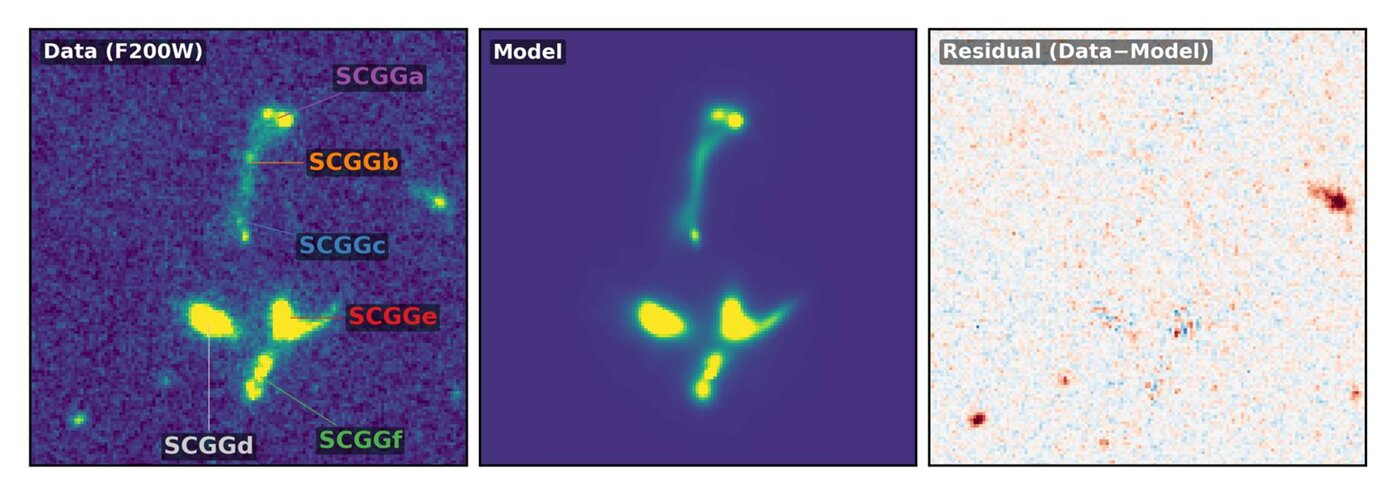
Astronomers say they have found SCGG-z5 galaxy formation unfolding in the early universe, where six young galaxies appear to be gathering into a future massive system. The group is seen as it was about 1.2 billion years after the Big Bang, offering a rare look at how large galaxies may assemble from smaller pieces.
The findings come from a study led by Ronaldo Laishram of the National Astronomical Observatory of Japan and posted July 13 to the arXiv preprint server. The team studied a compact proto-group called SCGG-z5 at redshift z = 4.97, using data from the James Webb Space Telescope.
What is SCGG-z5?
SCGG-z5 is a small, dense collection of six galaxy components in the young universe. Researchers describe such systems as proto-groups or proto-clusters: early gatherings of galaxies that can show how larger structures begin to form.
The standard Lambda Cold Dark Matter model predicts that galaxies grow through hierarchical assembly, with smaller galaxies merging over long spans of time. Dense early groups give astronomers a way to test that picture, because the galaxies are close enough to interact and may eventually become one larger object.
Laishram’s team reported that all six members of SCGG-z5 were spectroscopically confirmed. That means their distances were checked using specific features in their light, rather than inferred only from color and brightness.
How did JWST show the galaxy group is merging?
The researchers used deep JWST imaging and slitless spectroscopy from the SAPPHIRES survey to examine the group. They found the six galaxies packed into a region about 16,000 parsecs, or roughly 52,000 light-years, across — about half the diameter of the Milky Way.
The team measured the galaxies’ stellar masses and star-forming activity. Three members were at or above the typical star-formation rate for galaxies of that era, and one was forming stars at a notably higher rate than expected, according to the study.
The galaxies also appeared irregular and disturbed in shape. The researchers said those structures match a picture in which gravity is pulling the members into close interactions or a merger.
Maps of star formation suggested that gas may be moving inward toward the centers of some galaxies, which could point to inside-out growth. The most massive member showed a tentative different pattern, with lower central activity and more star formation toward its outer regions.
The study said those differences suggest the group setting is already affecting how the individual galaxies evolve before they combine into one object. The researchers also found a wide velocity spread among the six members, indicating an unsettled system in which the galaxies could make several close passes within about 14 million years.
What happens to SCGG-z5 next?
By comparing SCGG-z5 with the EAGLE cosmological simulation, the team estimated that the six galaxies could merge fully by around redshift z ~ 3–4. That corresponds to about 400 million years after the moment captured in the observations.
The resulting galaxy is expected to keep growing and may reach a stellar mass of 100 billion suns by redshift z ~ 1, according to the researchers. They said it could represent an early stage in the formation of a future cluster’s brightest central galaxy.
The team estimated that the full assembly process, from the beginning of star formation to final coalescence, would last about 800 million years. The researchers called for more JWST spectroscopy of gas motion and chemical composition, along with ALMA observations of cold gas, to test whether tidal interactions are driving the differences seen among the galaxies.
This story draws on original reporting from Phys.org.