
Rocky exoplanet in habitable zone found with an atmosphere
Researchers detected helium leaking from LHS 1140 b, 48 light-years away, marking the first confirmed atmosphere around a rocky habitable-zone exoplanet.
By Priya Raghavan · Science Reporter
3 min read
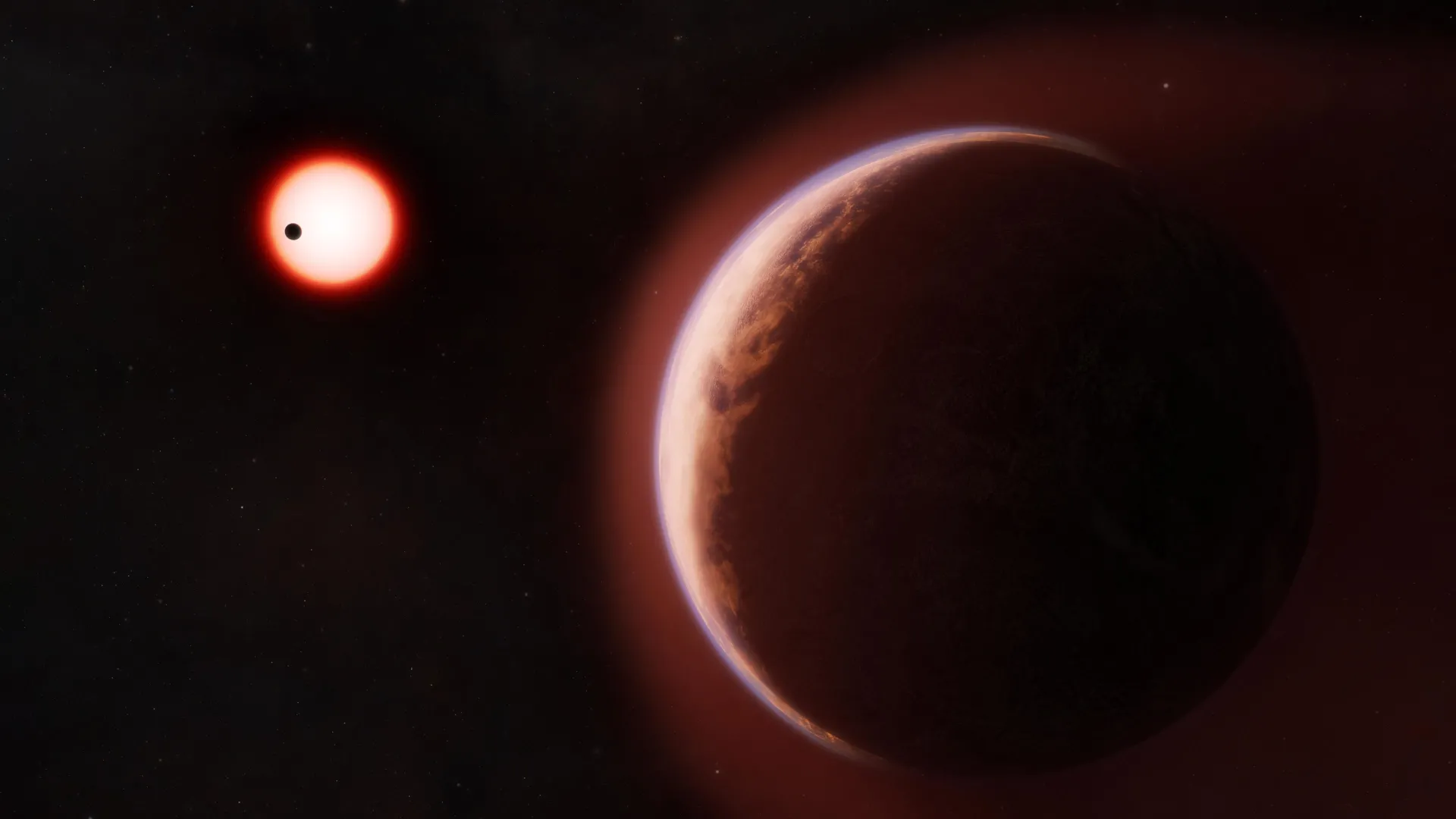
Astronomers have confirmed an atmosphere around LHS 1140 b, a rocky planet in the habitable zone of a red dwarf star, according to the Center for Astrophysics | Harvard & Smithsonian. The finding gives researchers a nearby target for studying whether Earth-like planets beyond the solar system can keep conditions linked to habitability.
The work was published July 16 in Science by a team led by Collin Cherubim, who recently earned a doctorate in Earth and planetary sciences from Harvard University, according to the center. The study identified helium escaping from the upper atmosphere of LHS 1140 b, which lies about 48 light-years from Earth.
Helium signal points to retained air
The Center for Astrophysics said LHS 1140 b is the first rocky planet in another star’s habitable zone with a confirmed atmosphere. Astronomers use the term habitable zone for the region around a star where temperatures and other conditions may allow liquid water to exist on a planet’s surface.
Researchers had already found rocky worlds in habitable zones, but the center said proving that such planets have atmospheres has remained difficult. In this case, Cherubim and colleagues built a model predicting that LHS 1140 b should have helium in its upper atmosphere and that some of it would be leaking into space.
The team then looked for that signature with the Warm Infrared Echelle, or WINERED, spectrograph at the Magellan Observatory in Chile, according to the center. Their observations came during a night when LHS 1140 b and another planet in the same system passed in front of their star.
The second planet did not show an atmospheric signal, the Center for Astrophysics said. LHS 1140 b did show escaping helium, which the researchers treated as evidence that the planet still has an atmosphere.
A nearby test case for rocky planets
Robin Wordsworth, a Harvard professor of environmental science and engineering and Earth and planetary sciences, said the result answers a question that followed earlier discoveries of terrestrial-type planets and rocky planets in habitable zones. According to the center, Wordsworth said the detection shows that at least one such world has kept an atmosphere.
David Charbonneau, head of Harvard’s astronomy department and an astronomer at the Center for Astrophysics, said he had doubted the effort at first because the expected signal came from a mathematical model and had not been seen from a rocky planet before. The center said Charbonneau described the eventual detection as statistically strong.
The researchers estimate that LHS 1140 b’s atmosphere may have persisted for more than three billion years, according to the Center for Astrophysics. That possible longevity makes the planet a high-priority object for more observations as astronomers look for rocky worlds that could sustain stable surface conditions.
Cherubim said he wants to determine the atmosphere’s full chemical makeup and eventually assess whether LHS 1140 b has oceans or other features tied to habitability, according to the center. The team also plans to apply its model to searches for atmospheres around other rocky exoplanets.
This story draws on original reporting from ScienceDaily.