
Quantum gravity model offers route from cosmic entropy to structure
A theoretical study says an expanding universe could gain total entropy while allowing local order to form, including galaxies, planets and life.
By Lucas Ferreira · Science & Environment Writer
3 min read
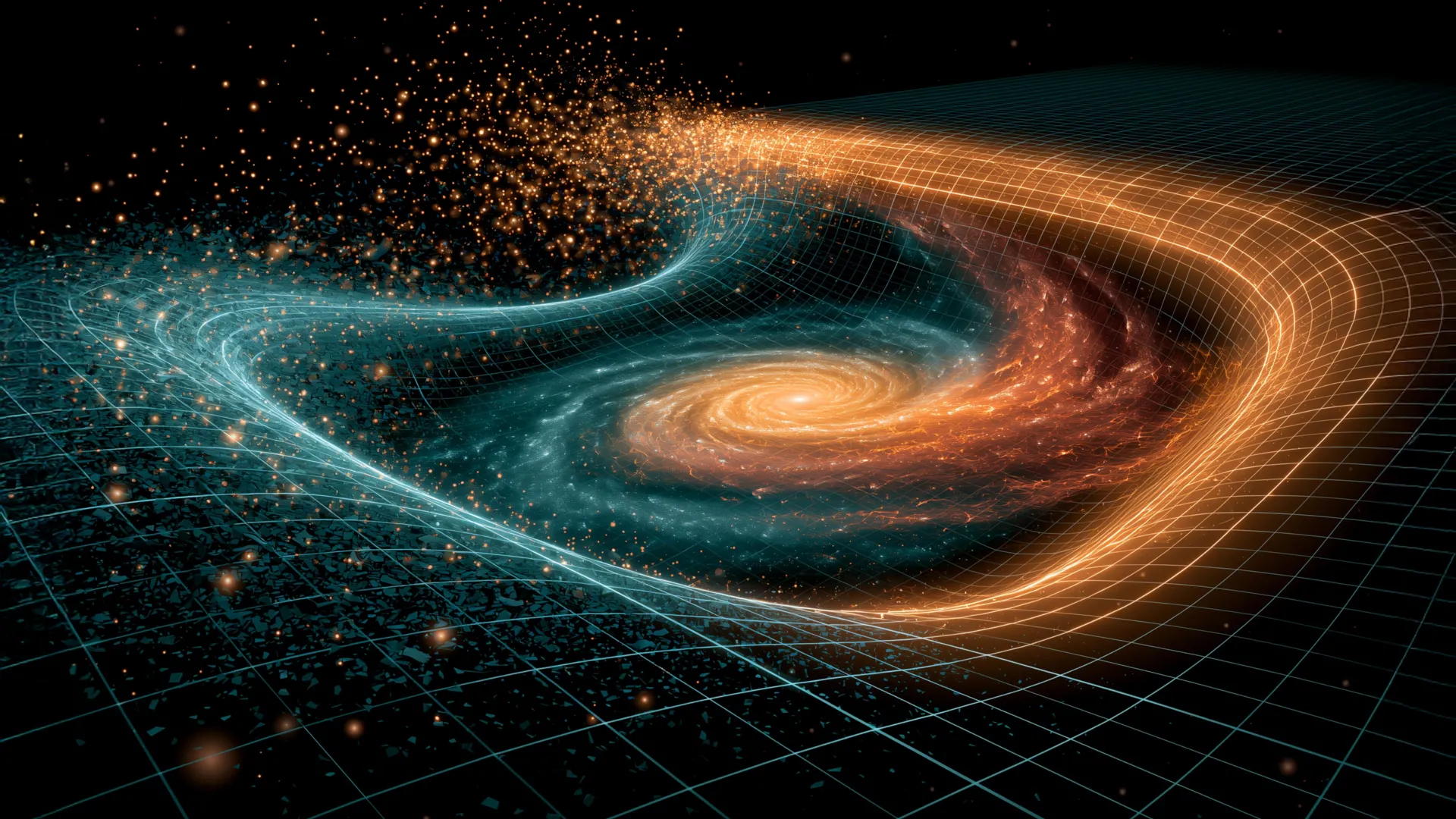
A new theoretical study proposes a way for the universe to build complex structures while still obeying the second law of thermodynamics. Queen Mary University of London said mathematician Ginestra Bianconi used a quantum gravity framework called Gravity from Entropy to examine how cosmic expansion may raise total entropy even as entropy per unit of volume falls.
The work, published in Physical Review D, addresses a long-running problem in cosmology: the early universe is generally understood to have started in a low-entropy state, yet matter later formed galaxies, stars, planets and living systems. The second law says the total entropy of an isolated system tends to increase with time, creating tension between overall disorder and local organization.
Bianconi’s study argues that the tension may ease if total entropy and local entropy density are treated separately. According to Queen Mary University of London, the model finds that expansion increases the volume of the universe, allowing total entropy to grow while the entropy associated with each unit of space declines.
Gravity treated as an entropy effect
Gravity from Entropy is a proposed approach to quantum gravity that uses statistical mechanics to describe gravity as emerging from microscopic properties of spacetime geometry. In this framework, gravity is tied to information and entropy rather than described only as a force or as spacetime curvature.
The study builds on earlier links between gravity and thermodynamics, including work by Jacob Bekenstein and Stephen Hawking in the 1970s. Their research showed that black holes carry entropy and can emit thermal radiation, results that connected spacetime, heat, information and gravity.
In the Gravity from Entropy approach, Queen Mary said gravity arises from an informational difference between the physical spacetime metric and another metric associated with matter fields and spacetime curvature. The theory expresses this through a quantity called Quantum Geometric Relative Entropy, or QGRE.
Dark energy enters the model
Bianconi’s paper reports that Gravity from Entropy reproduces general relativity at low energies and weak spacetime curvature. Under stronger conditions, however, the theory departs from Einstein’s equations and produces a dark energy term that changes over time.
Queen Mary said that changing term could provide predictions that might later be tested with cosmological observations. The study examines these effects in Friedmann-Robertson-Walker spacetimes, mathematical models used to represent a universe that expands uniformly on large scales.
Within that setting, the local geometry of spacetime follows a version of the first law of thermodynamics, according to the study. The dark energy contribution functions as internal energy, while QGRE represents local entropy per unit volume; quantities resembling temperature and pressure also appear in the theory.
The result, Queen Mary said, suggests the quantum state behind Gravity from Entropy may have a thermal character. As expansion enlarges cosmic volume, total entropy can rise even while local QGRE declines, leaving room for structure to develop in specific regions.
The proposal remains theoretical. Bianconi said the work shows how Gravity from Entropy may help connect the second law of thermodynamics with the rise of complex structures and, ultimately, life, while also contributing to efforts to link general relativity, quantum mechanics, thermodynamics and cosmology.
This story draws on original reporting from ScienceDaily.