
Psyche Mars flyby sets NASA probe on course for 2029 asteroid encounter
NASA says Psyche used Mars’ gravity, tested instruments and captured a time-lapse as it heads for a metal-rich asteroid in 2029.
By Priya Raghavan · Science Reporter
3 min read
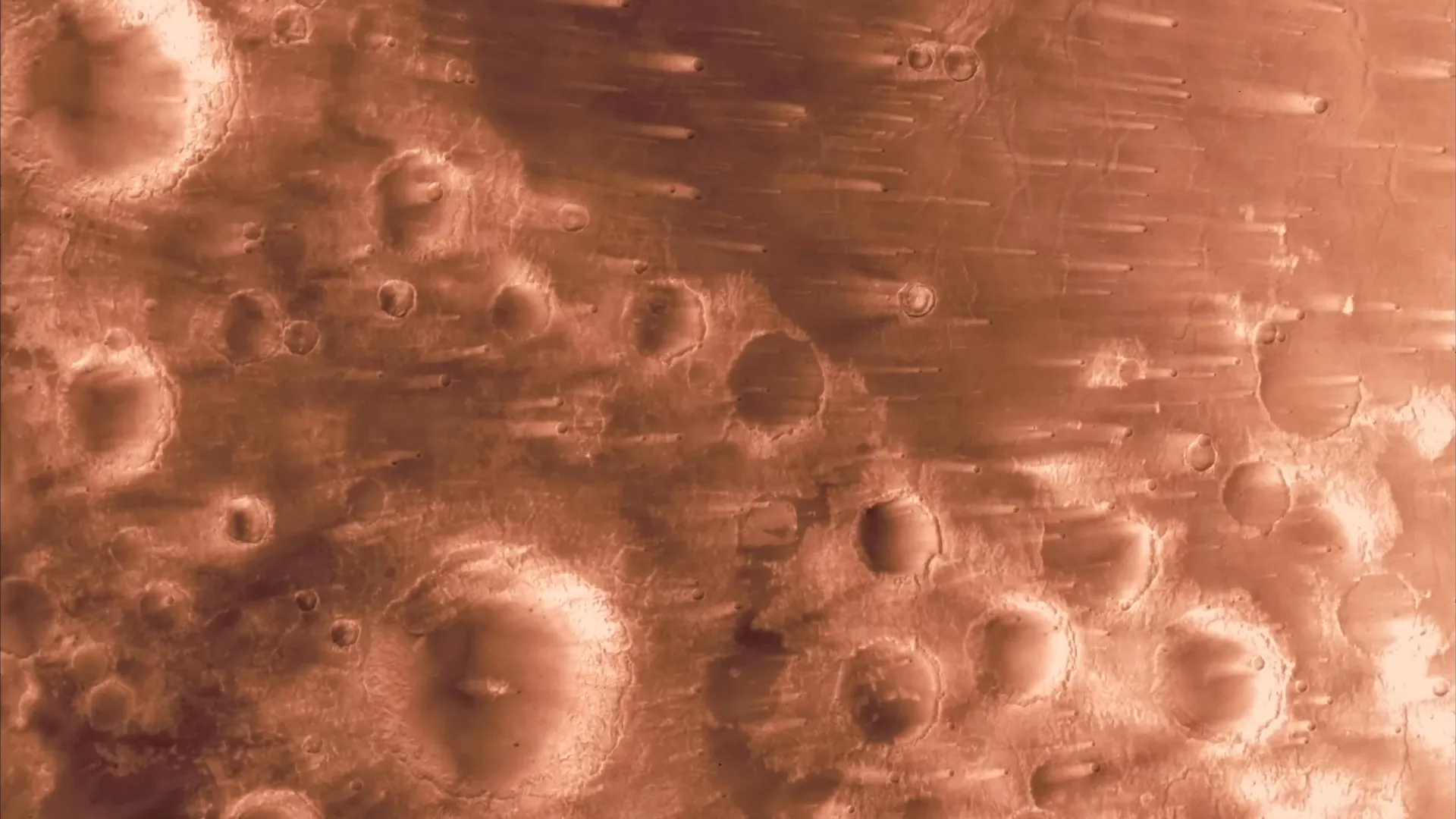
NASA’s Psyche Mars flyby has put the spacecraft on the path it needs to reach a metal-rich asteroid in 2029, NASA’s Jet Propulsion Laboratory said. The May 15 pass used Mars’ gravity to increase Psyche’s speed and make a small course change, while also giving mission teams a chance to test science instruments before the asteroid encounter.
The spacecraft returned data from its cameras, magnetometer and particle-detecting instruments, according to JPL. The agency said the observations lined up with existing knowledge of Mars and added measurements taken from Psyche’s unusual approach angle.
What did Psyche do at Mars?
Psyche passed Mars at an altitude of 2,864 miles, or 4,609 kilometers, JPL said. The gravity assist placed the spacecraft on a route toward asteroid Psyche, which orbits in the main asteroid belt between Mars and Jupiter.
Mars also served as a practice target for the mission’s main tools. Lindy Elkins-Tanton, the mission’s principal investigator at the University of California, Berkeley, said the teams running the imager, magnetometer and gamma-ray and neutron spectrometer used the encounter to test their systems and returned strong results, according to JPL.
What did Psyche see during the Mars flyby?
Psyche’s multispectral imager began observing Mars in early May and kept collecting views through the flyby, JPL said. The spacecraft approached at a high phase angle, so Mars first appeared as a thin bright crescent, with sunlight scattering through the planet’s atmosphere.
As the spacecraft drew nearer, the cameras recorded surface features including wind-shaped craters, the south polar ice cap and the double-ringed Huygens crater, according to JPL. Mission teams assembled the monthlong image sequence into a time-lapse video showing Psyche’s approach to and departure from Mars.
The cameras also picked out Mars’ small moons, Phobos and Deimos, from far away, JPL said. Jim Bell, the Psyche imager lead at Arizona State University, said that exercise helped the team practice for a future search for small moons around asteroid Psyche.
How the Mars test helps the asteroid mission
The gamma-ray and neutron spectrometer will be used at asteroid Psyche to help identify chemical elements in surface material, JPL said. The method relies on measuring neutrons and gamma rays released when cosmic rays strike a planetary body and transfer energy to material near the surface.
At Mars, the spacecraft was too far away to detect gamma rays from the planet, but the neutron spectrometer did register an increase in neutron counts around closest approach, according to JPL. David Lawrence of the Johns Hopkins Applied Physics Laboratory said the instrument performed well during the test.
Psyche’s magnetometer, which has operated since launch in 2023, also recorded its first magnetic signature from a planetary body, JPL said. Ben Weiss of the Massachusetts Institute of Technology said the instrument measured a sharp increase in magnetic field in the bow shock region, where the solar wind interacts with Mars’ magnetic environment.
Mission teams are comparing Psyche’s Mars observations with data from NASA’s Mars Reconnaissance Orbiter, 2001 Mars Odyssey, Curiosity and Perseverance, as well as ESA’s Mars Express and ExoMars Trace Gas Orbiter and the United Arab Emirates’ Hope orbiter, JPL said. Those checks are meant to refine the camera calibration before Psyche reaches its less familiar asteroid target.
Bob Mase, Psyche project manager at JPL, said the navigation team delivered the needed trajectory for a summer 2029 rendezvous. JPL said the spacecraft is healthy and is scheduled to resume sustained thrusting with its solar-electric propulsion system later this fall.
This story draws on original reporting from ScienceDaily.