
PSR J0435+3233 gamma rays detected from 3.2-millisecond pulsar
Astronomers used Fermi data to identify gamma-ray pulsations from PSR J0435+3233, an extreme pulsar 3,900 light-years away.
By Tom Brennan · Health & Medicine Correspondent
3 min read
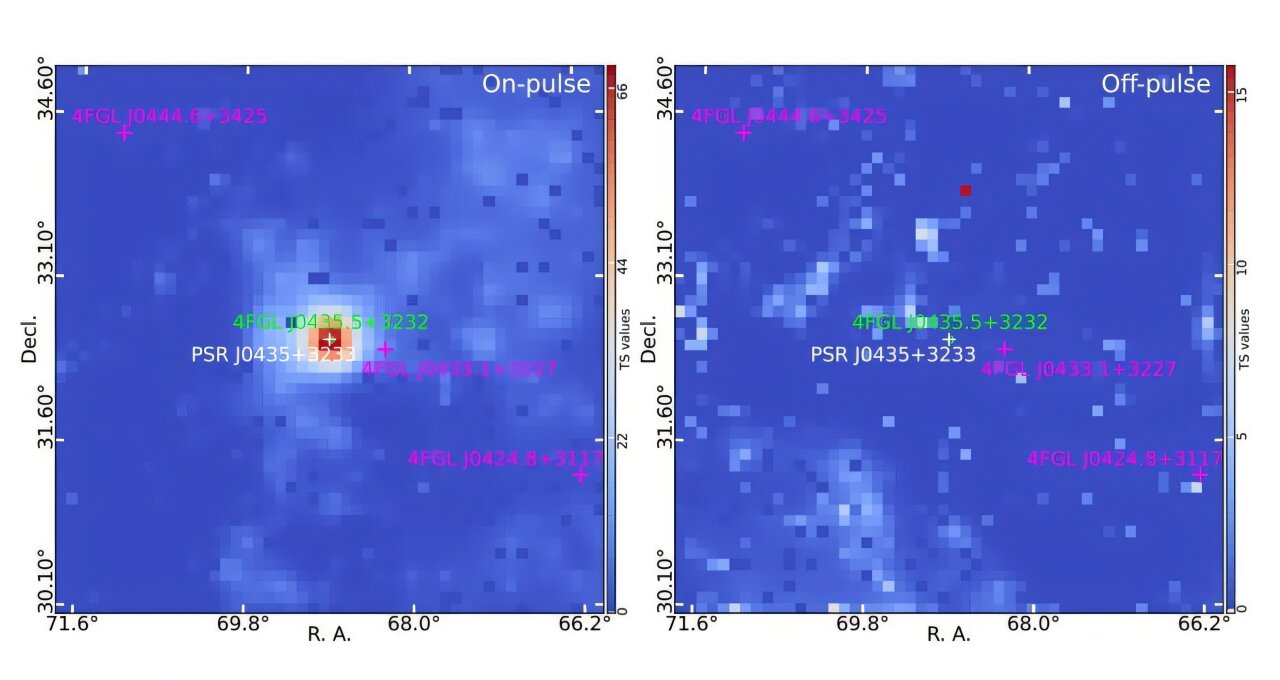
Astronomers have detected PSR J0435+3233 gamma rays in data from NASA’s Fermi Gamma-ray Space Telescope, adding a newly found millisecond pulsar to the list of gamma-ray emitters. The finding matters because the object combines very rapid rotation with unusually high spin-down power and very low apparent gamma-ray efficiency, according to a preprint posted July 17 on arXiv.
The study was led by Mengqing Zhang of Yunnan University in China. The researchers analyzed about 17.7 years of observations from Fermi’s Large Area Telescope, covering the 0.1 to 500 GeV energy range, to test whether the pulsar’s unusual properties were accompanied by detectable high-energy radiation.
What is PSR J0435+3233?
PSR J0435+3233 is a binary millisecond pulsar about 3,900 light-years from Earth, according to the research team. It was discovered in 2026 using China’s Five-hundred-meter Aperture Spherical radio Telescope, known as FAST.
Pulsars are highly magnetized neutron stars that rotate and emit beams of electromagnetic radiation, the researchers noted. Millisecond pulsars are the fastest members of that class, with spin periods below 30 milliseconds; PSR J0435+3233 rotates roughly once every 3.2 milliseconds.
The team described the pulsar as extreme because its period derivative is at least 100 times larger than those measured for other known millisecond pulsars. The paper also reports a spin-down luminosity of 58.9 undecillion erg per second, a level comparable to young, energetic pulsars.
How were the gamma rays detected?
Zhang’s team found a gamma-ray source named 4FGL J0435.5+3232 only 0.01 degrees from the radio-timing position of PSR J0435+3233. By comparing the Fermi data with the pulsar’s rotation, the researchers detected pulsations in gamma rays from that location.
The gamma-ray signal was concentrated in a narrow part of the pulsar’s rotation, the study reports. Emission appeared mainly in the phase interval from 0.44 to 0.69, covering one quarter of a full rotational cycle, while the off-pulse interval showed no significant emission.
The authors said three pieces of evidence tie the Fermi source to the pulsar: the close positional match, the gamma-ray pulses at the pulsar’s spin period and the way the emission changes with rotational phase. On that basis, they identify 4FGL J0435.5+3232 as the gamma-ray counterpart of PSR J0435+3233.
Why are these PSR J0435+3233 gamma rays unusual?
The study estimates the pulsar’s gamma-ray luminosity at 0.626 decillion erg per second. Despite its high spin-down luminosity, the inferred apparent gamma-ray efficiency is only 0.00001, according to the authors.
The paper also reports a surface dipole magnetic field of about 12.6 billion Gauss. That combination of rapid spin, strong magnetic field, high spin-down power and weak apparent gamma-ray output makes PSR J0435+3233 an unusual gamma-ray millisecond pulsar, the researchers wrote.
The authors said the detection offers a way to study particle acceleration, radiation beaming and viewing geometry in millisecond pulsars with extreme rotation-related properties. The paper, “Discovery of γ-Ray Pulsations from the Extreme-Spin-Down Millisecond Pulsar PSR J0435+3233,” is available on arXiv.
This story draws on original reporting from Phys.org.