
Proton shuttle found to speed energy transfer in quantum dots
Researchers say a temporary proton shift can sharply improve triplet energy transfer, offering a possible control point for solar cells, lasers and catalysis.
By Priya Raghavan · Science Reporter
3 min read
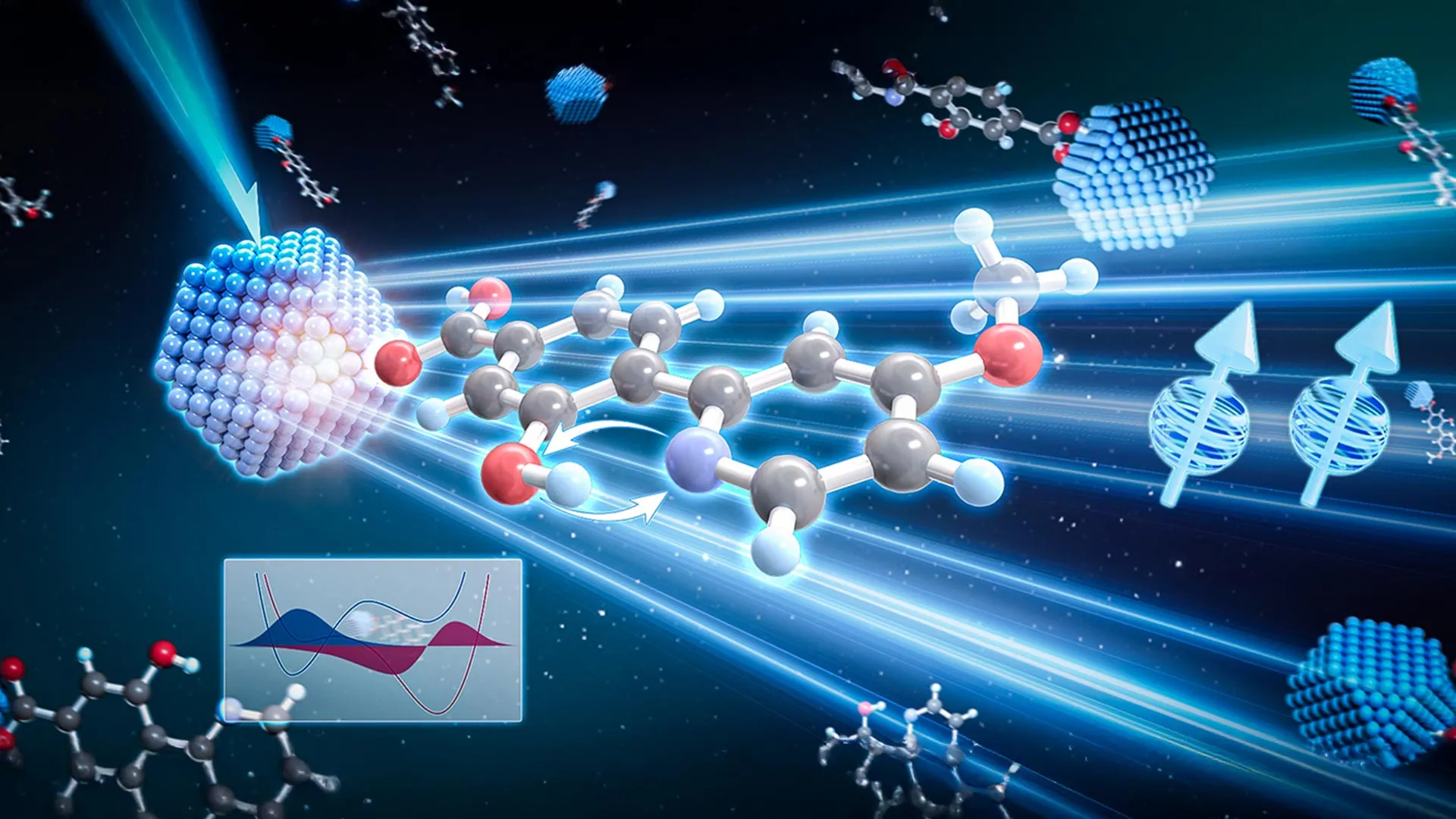
Researchers in China have identified a quantum-linked mechanism that can make triplet energy move more efficiently from quantum dots to nearby molecules. The finding matters because triplet excited states help govern the performance of materials used in solar energy, light-emitting devices and chemical catalysis.
The team, led by Prof. Kaifeng Wu at the Dalian Institute of Chemical Physics of the Chinese Academy of Sciences, reported the mechanism in Nature Materials. The researchers call it proton shuttle-assisted triplet energy transfer, or PS-TET.
According to the institute, the work builds on earlier research into proton-coupled electron transfer, known as PCET, and proton-coupled singlet energy transfer, known as PCEnT. PCET is involved in biological processes including cellular respiration, photosynthesis and nitrogen fixation, and it has also guided the design of artificial materials for energy conversion and storage, the institute said.
How the shuttle works
The researchers studied ZnSe-based colloidal quantum dots connected to phenol-pyridine dyadic acceptors on their surfaces, according to the paper by Zhaolong Wang, Jingyi Zhu and Kaifeng Wu. When the quantum dots absorb light, they enter an excited state, the institute said.
In the mechanism described by the team, a hole moves from ZnSe to phenol as a proton shifts from phenol to pyridine. An electron then moves from ZnSe to the phenoxyl radical while the proton returns from pyridinium to its original position.
The Dalian Institute said those linked steps move spin-triplet energy from the quantum dots to the phenol-pyridine dyads. The proton does not remain displaced, but its temporary motion has a large effect on the transfer process, according to the researchers.
The team found that the shuttle increased the rate and efficiency of triplet energy transfer compared with a methylated analog that lacked the same proton shuttle, the institute said. The researchers also reported that adding a strongly electron-withdrawing trifluoromethyl substituent to pyridine can alter the sequence of the proton-coupled electron and hole transfer steps.
Evidence for tunneling
The study found that the PS-TET rate changed little as temperature varied, according to the institute. The researchers said that behavior points away from a conventional heat-driven process and toward quantum mechanical tunneling by the proton.
Calculations of proton vibrational wavefunction overlap integrals supported that interpretation, the institute said. Those calculations helped explain which excited-state relaxation paths are favored and how the system is steered toward efficient triplet energy movement.
The Dalian Institute said the result shows that quantum effects can help control charge and energy transfer in complex materials at room temperature. Triplet energy transfer is a major route for moving energy in natural and engineered systems, but it differs from singlet energy transfer, according to the institute.
Possible device uses
Wu said the discovery has “profound implications” for molecular technologies that involve spin-triplet excited states. The institute said improving triplet generation could benefit photoredox and environmental catalysis.
In other applications, the same work may help researchers reduce unwanted triplet states, according to the institute. Organic optoelectronic devices such as solar cells and lasers can perform better when excess triplet formation is limited, the institute said.
The researchers said the proton shuttle could give scientists a way to tune triplet formation depending on the goal. Adding the shuttle may enhance energy transfer, while removing it may suppress the process, according to the Dalian Institute.
This story draws on original reporting from ScienceDaily.