
Researchers build one-nanometer membrane for cleaner industrial separations
A team in India and Singapore reports a crystalline filter that sorts molecules more precisely and could reduce energy use in water reuse and manufacturing.
By Priya Raghavan · Science Reporter
3 min read
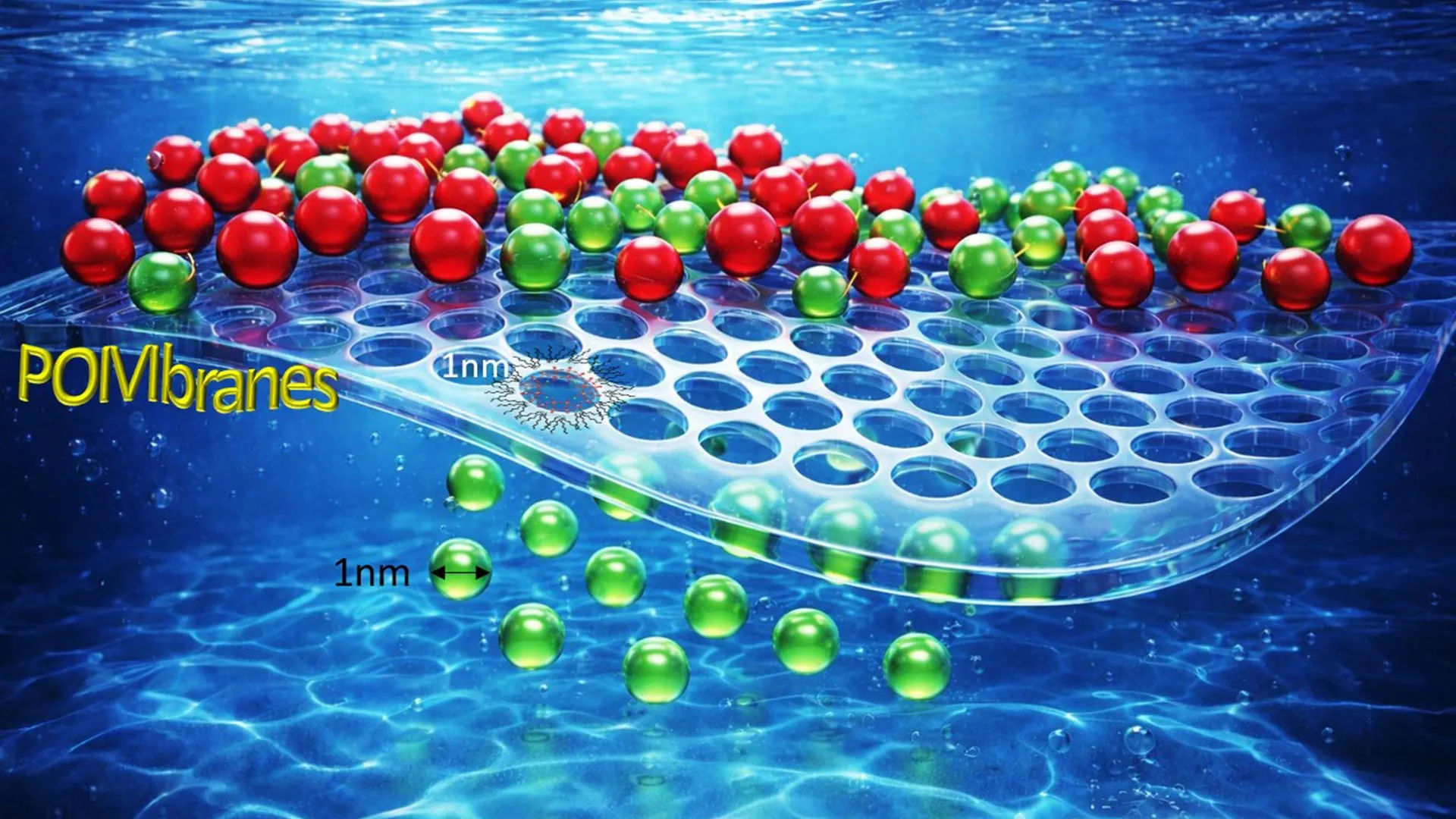
Researchers have developed a filtration membrane with uniform one-nanometer openings, a design they say could make industrial water recycling and chemical purification less energy-intensive. The work matters because separation steps used in manufacturing consume a large share of industrial energy, according to materials released by the Indian Institute of Technology Gandhinagar.
The membrane, described in the Journal of the American Chemical Society, was developed by researchers from CSIR-Central Salt and Marine Chemicals Research Institute, IIT Gandhinagar, Nanyang Technological University in Singapore and the S N Bose National Centre for Basic Sciences. The team calls the material “POMbranes,” a reference to polyoxometalate clusters used to build the filter.
According to IIT Gandhinagar, many industries rely on separations for drug purification, textile dye treatment and food production. The institute said such operations account for about 40% to 50% of global industrial energy consumption, with many plants still using distillation and evaporation.
Membrane filtration can use less energy than those approaches, but common polymer membranes have a weakness, the researchers said: their pores are often irregular and can deform or break down over time. That limits their value in demanding chemical settings.
How the membrane works
The new design takes cues from biological channels such as aquaporins, which control molecular movement through tightly defined passages. Dr. Shilpi Kushwaha, a senior scientist at CSMCRI, said the team engineered crystalline membranes with pores roughly one nanometer across.
The researchers used polyoxometalate clusters, which IIT Gandhinagar described as crown-shaped metal clusters with stable central openings. Priyanka Dobariya, a CSMCRI research scholar and co-first author, said those fixed openings address a key problem seen in conventional plastic filters, whose pore structures can shift.
To make a usable sheet, the team had to arrange large numbers of the clusters into a thin layer without defects. The researchers attached flexible chemical chains to the clusters; when placed on water, the modified clusters spread and self-organized into an ultrathin film, according to IIT Gandhinagar.
By altering the length of the attached chains, the team controlled how tightly the clusters packed. Dr. Raghavan Ranganathan of IIT Gandhinagar’s Department of Materials Engineering said that packing left molecules with only one route across the material: the one-nanometer holes in the clusters. Ranganathan and Vinay Thakur, an IIT Gandhinagar doctoral scholar and co-first author, also used molecular simulations to study the filtering process.
Tests point to sharper sorting
In tests reported by the team, the membranes separated molecules that differed by only 100 to 200 Daltons. The researchers said that level of selectivity is hard to obtain with standard polymer membranes.
Dr. Ketan Patel, principal scientist at CSMCRI, said the membranes showed nearly tenfold better separation performance than existing technologies while remaining flexible, stable and scalable. IIT Gandhinagar said the material also held up across different pH conditions and can be produced in large sheets.
The researchers identified textile and pharmaceutical manufacturing as possible uses. India’s textile and apparel sector contributes more than 2.3% of GDP and about 13% of industrial production, according to IIT Gandhinagar, which also said the domestic market is valued at $160 billion to $225 billion and is expected to reach $250 billion to $350 billion by 2030.
Textile dyeing and finishing produce contaminated wastewater, and IIT Gandhinagar said the membranes could help remove dye molecules while allowing water to be reused. In pharmaceuticals, Thakur said highly selective membranes could support drug purification and solvent recovery while reducing energy demand and maintaining quality standards.
The study, titled “Large-Area Supramolecular Crystalline Thin Films of Polyoxometalates with Controlled 1-nm Pores Enabling Ultra-Selective Molecular Transport,” was authored by Priyanka Dobariya, Vinay Thakur and colleagues and published in 2026 in the Journal of the American Chemical Society.
This story draws on original reporting from ScienceDaily.