
Nitrate removal from drinking water gets AI-guided catalyst search
Stevens researchers used AI to identify catalyst traits that could remove nitrate from water while limiting unwanted ammonium.
By Lucas Ferreira · Science & Environment Writer
3 min read
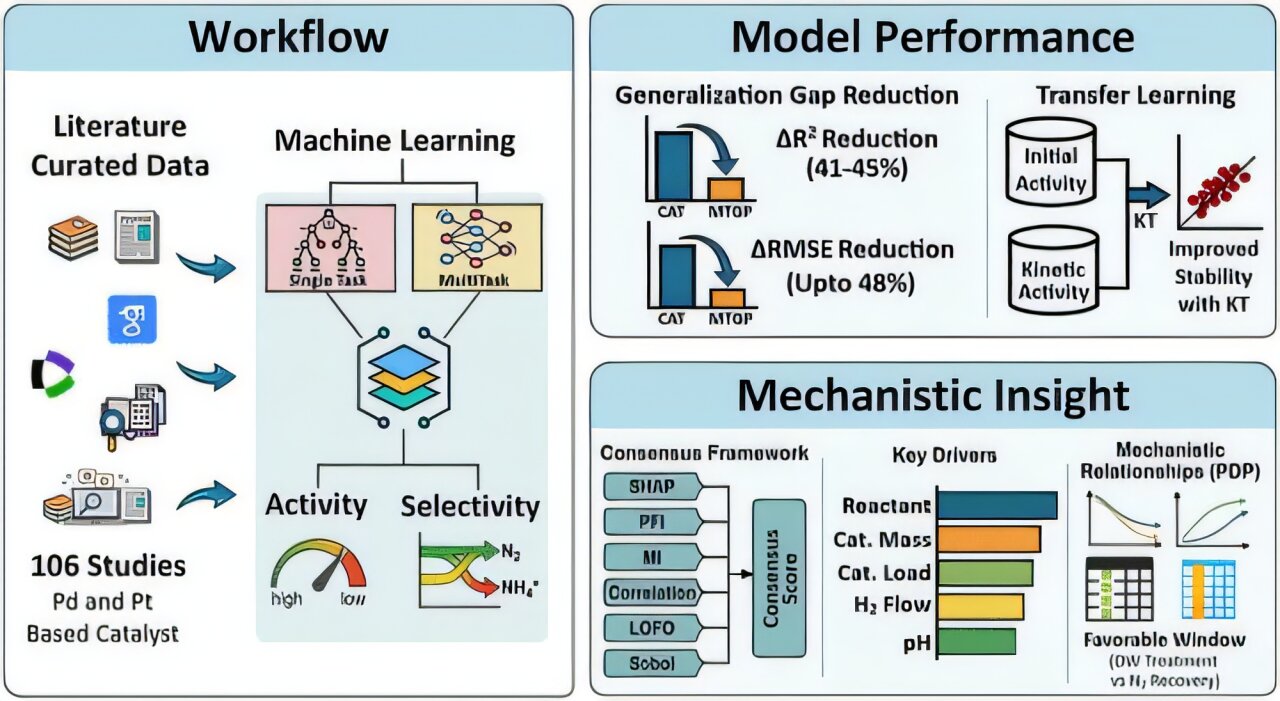
Researchers at Stevens Institute of Technology have used artificial intelligence to speed the search for better nitrate removal from drinking water, a problem tied to farm runoff, septic systems and private wells. Their study, published in Environmental Science & Technology, points to catalyst designs that could destroy nitrate rather than move it into another waste stream.
Nitrate contamination is a persistent concern in agricultural areas, where fertilizer, livestock manure and septic systems can carry nitrogen compounds into groundwater. Stevens said rural households that depend on private wells may face added risk because those wells are not always tested on a routine schedule.
Assistant Professor Tao Ye, who led the study in Stevens’ Department of Civil, Environmental and Ocean Engineering, said nitrate is among the most common drinking-water contaminants. High nitrate exposure can be dangerous for infants because it may interfere with oxygen transport in the blood, a condition often called blue baby syndrome, and studies have associated longer-term exposure with some cancers, thyroid problems and pregnancy complications, according to Stevens.
How would the new nitrate removal method work?
The approach centers on catalytic nitrate reduction, a chemical process meant to convert nitrate into water and nitrogen gas, the same gas that makes up most of Earth’s atmosphere. Stevens said the challenge is finding catalysts that drive that reaction efficiently while limiting ammonium, an unwanted byproduct.
Current nitrate treatment often relies on ion exchange, in which water passes through a resin that captures nitrate ions and releases less harmful ions such as chloride. Ph.D. student and co-author Mahjib Hossain said that method does not eliminate nitrate; it concentrates it in a brine that then must be treated or disposed of carefully.
Researchers have viewed palladium as a promising catalyst for nitrate treatment, but Stevens said palladium cannot efficiently split nitrate molecules on its own. It is commonly paired with another metal, such as indium, tin or copper, creating bimetallic catalysts whose performance can vary widely.
What did the AI model identify?
Ye and Hossain built an AI framework that drew on 106 studies spanning three decades of research into palladium- and platinum-based catalysts. The model evaluated more than one target at the same time, including how active a catalyst is and how selective it is in avoiding unwanted byproducts.
According to Stevens, the system produced more accurate predictions than conventional approaches and identified shared chemical features linked to better nitrate reduction. Those features included catalyst composition, acidity measured by pH, and other factors that affect reaction performance.
The researchers said the work is intended as a guide for designing catalysts faster, rather than as a single finished water-treatment product. Hossain said traditional catalyst development can depend on trial and error, requiring years of laboratory testing and specialized equipment.
Ye said nitrogen pollution remains difficult to address because nitrogen is central to agriculture. Stevens said improved nitrate-removal technology could help protect both drinking-water supplies and rivers and lakes, where excess nitrate can feed algal blooms that deplete oxygen and create dead zones for fish and other aquatic life.
The paper, “Multitask Learning Reveals Shared Descriptors Governing Activity and Selectivity in Catalytic Nitrate Reduction,” lists Md. Mahjib Hossain and colleagues as authors and carries the DOI 10.1021/acs.est.6c02715.
This story draws on original reporting from Phys.org.