
Mirror neutrons experiment finds no sign of neutron disappearances
PSI researchers measured about 25 billion ultracold neutrons and found no evidence that they oscillate into mirror-world particles.
By Tom Brennan · Health & Medicine Correspondent
3 min read
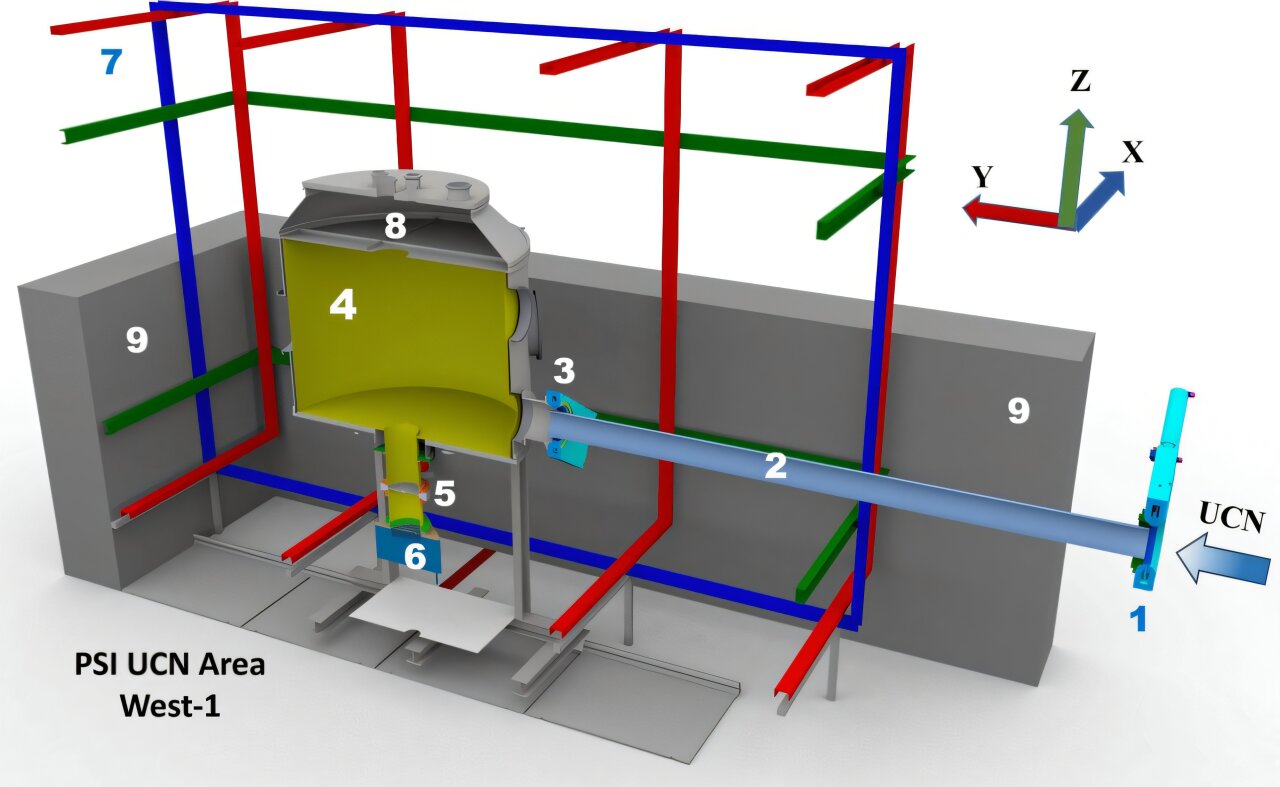
A new mirror neutrons experiment at the Paul Scherrer Institute found no sign that ordinary neutrons are slipping into a hidden “mirror” version of matter. The result matters because mirror particles have been proposed as possible dark matter candidates, and because neutron disappearances have been discussed as one possible clue in particle physics.
The work, published in Physical Review Letters, examined about 25 billion ultracold neutrons at PSI’s ultracold neutron source. According to PSI, the measurement rules out with very high probability the idea that neutrons transform into mirror neutrons under the conditions tested.
Do neutrons turn into mirror neutrons?
PSI says its experiment found no evidence that they do. Researchers stored ultracold neutrons in a controlled vessel, changed magnetic-field settings over months of measurements and looked for losses that would match the expected pattern of neutron-to-mirror-neutron oscillations.
The mirror-world idea comes from theoretical physics. In that picture, known particles would have counterpart particles: mirror electrons, mirror protons and mirror neutrons. Geza Zsigmond of PSI’s Center for Neutron and Muon Sciences said the two sectors would barely affect each other, with gravity as the main shared interaction.
That weak connection is also why the hypothesis has attracted attention in dark matter discussions. PSI notes that mirror particles, if they existed, could be difficult to detect because they would interact with ordinary matter only through gravity or through rare oscillations involving neutral particles.
How the PSI search worked
The research team, working with ETH Zurich and Jagiellonian University in Kraków, used neutrons produced at PSI’s high-intensity proton accelerator and slowed them into an ultracold state. Ultracold neutrons move slowly enough that researchers can store them and count how many remain after a set time.
In each run, the team placed about 1.5 million neutrons into a nonmagnetic stainless-steel vacuum container. After roughly 200 seconds, the vessel was emptied and the remaining neutrons were counted. PSI says the process was repeated every five minutes over several months.
Magnetic-field coils around the container were central to the test. Bernhard Lauss, who leads PSI’s ultracold neutron physics group, said the team varied the strength and direction of the field to cover the regions where neutron and mirror-neutron oscillations might be expected.
The group reported no signal consistent with such oscillations. PSI described the measurement as the strongest experiment of its kind, adding that major improvements would require a far more complex setup.
Why physicists care about a null result
The result does not settle every question about dark matter or hidden sectors. It narrows the room available for one specific proposal: that neutrons could vanish into mirror neutrons at a rate detectable in this kind of experiment.
Neutrons were useful for the search because they carry no electric charge and because their measured lifetime differs depending on the method used, PSI said. One speculation had been that some missing neutrons might be leaving ordinary matter during measurement.
PSI said the findings push theorists toward other explanations. The paper is titled “New High-Sensitivity Search for Neutron to Mirror-Neutron Oscillations at the PSI Ultracold Neutron Source,” by N. J. Ayres and colleagues.
This story draws on original reporting from Phys.org.