
Miocene bear-dog species identified from Catalonia fossils
Researchers named Paludocyon moyasolai from 15.9 million-year-old fossils found at the Els Casots site near Barcelona.
By Priya Raghavan · Science Reporter
3 min read
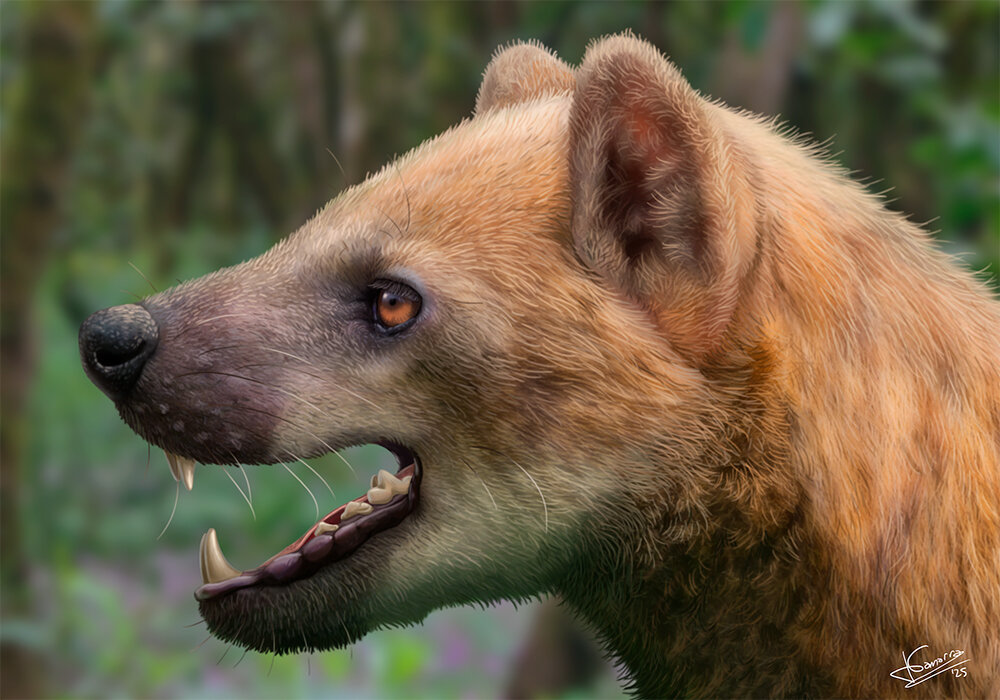
Researchers have identified a previously unknown species of extinct carnivore from fossils found at Els Casots, a Miocene site in Subirats in Catalonia’s Alt Penedès region. The find adds a new member to the amphicyonids, the extinct group often called bear-dogs, and helps refine the picture of predators living in northeastern Spain about 15.9 million years ago.
The study, by Jorge Morales and colleagues and published in the Journal of Mammalian Evolution, describes the species as Paludocyon moyasolai. The work involved the Institut Català de Paleontologia Miquel Crusafont, which said the name honors Salvador Moyà-Solà, a major figure in Iberian vertebrate paleontology and the institute’s director from its founding until 2017.
Amphicyonids belonged to Carnivora, but the Institut Català de Paleontologia said they were not direct relatives of living bears or dogs. The group ranged widely in size and diet across North America and Eurasia through much of the Cenozoic, with some species adapted for crushing food and others showing teeth suited to meat-heavy diets.
The new species is assigned to Paludocyon, a genus established in 2011 by Morales and colleagues for animals previously grouped with Cynelos. According to the study, members of Paludocyon had relatively meat-adapted teeth, sturdy upper molars and smaller premolars.
The fossils used to define P. moyasolai include a largely complete skull that was crushed from the side, nearly complete upper teeth and a separate second lower molar. The researchers said the upper teeth show traits that set the animal apart from other known Paludocyon species, including distinct upper molar proportions and a more developed third molar with clear front cusps.
The Institut Català de Paleontologia said Paludocyon was probably a medium-sized, quick predator. It was smaller and more agile than another, still-undescribed amphicyonid from Els Casots that was about the size of a leopard, according to the institute.
The predator likely shared the area with primitive cats, large mustelids and small crocodiles of the genus Diplocynodon, the institute said. Researchers infer that P. moyasolai probably preyed on small and medium-sized herbivores, including some deer, bovids and small suids.
Els Casots and the Miocene record
Els Casots is regarded by the Institut Català de Paleontologia as a key Miocene vertebrate site in southeastern Europe. Its age, about 15.9 million years, is based on biostratigraphic and magnetostratigraphic evidence.
The site sits on the southern edge of the Vallès-Penedès Basin. It was discovered in 1989, excavated until 1994, and fieldwork resumed in 2018, according to the institute. More than 5,000 large vertebrate remains have been recovered there, representing nearly 80 species of fish, amphibians, reptiles, birds and mammals.
Evidence from fossils, plants and sediments indicates that Els Casots was once a shallow freshwater lake near the coast under warm conditions linked to the Miocene Climatic Optimum, the institute said. The genus name Paludocyon means “swamp dog.”
Name honors Salvador Moyà-Solà
Moyà-Solà, born in Palma de Mallorca in 1955, studied geology at the Universitat Autònoma de Barcelona and earned his doctorate there, according to the Institut Català de Paleontologia. He later worked at the Institut de Paleontologia de Sabadell, became an ICREA research professor in 2006 and is now an emeritus researcher at the ICP.
The tribute also reflects Moyà-Solà’s direct connection to Els Casots. The institute said he helped launch the first systematic excavations after the site’s discovery, and the skull used to describe P. moyasolai was recovered during those early campaigns in 1991.
This story draws on original reporting from Phys.org.