
Metallic glass discovery gets faster with resistivity indicator
Researchers screened about 3,500 alloy compositions using resistivity changes, a shortcut they say can identify better metallic glass candidates.
By Tom Brennan · Health & Medicine Correspondent
3 min read
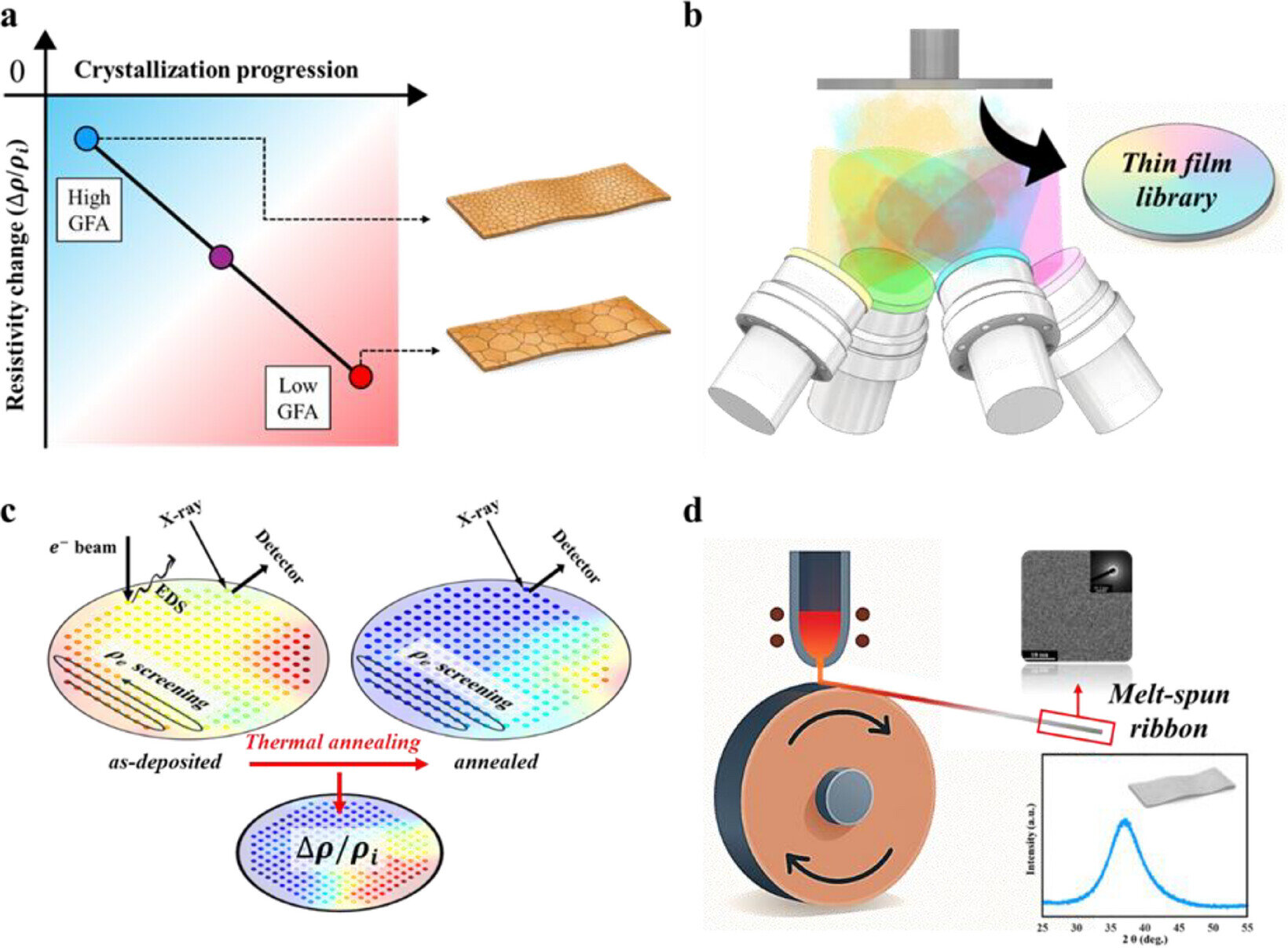
A research team says it has found a faster way to guide metallic glass discovery by measuring how an alloy’s electrical resistivity changes after heat treatment. Sungkyunkwan University said the method gives researchers a quick signal for which alloy mixtures are more likely to form glass instead of crystals.
The work was led by Dongwoo Lee, an associate professor in Sungkyunkwan University’s School of Mechanical Engineering, and Yanhui Liu of the Institute of Physics at the Chinese Academy of Sciences. The findings were published in Advanced Materials.
Metallic glasses are alloys whose atoms lack the regular, ordered pattern found in conventional crystalline metals. According to Sungkyunkwan University, many of these materials can combine high strength, wear resistance and precise shaping, making them candidates for uses in robotics, aerospace systems and next-generation medical devices.
How does the metallic glass indicator work?
The new indicator is based on electrical resistivity, which changes as an alloy’s internal atomic arrangement changes. The researchers used the size of the resistivity drop after annealing as a sign of how much crystalline order formed in the material, according to the study.
Alloys with stronger glass-forming ability showed smaller decreases in resistivity after annealing, Sungkyunkwan University said. Alloys with weaker glass-forming ability crystallized more and showed larger resistivity declines.
Glass-forming ability, often shortened to GFA, describes how readily an alloy becomes a glass rather than arranging itself into a crystal. The university said predicting GFA has been difficult because researchers have often needed to make many separate compositions and test them one by one with methods such as X-ray diffraction or thermal analysis.
For the new work, the team made combinatorial thin-film libraries with continuous composition gradients using magnetron sputtering, according to the paper summary. That setup let the researchers examine a broad spread of alloy mixtures on a substrate rather than preparing each composition separately.
The researchers then annealed the samples under controlled conditions and mapped resistivity before and after heating across about 3,500 alloy compositions, Sungkyunkwan University said. The result was a composition-by-composition view of how strongly each material resisted crystallization.
Why could this speed up alloy screening?
Sungkyunkwan University said measuring electrical resistivity for one composition takes only a few seconds. The university described the approach as hundreds of times faster than conventional characterization based on diffraction or calorimetry.
The method also avoids some complex fabrication and testing steps needed in slower screening workflows, according to the university. Its main value is rapid mapping: researchers can see where glass-forming ability rises or falls across large composition ranges before choosing candidates for more detailed study.
The team also tested selected compositions as melt-spun ribbon samples, which are produced through a different cooling and solidification route than the thin films. Sungkyunkwan University said those samples showed the same composition-dependent trends, supporting the reliability of the resistivity-based indicator.
Lee said the resistivity change offers a quick reading of atomic disorder and resistance to crystallization. According to Sungkyunkwan University, the researchers expect the approach to help accelerate the search for next-generation bulk metallic glasses and related advanced materials.
This story draws on original reporting from Phys.org.