
Mars terraforming gains new attention as technology advances
A 2025 workshop summary argues that new tools justify studying how Mars could be warmed, while warning of major scientific and ethical risks.
By Tom Brennan · Health & Medicine Correspondent
3 min read
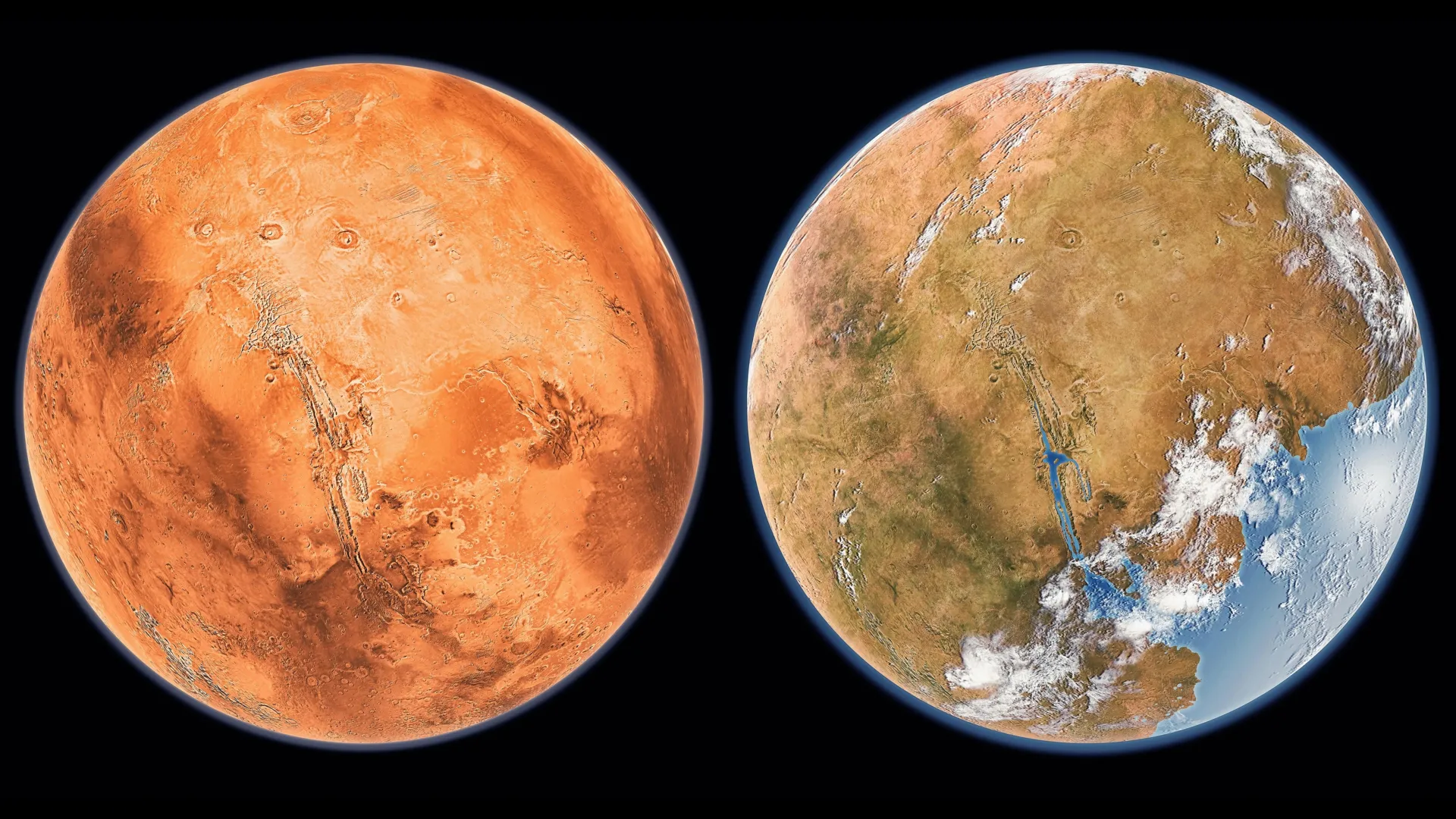
Scientists are taking a fresh look at terraforming Mars after advances in launch systems, synthetic biology and climate modeling made the idea less remote, according to Universe Today. The work does not call for an effort to remake the planet now, but it argues that researchers should study what such a project would require and what it could destroy.
Terraforming means changing a world so it can support people and Earth-like life. For Mars, that would involve altering its atmosphere, temperature and surface conditions enough to allow liquid water, oxygen production and eventually more stable habitats.
Universe Today reported that Dr. Erika DeBenedictis, CEO of Pioneer Labs, prepared the summary for the 2025 Green Mars Workshop. The summary says a concept long treated mainly as science fiction now deserves formal research because the limiting questions have shifted from basic physical possibility to safety, feasibility and ethics.
A step-by-step Mars plan
The workshop summary starts with a future version of Mars that could support life, then works backward through the steps that would be needed, according to Universe Today. The first stage would be to warm the planet by several tens of degrees over a few decades.
Researchers cited in the summary propose using engineered aerosols or greenhouse gases to raise average temperatures. Studies discussed in the report say Mars has enough frozen water to form an ocean of almost 4 million square kilometers with an average depth of about 300 meters, if that ice could be melted and stabilized.
A temperature rise of about 30 degrees Celsius could start turning some of those reserves into surface liquid water, according to the summary. That would not make Mars Earth-like, but it could open the door to biological steps that cannot begin under present Martian conditions.
Microbes and oxygen would take far longer
After initial warming, the researchers envision introducing engineered extremophiles, microbes adapted from organisms that can survive severe cold, radiation and low pressure. Universe Today reported that such organisms could be designed to spread in algae-like layers across parts of the planet within decades.
Those microbes would use photosynthesis to begin changing the atmosphere, but the process would be slow. The summary estimates that producing enough oxygen naturally for a broader breathable atmosphere would take about a thousand years.
The plan also considers large enclosed habitats about 100 meters tall as early oxygen-producing zones. Inside those domes, oxygen could come from photosynthesis or water electrolysis, while later plant growth outside controlled areas would contribute gradually to the wider Martian atmosphere, according to the workshop summary.
Unknowns and risks remain
The report identifies major gaps that would have to be closed before any planet-scale action. Scientists still need to know more about what sits beneath Mars’s ice sheets, how dust storms would behave in a warmer and wetter climate, and whether the planet has enough raw materials for large-scale electrolysis, Universe Today reported.
Ethical concerns are central to the argument. The summary warns that changing Mars could erase parts of its natural record and limit future research into the planet’s original state.
The risk would be greater if Mars already hosts native life, even microscopic organisms. Introducing Earth life could damage or eliminate Martian life before scientists fully understand it, according to the researchers cited by Universe Today.
The summary also says terraforming research could have uses on Earth. Work on drought-resistant crops, closed-loop life-support systems and cleaner space technologies could aid sustainability efforts here, even if Mars itself is not transformed for centuries.
For now, the proposed path is limited to laboratory studies, improved climate models and possible small Mars mission experiments aimed at local warming. Universe Today reported that the workshop’s main conclusion is that any attempt to alter Mars would require a much deeper scientific and ethical assessment first.
This story draws on original reporting from ScienceDaily.