
Looping lawn sprinklers help settle Feynman’s reverse-sprinkler puzzle
Experiments with oddly shaped sprinklers found that water’s angular momentum drives rotation in both forward and reverse operation.
By Priya Raghavan · Science Reporter
3 min read
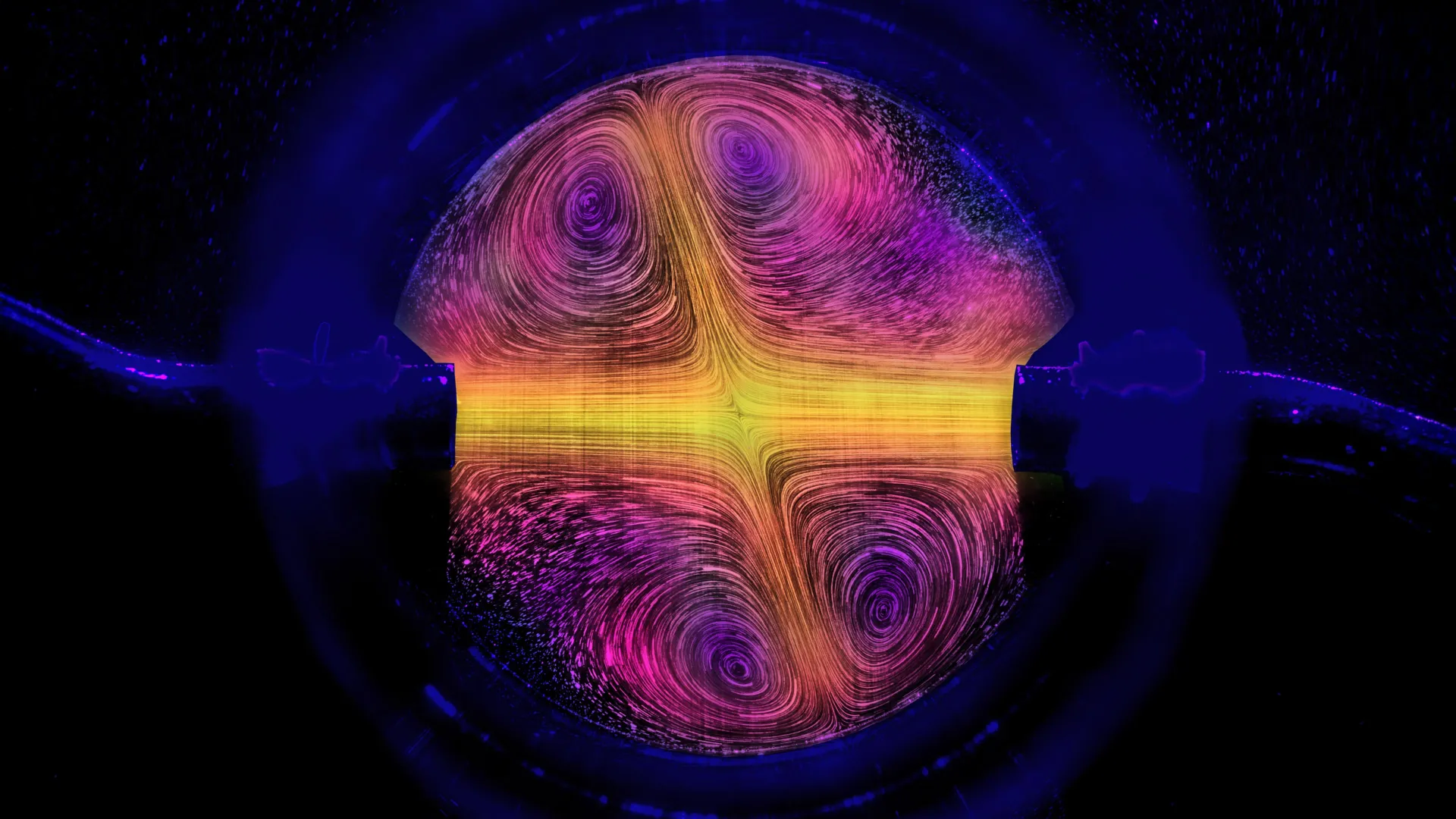
Mathematicians say they have resolved a long-running fluid mechanics problem linked to Richard Feynman by testing sprinklers with twisting, looping arms. The work matters because the same physics can help explain how flowing liquids push and rotate parts in machines that draw power from fluids, according to New York University.
The study, published in Proceedings of the National Academy of Sciences, examined what makes a sprinkler spin when it sprays water outward and what happens when the process is reversed so water is pulled inward. The researchers concluded that rotation in both cases is governed by the momentum carried by moving water, rather than by water flowing around the outside of the device.
A famous problem, tested with odd shapes
Feynman’s sprinkler problem asks how a sprinkler behaves when it runs backward. In the familiar version, jets shoot from the arms and the sprinkler turns in response, much like a small rotating rocket, according to the NYU team.
In reverse, water enters through the arms and moves toward the central chamber. NYU researchers said the incoming jets meet there slightly off center, creating forces that make the device rotate the other way.
The question became widely known after Feynman described his unsuccessful efforts to test it experimentally in the 1980s, according to NYU. In earlier work published in 2024, the same research group found that a reverse sprinkler spins roughly 50 times more slowly than a standard sprinkler, while relying on related physical effects.
The new study broadened that work by using sprinklers modeled on colorful lawn devices with curved and looping tubes. Those shapes let the researchers test whether more complex arm geometry changed the mechanism behind the spin.
Momentum beat rival explanations
The team built multiple sprinkler designs and ran each in two modes: forward, with water expelled outward, and reverse, with water drawn inward. According to NYU, the researchers recorded rotation, visualized water movement inside and outside the sprinklers, and measured torque while holding the devices fixed.
The researchers compared their momentum-flux explanation with two other ideas. One, introduced by physicist Ernst Mach in the 1880s, holds that fluid turning one way drives the sprinkler the other way, but the new measurements did not match that model, according to the paper.
A second explanation, associated with Feynman and later researchers, emphasized flow near the outer ends of the sprinkler arms. The NYU-led team reported that changes to the outside arm sections and the surrounding water did not determine the measured rotation or torque.
The results instead supported the group’s momentum-flux theory across all of the sprinkler shapes tested, according to the study. The researchers also reported that arm geometry can shape and control the water jets, a finding they said could be useful in designing fluid-powered devices.
Leif Ristroph, an associate professor at NYU’s Courant Institute and senior author of the paper, said the experiments show that angular momentum in the water flow drives sprinkler rotation across several designs. Co-author Brennan Sprinkle of the Colorado School of Mines said the findings may aid work on devices such as turbines that convert fluid motion into energy, according to NYU.
The paper’s other authors are NYU graduate students Jesse Etan Smith and Mingxuan Zuo and NYU undergraduate Will Kuhlke. NYU said the work was supported by National Science Foundation grants DMS-2407787 and DMS-2407788.
This story draws on original reporting from ScienceDaily.