
LHC oxygen collisions add signs of quark-gluon plasma
CERN says all four main LHC experiments see new evidence that light-ion collisions can form quark-gluon plasma.
By Tom Brennan · Health & Medicine Correspondent
3 min read
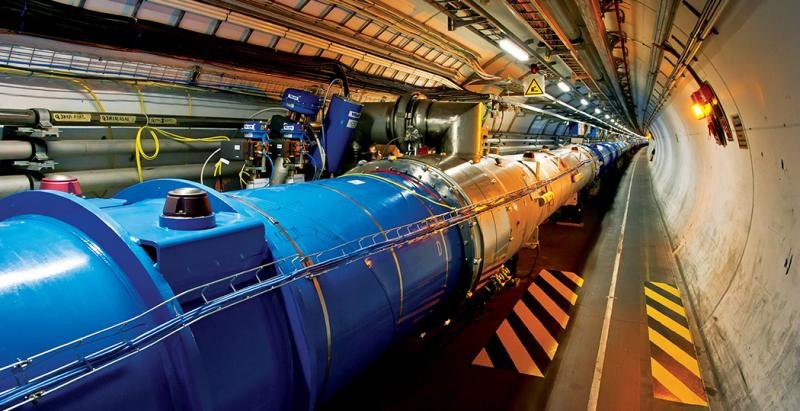
LHC oxygen collisions are giving physicists new evidence that a tiny, extremely hot form of matter can emerge from lighter atomic nuclei than once expected. CERN said the four main Large Hadron Collider experiments — ALICE, ATLAS, CMS and LHCb — have now reported signs of quark-gluon plasma in oxygen-oxygen and neon-neon collisions.
The findings matter because quark-gluon plasma is linked to conditions in the universe’s first microseconds after the Big Bang, according to CERN. The new reports extend earlier hints from oxygen collisions and add to recent results suggesting that this state may also appear in smaller collision systems.
What did the LHC experiments find in oxygen collisions?
CERN said the experiments found several patterns that match expected behavior of quark-gluon plasma, rather than relying on a single measurement. Those signs include energy loss by fast-moving quarks and gluons, reduced production of some energetic particles, suppression of heavy quark-antiquark states and directional flow in certain particles.
Quark-gluon plasma forms under intense pressure and at temperatures more than 100,000 times hotter than the sun’s center, according to CERN. In that state, particles made from quarks break apart into quarks and gluons, the carriers of the strong force that usually bind them together.
For years, CERN said, physicists associated quark-gluon plasma mainly with collisions of heavy ions such as lead, which is more than 200 times heavier than the protons normally collided at the LHC. Recent measurements have tested that assumption, including ALICE results from proton-proton and proton-lead collisions reported earlier this year.
How the experiments saw the signs
ATLAS reported an imbalance between pairs of particle jets produced in oxygen-oxygen and neon-neon collisions, which CERN identified as evidence of parton energy loss. The effect grew stronger in more central, head-on collisions, where CERN said a larger volume of quark-gluon plasma would be expected to drain more energy from passing quarks and gluons.
CERN said preliminary ATLAS work on charged particles recoiling against photons showed the same dependence on collision centrality. ALICE, CMS and LHCb looked at related energy-loss signals by measuring how production of different energetic particles was suppressed.
- CMS found suppressed charged-particle production in oxygen-oxygen and neon-neon collisions compared with proton-proton collisions, according to CERN.
- LHCb found evidence that suppression of particles containing a charm quark and a light quark was stronger in neon collisions than in oxygen collisions.
- ALICE compared neutral pion production in oxygen-oxygen and proton-oxygen collisions and found evidence for parton energy loss in oxygen-oxygen collisions, CERN said.
CMS also reported evidence involving upsilon mesons, particles made of a bottom quark and its antiquark. CERN said different levels of suppression among these short-lived bound states are one way researchers infer the presence of quark-gluon plasma. LHCb found preliminary evidence for the same type of suppression in proton-oxygen and oxygen-oxygen data.
ALICE added another preliminary result: baryons, which contain three quarks, showed a stronger preferred emission direction in oxygen-oxygen collisions than mesons, which contain two quarks. CERN said the leading explanation is anisotropic flow from quark-gluon plasma, with baryons carrying more of that flow because they contain one more quark.
CERN said researchers are continuing to study the LHC data for possible quark-gluon plasma formation in light-ion collisions. The collider is also being upgraded into the High-Luminosity LHC, which CERN said will allow deeper study of quark-gluon plasma.
This story draws on original reporting from Phys.org.