
Keystone molecules ecology idea gets new test in rare compounds study
Erika C. Freeman says scarce molecules can reshape ecosystems, offering tests to identify chemical drivers in mudflats, soils and freshwaters.
By Tom Brennan · Health & Medicine Correspondent
3 min read
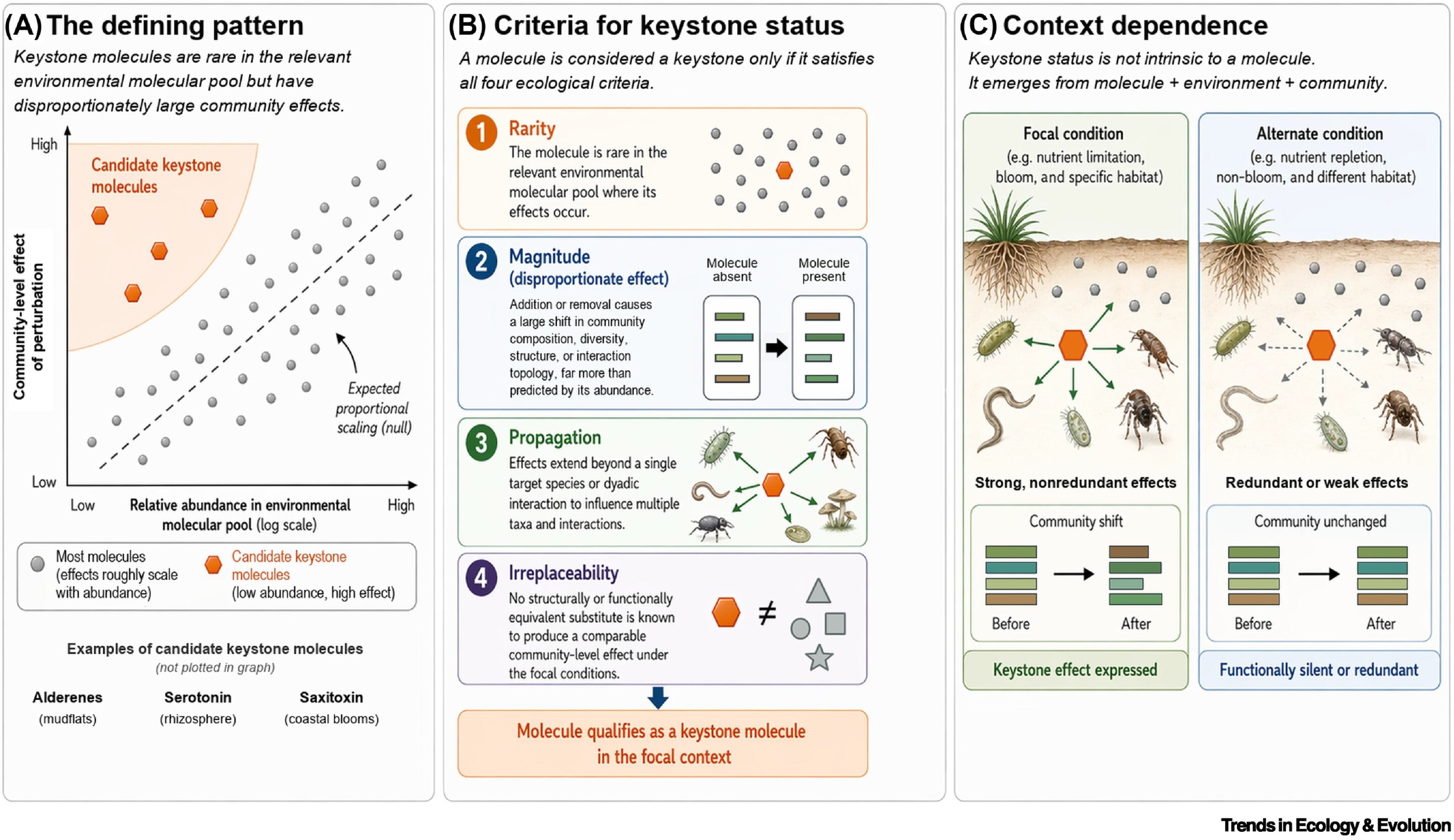
A new keystone molecules ecology paper argues that tiny amounts of certain chemicals can steer whole biological communities, even when those compounds are scarce. Erika C. Freeman of the Leibniz Institute of Freshwater Ecology and Inland Fisheries in Berlin says recent studies show that rare molecules can act with effects more often associated with influential species.
Freeman’s article, published in Trends in Ecology & Evolution, describes “keystone molecules” as chemical agents whose influence is far larger than their abundance suggests. The idea matters because researchers often focus on compounds found in large quantities, while overlooking molecules present only in trace amounts.
What are keystone molecules in ecology?
Keystone molecules are rare compounds that strongly affect the makeup or behavior of a biological community. Freeman compares them with keystone species: uncommon organisms whose removal can alter an ecosystem far beyond what their numbers would predict.
The name reaches back to the keystone species concept associated with ecologist Robert Paine, who showed in 1969 that an uncommon starfish could help maintain the structure of a rocky shoreline community. Freeman’s paper says chemistry may work in a similar way when one small molecule helps organize interactions among many organisms.
The term “keystone molecule” was introduced in 2007 by neuroecologists Richard Zimmer and Ryan Ferrer, according to Freeman. Her article argues that newer field and microbiome studies now provide stronger evidence that such molecules can be found and tested in real ecological communities.
Examples from mudflats and plant roots
One example comes from estuarine mudflats in California, where the sea slug Alderia harvardiensis produces defensive compounds called alderenes. Freeman reports that alderenes account for about 0.1% of the animal’s body weight, yet studies found they changed the composition of the mudflat community across four animal phyla by attracting some species and deterring others.
A second example involves switchgrass roots under nitrogen stress. Freeman says two uncommon metabolites, serotonin and ectoine, acted as signals that reshaped the plant’s root microbiome. Serotonin is widely known as a neurotransmitter in animals, but the paper points to its role in plant-associated microbial communities.
Taken together, Freeman says these cases suggest that low-abundance chemistry can have broad ecological consequences in settings as different as tidal flats and root systems. The article frames the compounds as active community organizers rather than background chemical noise.
How scientists could find rare chemical drivers
Freeman sets out four tests for identifying a true keystone molecule. The molecule should be rare, have a large effect on a community, influence more than one target organism or interaction, and lack an easy substitute that performs the same role.
The paper also points to methods that could help researchers search for these compounds across oceans, freshwaters and soils. Freeman lists network analysis of high-resolution mass spectrometry data, experiments using simplified synthetic communities, and machine learning as tools for detecting chemical patterns that would otherwise be hard to see.
Freeman’s broader claim is that ecology may need to pay closer attention to the smallest chemical signals in a system. If the framework holds across more environments, rare molecules could become a regular part of how scientists explain why living communities form, change and persist.
This story draws on original reporting from Phys.org.