
JWST exo-Io detection method targets volcanic moons near super-Jupiters
Researchers say JWST light curves could reveal volcanic exomoons by tracing auroras on super-Jupiter worlds such as SIMP 0136+0933.
By Lucas Ferreira · Science & Environment Writer
3 min read
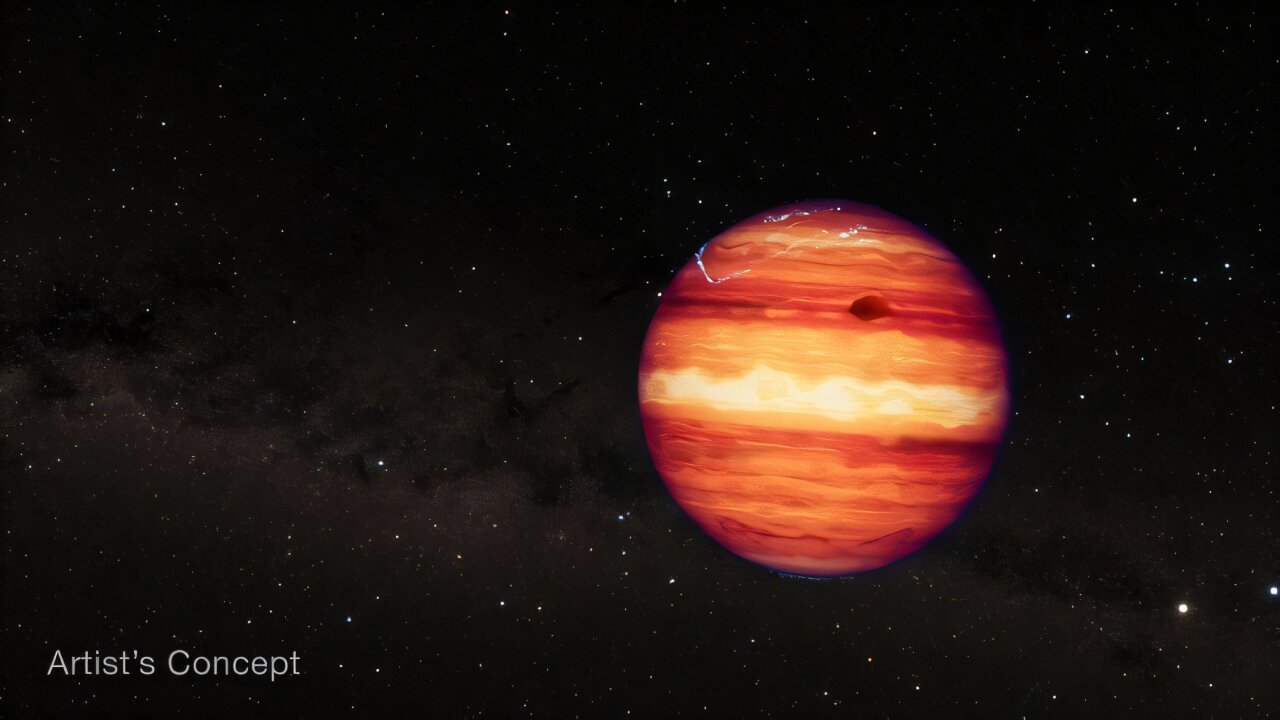
A new JWST exo-Io detection method could give astronomers a way to look for volcanic moons beyond the solar system by watching auroras around giant worlds. Researchers led by Brooke Kotten report that light curves from NASA’s James Webb Space Telescope may be able to pick out Io-like moons orbiting aurorally active super-Jupiters.
The study, accepted for publication in The Astronomical Journal and available on arXiv, focuses on whether volcanic exomoons could reveal themselves through the material they feed into a planet’s magnetic environment. Universe Today reported that the work uses Jupiter’s moon Io as the model.
Io is the solar system’s most volcanically active planetary body, according to the report, with hundreds of active volcanoes. Its activity is driven by tidal heating, a process in which Jupiter’s gravity stretches and squeezes the moon as it follows a noncircular orbit.
The same moon also helps power Jupiter’s auroras, the report said. Gases from Io move along Jupiter’s magnetic field lines and contribute to bright auroral emissions seen by spacecraft and telescopes on Earth.
How would JWST detect an exo-Io?
An exo-Io is an extrasolar moon similar to Io: a volcanically active satellite orbiting a much larger planet or planet-like body. The researchers propose looking for signs that such a moon is supplying material to auroras around a super-Jupiter, then using JWST light curves to test whether a transiting satellite could be present.
The team studied JWST auroral data for SIMP 0136+0933, a nearby planetary-mass object about 20 light-years from Earth. Universe Today reported that SIMP 0136+0933 has a mass of about 12.7 Jupiters and rotates once every 2.4 hours, compared with Jupiter’s rotation period of slightly under 10 hours.
The analysis asked whether a volcanically active exomoon might be feeding the object’s auroras in a way comparable to Io’s role at Jupiter. The researchers estimated detection success rates of 66% for an Io-like moon and 93% for a Ganymede-like moon in the system, according to the report.
The study does not claim a confirmed exomoon around SIMP 0136+0933. In its conclusion, the researchers said existing light curves show the transit technique can detect Io-like satellites in principle, but the available archival data are too short to put strong limits on whether such a moon is actually present.
The researchers said JWST light curves covering about 1.5 days for roughly four to 12 known aurorally active super-Jupiters would be needed to test statistically whether Io analogs are common in those systems.
What is SIMP 0136+0933?
SIMP 0136+0933 is described in the report as both a super-Jupiter and a free-floating planetary-mass object. Universe Today said that classification places it near the boundary between objects too small to be stars and objects too large to be typical planets, though calling it a rogue planet is still acceptable.
When discovered in 2006, SIMP 0136+0933 was classified as a brown dwarf in a roughly 200-million-year-old cluster of stars, the report said. Later observations put its mass at 12.7 times Jupiter’s, below the threshold for a failed star.
No exomoon has yet been definitively confirmed, according to Universe Today. Reported candidates include possible moons around WASP-49 b, Kepler-1625 b, Kepler-1708 b and HD 206893 b, but the search is difficult because moons are far smaller than the planets and stars around them.
This story draws on original reporting from Phys.org.