
Josephson junction black hole study finds gravity shifts readings
A theoretical study says black-hole gravity would redshift a quantum circuit’s output without changing its local Josephson physics.
By Tom Brennan · Health & Medicine Correspondent
3 min read
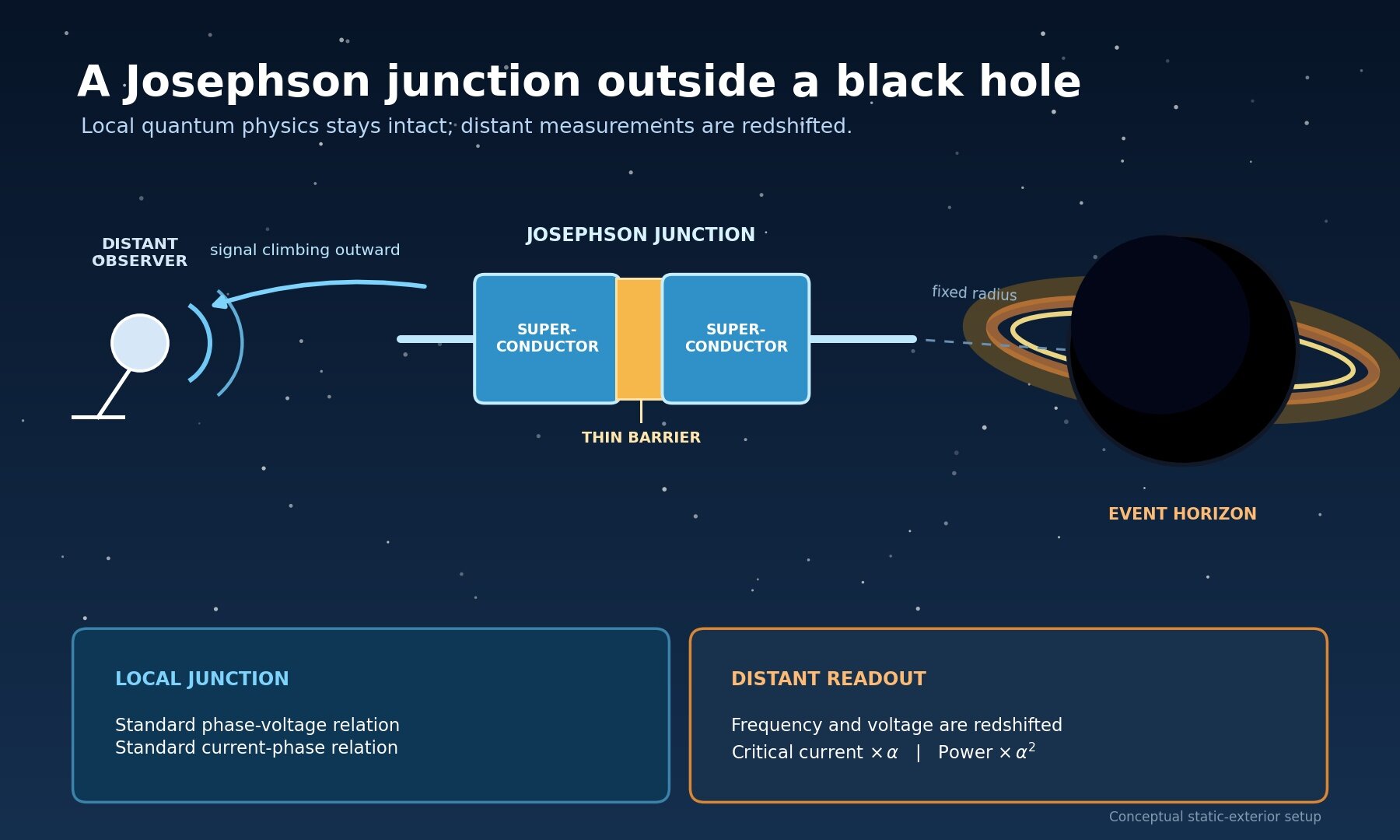
A Josephson junction black hole model finds that extreme gravity would alter how a faraway observer records a quantum circuit, while leaving the circuit’s local rules unchanged. Reggie C. Pantig and Ali Övgün report the result in a study published in the Journal of High Energy Physics, using an idealized setup outside a nonrotating black hole.
The work treats a Josephson junction as a small superconducting device held at a fixed distance outside a Schwarzschild black hole. The researchers say the device would obey the familiar Josephson relations in its own local frame, but measurements translated to a distant observer would be redshifted by gravity.
How would a Josephson junction behave near a black hole?
A Josephson junction is made from two superconductors separated by an extremely thin barrier. It can carry a supercurrent without an applied voltage, and when a steady voltage is applied, the quantum phase across the barrier oscillates at a frequency tied to that voltage.
Pantig and Övgün say those local relations survive in curved spacetime. The change comes from the fact that clocks run at different rates at different gravitational potentials, so voltage, energy and frequency must be tied to the observer doing the measuring.
The study uses the gravitational redshift factor, known as alpha, to connect the local circuit to a distant observer. Alpha is near one far from the black hole and tends toward zero close to the event horizon, according to the researchers.
For superconducting parts placed at different radii, the same local voltage drops would not translate into the same phase rates when measured against the distant clock, Pantig and Övgün report. Each local voltage is weighted by the redshift factor at its position, making the effect a matter of measurement comparison rather than a revision of superconductivity.
What changes for current, power and SQUID patterns?
The researchers find that the critical current assigned by an observer far away carries one factor of alpha. Power carries two: one from the clock-rate effect and another from the redshift of energy. That means the farther down the gravitational well the device is placed, the smaller its distant current reading becomes, while the distant power reading falls more steeply.
The paper also considers a vertical SQUID, a superconducting interferometer with two junctions at slightly different gravitational potentials. In direct-current operation, Pantig and Övgün find that gravity mainly changes the interference amplitude at first order, rather than shifting the centers of the interference lobes away from their usual magnetic-flux values.
For radio-frequency driving, the researchers distinguish redshift from propagation effects. If the drive and bias are described using quantities measured at infinity, the Shapiro-step positions remain fixed in those variables; apparent shifts in radio-frequency interference lobes arise from phase picked up along different signal paths, including the curved-spacetime form of Shapiro time delay.
Could this be tested near an event horizon?
Pantig and Övgün describe the setup as a theoretical static-exterior model, not a plan for placing equipment next to a black hole. A device could not hover exactly at the event horizon because the required acceleration would diverge, and the circuit would also need to be small compared with the distance over which gravity changes appreciably.
On Earth, the corresponding effect is far too small for ordinary Josephson devices to see, according to the researchers. Across a vertical height of 1 meter, the fractional gravitational redshift is about one part in 10 quadrillion.
The study’s main use, the authors say, is to separate local quantum physics from the bookkeeping needed when observers use different clocks and energy standards. In their calculation, gravity changes the reading assigned from far away, not the Josephson rule followed by the circuit nearby.
This story draws on original reporting from Phys.org.