
Hydrogel electrode steadies insect odor sensors for drones
Shinshu and Chiba researchers say a water-retaining electrode kept moth antenna odor sensors usable for seven hours.
By Priya Raghavan · Science Reporter
3 min read
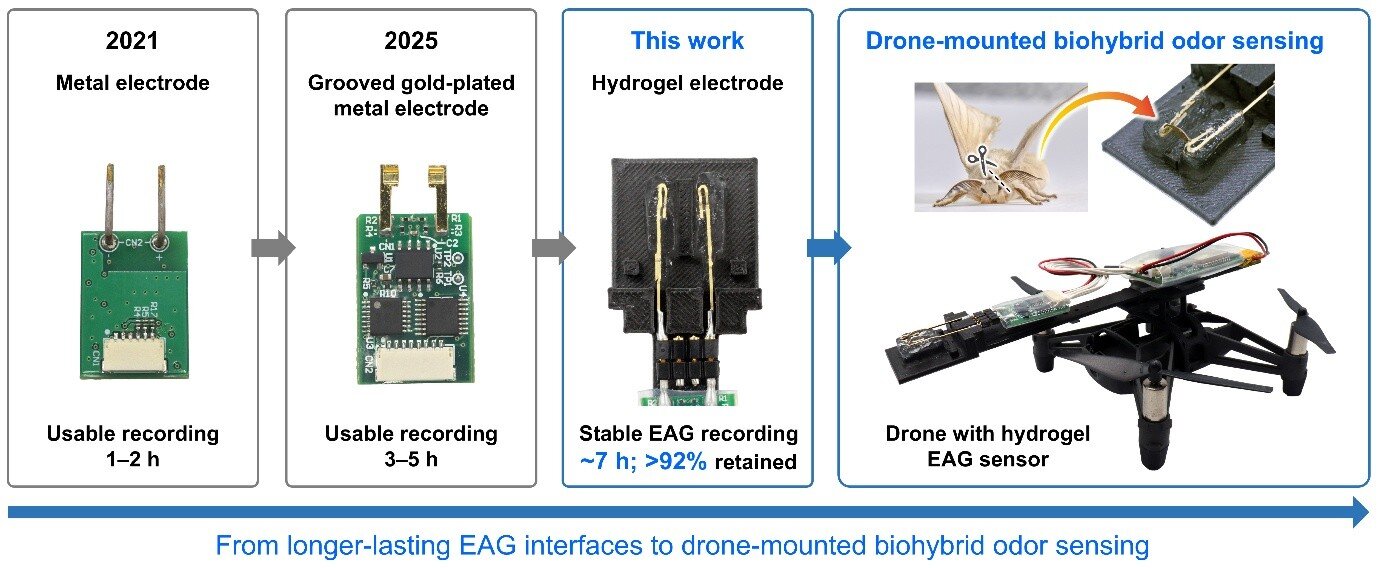
Researchers in Japan have developed a hydrogel electrode that could make insect odor sensors for drones more stable during longer missions. Shinshu University said the design helps keep excised insect antennae from drying out, a problem that has limited biohybrid smell sensors outside the lab.
The work, by researchers at Shinshu University and Chiba University, was published in Sensors and Actuators B: Chemical. The team was led by Associate Professor Daigo Terutsuki of Shinshu University, with Reina Omori, Kie Kondo, Yosuke Kageshima and Toshiyuki Nakata.
Drones already support disaster response, infrastructure checks and environmental monitoring, but Shinshu University said many systems still depend on cameras and other visual sensors. Those tools can lose value in smoke, dust, darkness or damaged structures, where odor sensing could help detect gas leaks or chemical emissions.
How do insect odor sensors for drones work?
The sensors use insect antennae to record electroantennogram, or EAG, signals. An EAG signal is the electrical response produced by an antenna when it is exposed to an odor.
In this study, the researchers tested antennae from male silkworm moths, Bombyx mori. The challenge is that excised antennae dry over time, which weakens signal quality and makes the electrical contact with recording equipment less reliable, according to Shinshu University.
The new electrode combines a moisture-retaining hydrogel with a conductive gel layer, a gold-plated core and a 3D-printed frame. Shinshu University said the hydrogel keeps the contact area around the antenna hydrated while preserving electrical coupling for EAG recording.
Under indoor room-temperature test conditions, the hydrogel electrode retained more than 92% of its initial EAG response amplitude after seven hours, according to the researchers. A conventional grooved gold-plated metal electrode dropped below the study’s 50% practical-usability threshold by four hours.
The team also used electrochemical impedance measurements to examine the electrical interface. Those tests supported more stable coupling in the hydrogel electrode assembly during the first hour, Shinshu University said.
What did the drone tests show?
To test the sensor on a moving platform, the researchers mounted the stabilized setup on a lightweight drone. In proof-of-concept experiments, the drone-mounted sensor detected odor-triggered EAG signals, according to Shinshu University.
In separate free-flight proof-of-concept tests, EAG threshold crossings activated a programmed stop-and-advance movement. The researchers said the tests did not show optimized odor-source localization; they showed that the stabilized biohybrid interface could support drone-based odor sensing under the tested flight conditions.
Terutsuki said, according to Shinshu University, that improving a drone’s odor-tracking range is only part of the problem, because the biological sensor also has to remain stable on a moving platform. He said the team focused on the antenna-electrode interface to maintain a hydrated contact environment for several hours.
The researchers said longer-lasting biological odor sensors could be useful in disaster-prone regions such as Japan, including search-and-rescue work after earthquakes. They also pointed to possible industrial uses, including mobile detection of gas leaks or chemical emissions in places that are difficult or risky for people to enter.
The study presents the hydrogel interface as a step toward more practical biohybrid sensing platforms. Shinshu University said the longer recording window could support future systems for mobile robotics, hazardous chemical monitoring, infrastructure inspection and environmental monitoring.
This story draws on original reporting from Phys.org.