
Hot electrons reshape metals in ultrafast phase-change study
A Manchester-led study says electronic excitation can switch metal crystal structures before atoms heat up, pointing to new ultrafast control methods.
By Priya Raghavan · Science Reporter
3 min read
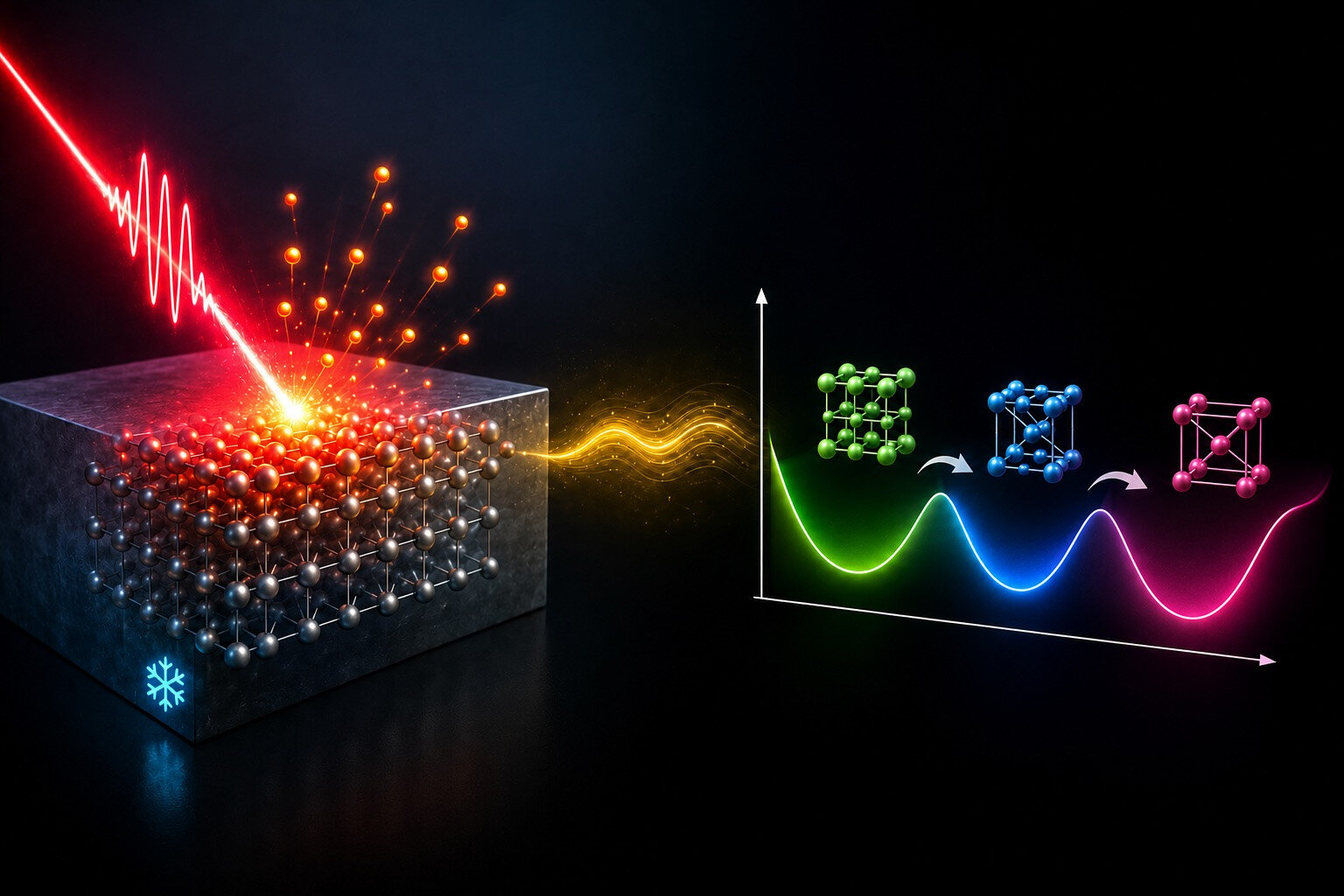
Hot electrons reshape metals on ultrafast timescales, according to research from The University of Manchester that examines what happens after metals are hit with powerful laser pulses. The study matters because it points to a way to change a material’s crystal structure before its atoms have warmed in the usual sense.
The work, led by Dr. Sam Azadi and published in Physical Review Materials, focuses on intense electronic excitation. The University of Manchester said laser pulses can raise the temperature of a metal’s electrons almost immediately while the atomic lattice remains comparatively cool.
Under those conditions, the Manchester team found that the metal’s response can be controlled by the electronic system rather than by heat moving through the atoms. The study reports that this effect can drive switches between crystal structures in a fraction of a picosecond.
How do hot electrons reshape metals?
The mechanism identified by the researchers is electronic entropy, which describes how electrons spread among available energy states when electronic temperatures are high. In the study, that electronic contribution changes the relative stability of different crystal arrangements, allowing one solid structure to give way to another without a conventional lattice-heating route.
Azadi said, according to the University of Manchester, that electronic entropy should be treated as its own thermodynamic control factor. He compared its role to pressure, which can also push crystals from one structure into another by altering the material’s energy balance.
What the simulations found
The researchers modeled 17 elemental metals and calculated how their crystal structures’ free energies changed as electronic temperature rose. According to the University of Manchester, nearly all of the metals studied showed at least one solid-to-solid phase transition caused by the electronic effect alone.
The calculations included transitions among common crystal forms such as hexagonal close-packed, face-centered cubic and body-centered cubic structures. The university said the results showed patterns across groups of metals, while also revealing exceptions tied to the details of each element’s electronic structure.
One reported trend was that higher electronic temperature often favored less dense structures. The Manchester team linked that tendency to electronic thermal pressure, an effect produced by highly excited electrons.
The study also found that some metals behave in more complicated ways. According to the researchers, small differences in the distribution of electrons near the Fermi level can lead to less expected phase changes.
Why ultrafast materials changes matter
The findings help explain how metals may behave in nonequilibrium settings, including laser experiments and high-energy environments, according to the University of Manchester. Because the predicted transitions happen from femtoseconds to picoseconds, the researchers said they could be tested with time-resolved X-ray diffraction or electron diffraction.
The university said the work suggests that ultrafast laser pulses may be used to place materials briefly into structural states that are not reachable under ordinary equilibrium conditions. The study could inform research in ultrafast electronics, high-energy physics and advanced manufacturing, where materials can be driven far from their normal states.
This story draws on original reporting from Phys.org.