
Herbivores drive grassland food web stability, study finds
A three-year Inner Mongolia study found herbivore timing, more than plants or predators, helped stabilize grassland food webs.
By Lucas Ferreira · Science & Environment Writer
3 min read
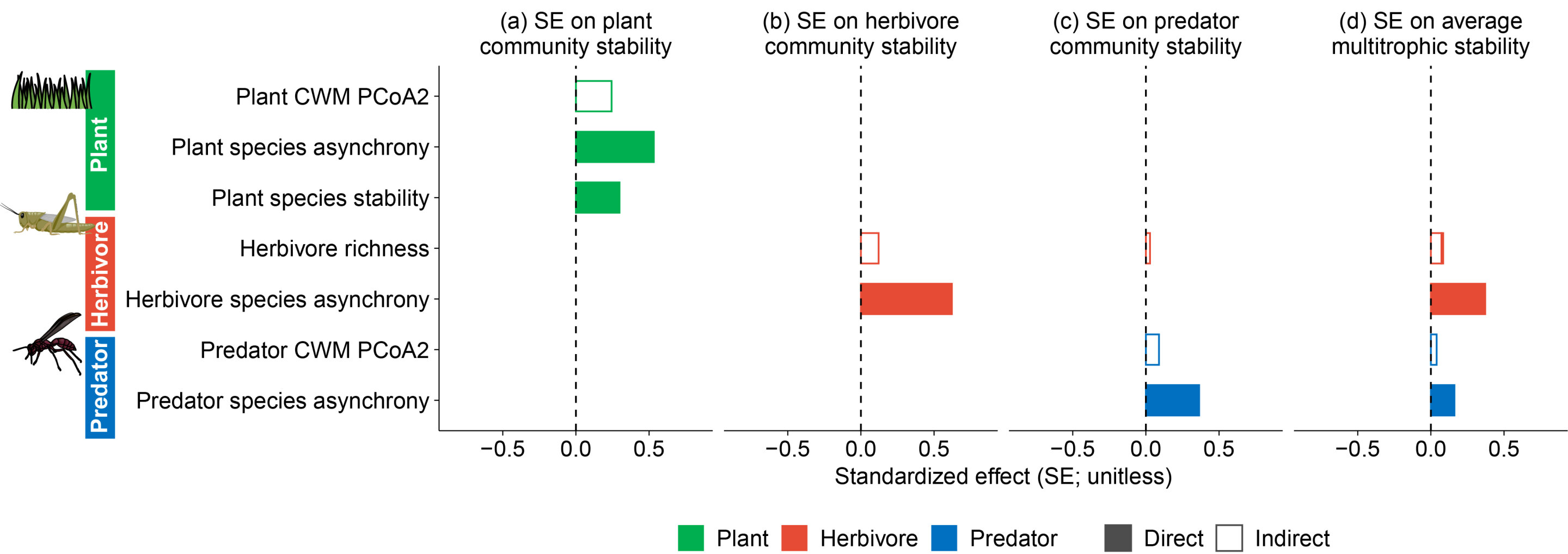
Herbivores grassland food web stability may depend less on the number of species present than on when different herbivore species rise and fall, according to a new study in the Journal of Animal Ecology. Researchers led by Yokohama National University found that herbivore communities helped buffer changes between plants and predators in a semiarid grassland in Inner Mongolia.
The study matters because ecologists have often examined ecosystem stability one layer at a time, such as plants alone or animal communities alone. The research team assessed plants, herbivores and predators together to test how stability is maintained across a food web.
Takehiro Sasaki, a professor at Yokohama National University and the study’s lead author, said the team wanted to determine whether whole food webs are stabilized mainly by plants, predators or the herbivores that connect them.
How do herbivores stabilize a grassland food web?
A food web is the network of feeding relationships in an ecosystem. A trophic level is an organism’s position in that network, such as plants as producers, herbivores as plant-eaters and predators as consumers of herbivores.
The researchers reported that herbivore species did not all change in abundance at the same time. When one herbivore species decreased, another could increase, a pattern the team described as compensatory dynamics within the herbivore community.
That timing difference, known as species asynchrony, was the strongest and most consistent predictor of stability across the grassland food web, according to the study. The finding places herbivores in a central role because they influence both plant consumption and the supply of prey for predators.
What the researchers measured
The team used three years of cumulative data from a natural grassland in Inner Mongolia. Researchers from Yokohama National University, the Chinese Academy of Sciences, Tokyo City University and Inner Mongolia University examined species diversity, community composition, the timing of species dominance and species-level stability across plants, herbivores and predators.
To analyze those relationships, the team used structural equation models. The researchers also applied two measures of whole-ecosystem stability: an averaging approach and a multiple-threshold approach.
The averaging method measured mean stability across trophic levels, while the multiple-threshold method tested whether stability held across all levels. The study said the second approach can capture cases where average stability hides sharp differences among groups.
Why herbivore timing matters
The researchers found that asynchronous changes within trophic groups helped stabilize communities. Across the full grassland food web, herbivore species dynamics stood out more strongly than plant or predator dynamics.
According to the study, herbivores acted as a biological buffer between plant and predator communities. The finding challenges the view of herbivores only as consumers that can destabilize plant communities; in this system, they also helped support broader biodiversity stability.
The work was published July 18 in the Journal of Animal Ecology under the title “Herbivore species asynchrony underpins multitrophic stability across plants, herbivores and predators.”
Where the findings may be tested next
The current research focused on a semiarid grassland, and the team said further work is needed in other grasslands, forests and agricultural systems. The researchers also want to study food webs under stronger climate variability.
Sasaki said the broader goal is to identify which parts of biodiversity matter most for ecosystem function and by what mechanisms. Longer monitoring, the team said, could show when herbivore buffering protects ecosystems and when that capacity fails.
This story draws on original reporting from Phys.org.