
Fe-doped CaTiO3 carbon recycling material avoids rare earths
Science Tokyo researchers made an iron-substituted calcium titanate that speeds CO2-to-CO conversion using low-cost elements.
By Priya Raghavan · Science Reporter
3 min read
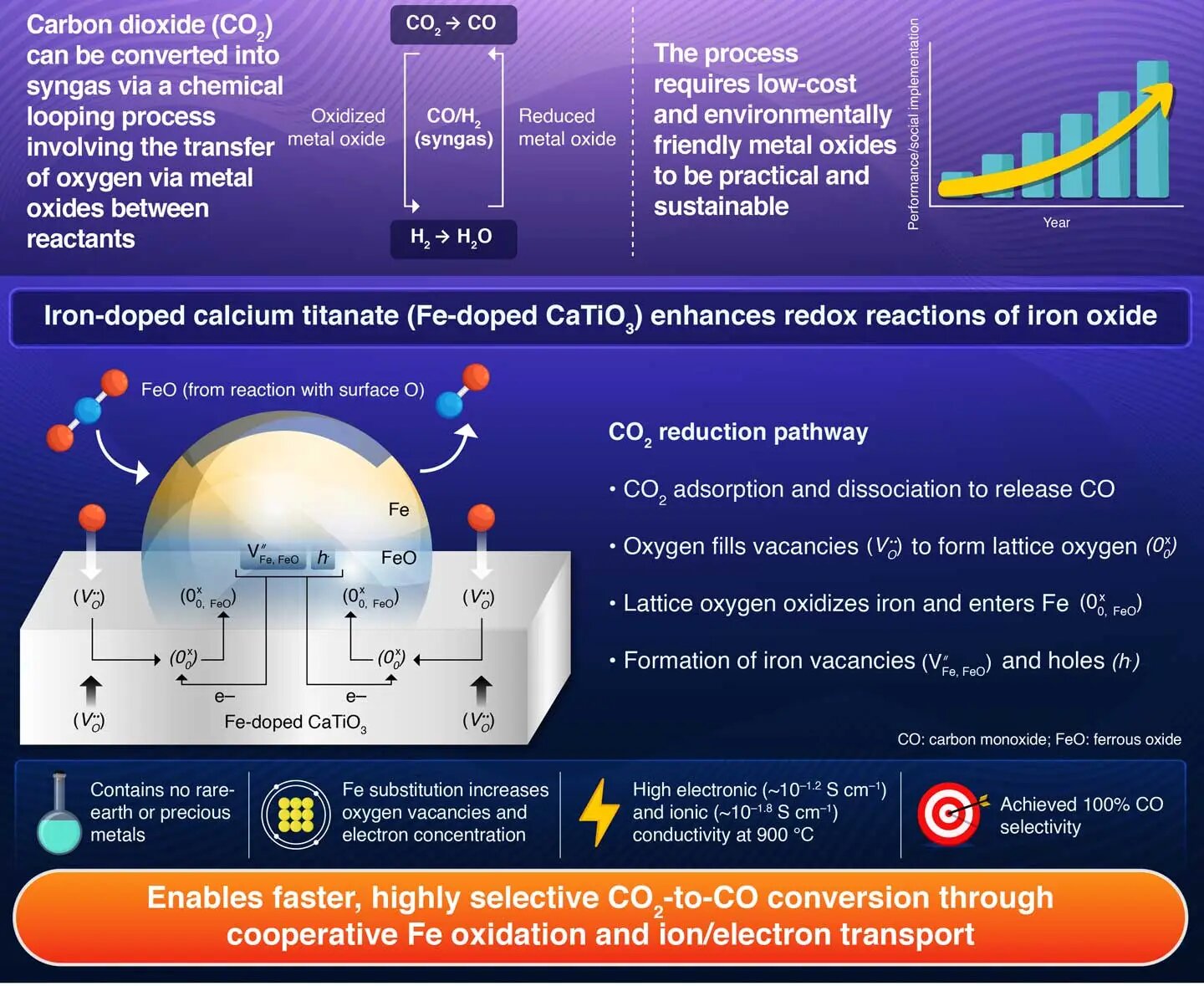
Fe-doped CaTiO3 carbon recycling could offer a cheaper route for turning carbon dioxide into useful industrial feedstocks, according to researchers at the Institute of Science Tokyo. The team reported that iron-substituted calcium titanate helped convert CO2 into carbon monoxide without relying on rare-earth or precious metals.
The work, published June 15, 2026, in the Chemical Engineering Journal, focuses on chemical looping, a process that uses metal oxides to move oxygen between gases through repeated reduction and oxidation steps. Carbon monoxide produced this way can be used directly or combined with hydrogen in syngas for fuels and chemical production.
Professor Junichiro Otomo and doctoral student Takayuki Kosaka of Science Tokyo worked with Arufa Shiota of Mitsubishi Electric Corporation on the material. Otomo said the group achieved efficient CO2 reduction through chemical looping with iron-substituted CaTiO3 and expects the work to support carbon neutrality through carbon recycling.
How does iron-doped calcium titanate recycle carbon dioxide?
In chemical looping, a metal oxide gives and takes oxygen as gases flow over it. In the cycle studied by the researchers, hydrogen first reduces the iron oxide, and carbon dioxide is then introduced to oxidize the material again, producing carbon monoxide.
Iron oxide is attractive because iron is abundant, inexpensive and can carry oxygen. The problem, according to the Science Tokyo team, is that repeated reactions can cause iron atoms to move, creating small pores that weaken the material and hurt performance over time.
The researchers addressed that problem by placing iron within calcium titanate, a support material known chemically as CaTiO3. They replaced some titanium atoms with iron, producing Fe-doped CaTiO3. The substitution created oxygen vacancies, which are missing oxygen atoms in the crystal structure.
Those vacancies matter because they give oxide ions easier paths through the material. Under reaction conditions, the material also carried electrons and holes, improving charge movement during redox reactions, according to the paper.
How the material performed in tests
The team tested Fe-doped CaTiO3 with a thermogravimetric analyzer and in a tubular reactor designed to imitate the fluidized-bed conditions used in chemical looping systems. The researchers compared it with yttria-stabilized zirconia, an oxide-ion conductor, and alpha-alumina, an insulating material.
Fe-doped CaTiO3 reduced CO2 faster than the other tested support materials, the researchers reported. In the tubular reactor, it also maintained 100% selectivity for carbon monoxide.
The paper attributes the faster reaction to the material’s mixed conductivity. At 900°C, a temperature used in chemical looping systems, the researchers measured electronic conductivity of about 10-1.2 S cm-1 and oxide-ion conductivity of about 10-1.8 S cm-1 under oxidation conditions.
During the reaction, CO2 molecules break apart on the iron surface into carbon monoxide and oxygen species. At the boundary between the iron and the support, oxygen vacancies help move oxide ions through the material, while electrons support charge transfer as iron oxidizes.
The researchers said the findings could guide the design of oxide materials and redox reactions for carbon recycling with renewable energy. Because the material uses widely available, low-cost elements, the team said it could help make CO2 conversion systems more scalable.
This story draws on original reporting from Phys.org.