
Elephant bone hammer at Boxgrove dates to nearly 500,000 years ago
Researchers say a rare Boxgrove find is Europe’s oldest known elephant bone tool and was used to sharpen prehistoric handaxes.
By Priya Raghavan · Science Reporter
3 min read
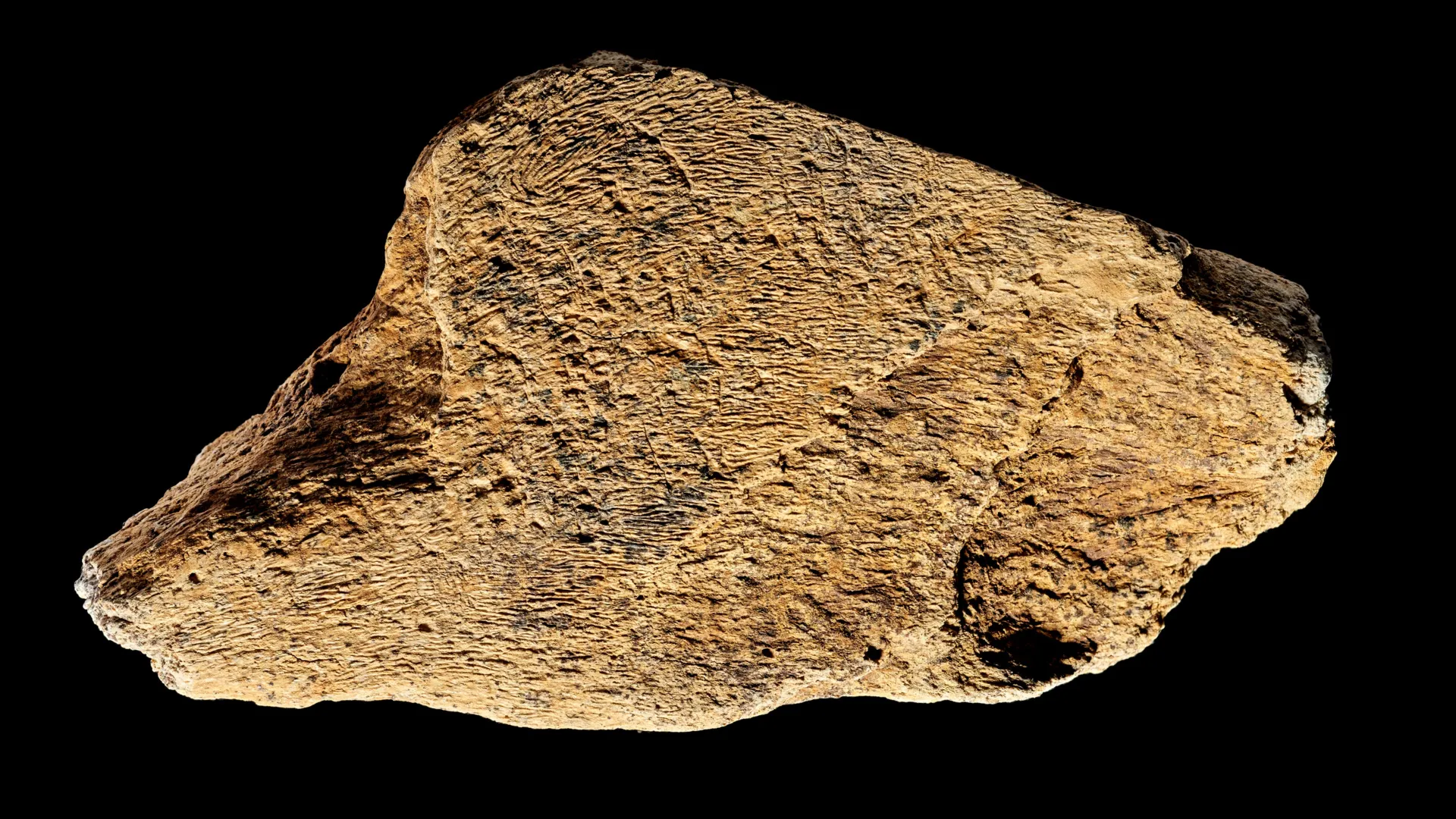
Researchers have identified an elephant bone hammer from southern England as a nearly 500,000-year-old tool used by early humans to keep stone implements sharp. The find matters because University College London and the Natural History Museum, London say it is the oldest known elephant bone tool found in Europe.
The study, published in Science Advances, concludes that the object was probably made and used by early Neanderthals or Homo heidelbergensis. Rather than a heavy-duty pounding tool, the bone appears to have served as a softer striking implement for repairing handaxes and other cutting tools.
What is the Boxgrove elephant bone hammer?
The artifact is a fossilized bone fragment from Boxgrove, an archaeological site near Chichester in West Sussex. It is roughly triangular and measures about 11 centimeters long, six centimeters wide and three centimeters thick, according to the research team.
The object is made largely of cortical bone, the dense outer layer of bone. Its thickness led the researchers to identify it as coming from an elephant or mammoth, though too little survives to say which species it belonged to or which part of the animal’s skeleton it came from.
The fragment was recovered in the early 1990s, but its function was not recognized at the time. A more recent review of material from the site led researchers to study the piece in greater detail.
How did researchers identify it as a tool?
The team used 3D scanning and electron microscopes to examine damage on the bone. They reported notches, impact marks and other wear patterns consistent with repeated use as a hammer-like tool.
Small pieces of flint were found trapped in the marks. UCL and the Natural History Museum said those embedded fragments support the conclusion that the bone was used to strike and reshape stone tools more than once.
The researchers describe the object as a retoucher. A retoucher is a tool used to tap the edge of a stone implement, removing small flakes so the edge can be restored or refined; that process is part of stone-tool making known as knapping.
Bone can give a toolmaker more control than stone because it is softer, reducing the risk of damaging the tool being repaired. The researchers said elephant bone would have been useful because its dense outer layer was tougher than the bones of many animals available in the region.
Why does the find matter?
Elephants and mammoths were uncommon in prehistoric southern England, according to the study. The researchers argue that selecting and keeping such material shows that early humans at Boxgrove recognized its value and used it for a specific task.
Simon Parfitt of the UCL Institute of Archaeology and the Natural History Museum said the find points to early humans’ knowledge of local materials and their ability to make refined stone tools. Co-author Silvia Bello of the Natural History Museum said collecting, shaping and repeatedly using the bone fragment showed complex thinking and skill.
Boxgrove has produced many flint, bone and antler tools, but no elephant bone tool had previously been identified there. The researchers said damage and deformation on the artifact suggest the bone was still relatively fresh when it was worked and used.
Elephant bone tools have been reported from Olduvai Gorge in Tanzania, including examples dated to about 1.5 million years ago. In Europe, however, the researchers said such finds are rare before 43,000 years ago, when Homo sapiens spread widely across the continent and made many objects from ivory and elephant bone.
Before the Boxgrove identification, no European elephant bone tool was known to be older than about 450,000 years, according to the study. The research was supported by English Heritage, UCL and the Calleva Foundation.
This story draws on original reporting from ScienceDaily.