
Evidence points to distant sun-like star swallowing a planet
Astronomers found unusual lithium levels in TOI-5882, a chemical sign that the star may have consumed a planet.
By Tom Brennan · Health & Medicine Correspondent
3 min read
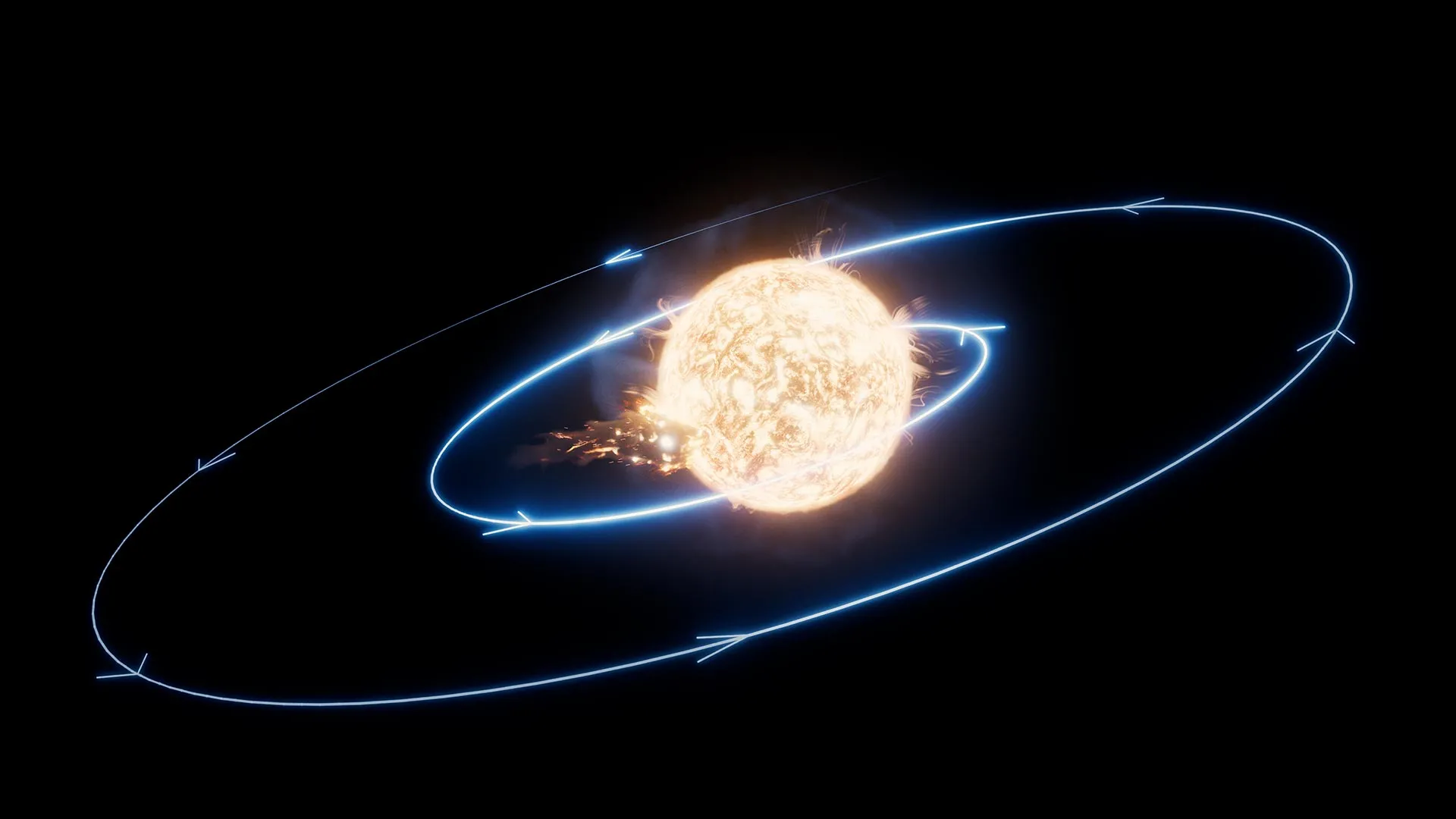
Astronomers say a sun-like star about 1,300 light-years from Earth may have swallowed one of its planets. The finding matters because such events are hard to observe directly, so researchers rely on leftover chemical evidence to learn how often stars destroy worlds around them.
The University of Michigan said a team led by astronomer Brooke Kotten identified an unusually large amount of lithium in the star, known as TOI-5882. The finding is described in a study published in The Astrophysical Journal.
According to the researchers, lithium is a useful marker because planets tend to contain much more of it than stars do. If planetary material falls into a star and mixes into its outer layers, the star can carry a detectable lithium surplus.
A chemical clue in starlight
The team used spectroscopy, which reads chemical signatures from light, to study TOI-5882. The University of Michigan said the measurements showed lithium levels far above what astronomers expected for a star with its basic properties.
To check whether the signal was unusual, the researchers compared TOI-5882 with 62 stars of similar age, mass and temperature. Melinda Soares-Furtado of the University of Wisconsin, a senior author on the paper, said the star stood out under multiple tests and ranked at least in the 97th percentile for lithium enrichment.
Based on the lithium detected, the researchers estimate the consumed planet may have ranged from a few Earth masses up to roughly Neptune’s mass. The team describes TOI-5882 as a candidate case of planetary engulfment, the term astronomers use when a star consumes a planet.
Brown dwarf may have pushed planet inward
The University of Michigan said TOI-5882 has not expanded enough for its size alone to explain how it could have taken in a planet. The researchers are therefore examining whether another object in the system helped destabilize the planet’s orbit.
That object is a brown dwarf orbiting TOI-5882. According to the university, it is more than 20 times as massive as Jupiter, yet too small to ignite like a star.
The team suspects the brown dwarf may have disturbed the missing planet’s path and sent it toward the star. Kotten said that scenario will be addressed in a separate study, according to the University of Michigan.
Rare evidence of a brief event
Planetary engulfment can happen over days or weeks on cosmic timescales, the researchers said. Because that window is so short, astronomers are unlikely to catch the event as it occurs and instead search for chemical traces left afterward.
The study builds on earlier work by Soares-Furtado identifying stars that are more likely to preserve evidence of planet consumption. The University of Michigan said TOI-5882 fit that category, making its lithium signature more useful than it would be in many other stars where such evidence may fade or become hard to separate from normal stellar chemistry.
The comparison sample also included a few stars with unexpectedly high lithium, according to the researchers. That suggests planet engulfment may not be the only process that can enrich a star with lithium, leaving another question for future work.
The research involved 14 scientists from the United States and Chile, according to the University of Michigan. The university said the work received support in part from NASA and the U.S. National Science Foundation.
This story draws on original reporting from ScienceDaily.