
Chang’e-6 samples show Earth shields the Moon’s near side
Far-side lunar soil preserved signs of faster solar wind impacts, a study of Chang’e-6 samples reports.
By Lucas Ferreira · Science & Environment Writer
3 min read
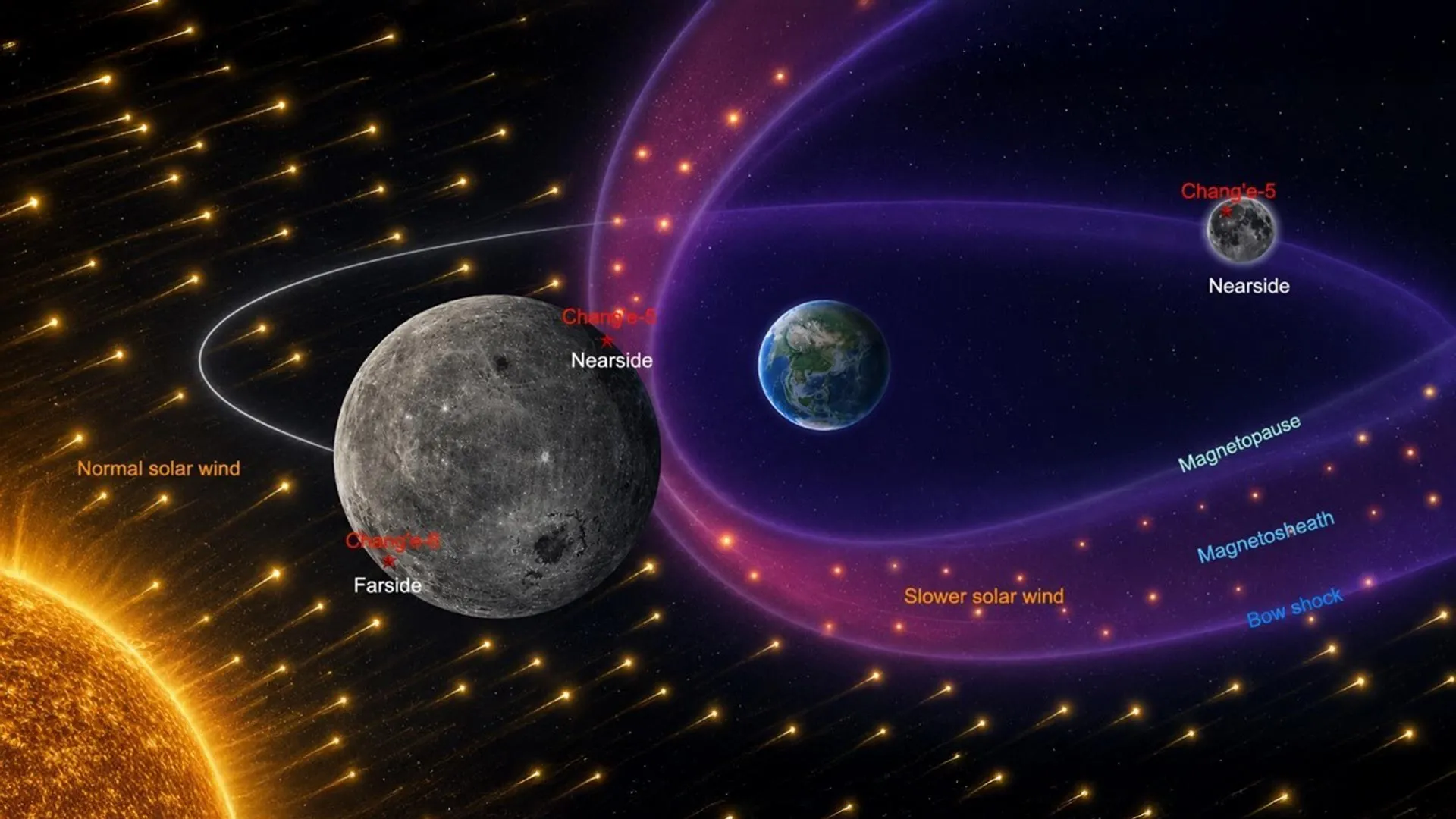
China’s Chang’e-6 mission has given scientists the first direct sample-based evidence that solar wind particles strike the Moon’s two hemispheres differently. Researchers say Earth’s magnetic environment slows particles that reach the lunar near side, while the far side records a faster and more energetic bombardment.
The findings, reported in Nature Geoscience by a team led by the Institute of Geology and Geophysics at the Chinese Academy of Sciences, are based on noble gases trapped in lunar soil. The team studied material returned from the South Pole-Aitken basin, on the Moon’s far side.
Far-side soil records a different solar wind
The solar wind is a stream of charged particles from the Sun, according to the Chinese Academy of Sciences. Because the Moon has no thick atmosphere and no global magnetic field, those particles can hit its surface and become embedded in the loose lunar regolith.
The researchers analyzed helium, neon, argon, krypton and xenon in 1.935 grams of Chang’e-6 regolith. Noble gases are useful for this work because they react weakly with other materials, allowing them to preserve a record of particle implantation in lunar soil, the academy said.
Until Chang’e-6, researchers had direct access only to near-side lunar samples. The new far-side material allowed the team to compare how solar wind particles were stored on opposite sides of the Moon.
Neon, krypton and xenon pointed to deeper impacts
The team found that neon isotopes in the Chang’e-6 samples differed from previously studied near-side material. According to the study, the far-side regolith had an average 20Ne/22Ne ratio of 11.34, with an uncertainty of 0.22, lower than values measured in near-side samples and close to theoretical expectations after strong solar wind fractionation.
The researchers interpreted that pattern as evidence that the far side underwent stronger isotopic fractionation, leaving it relatively enriched in the heavier neon isotope. Xuhang Zhang, a postdoctoral researcher at the institute, led the study under the supervision of Professor He Huaiyu, with collaborators from the University of Science and Technology of China and the Chang’e-7 volatile payload team, according to the academy.
Krypton and xenon added another line of evidence. In heating experiments, solar-wind xenon from Chang’e-6 material was released mainly at high temperatures, while Chang’e-5 near-side samples released substantial xenon at both lower and higher temperatures, the researchers reported.
The team said that difference means particles on the far side were implanted deeper in the soil. Deeper implantation generally requires higher particle energy, supporting the conclusion that the far side was exposed to faster solar wind particles.
Earth’s magnetosphere slowed particles on the near side
The researchers attributed the split to Earth’s magnetosphere. As the Moon orbits Earth, it can pass through the magnetosheath, a buffer around the magnetosphere where the solar wind slows from about 400 kilometers per second to roughly 200 kilometers per second, according to the academy.
That slower flow mainly affects the side of the Moon facing Earth. Lower-energy particles do not penetrate as far into the regolith, leaving a shallower signature in near-side soil.
The far side, which faces away from Earth, does not receive the same shielding effect, the researchers said. They estimated that about one-quarter of the solar wind exposure recorded at the Chang’e-5 site involved the slower flow, while the Chang’e-6 site showed no such protective signal.
The team also said heavy noble gases in lunar regolith could help reconstruct past interactions between the solar wind and Earth’s magnetosphere. Used with paleomagnetic evidence, the Chang’e samples may give researchers another way to study how Earth’s magnetic shield changed over long spans of time.
This story draws on original reporting from ScienceDaily.