
Chang'e-6 moon rocks point to longer asteroid bombardment
Far-side lunar samples suggest asteroid impacts faded over time, challenging the idea of one brief, violent bombardment early in solar history.
By Priya Raghavan · Science Reporter
3 min read
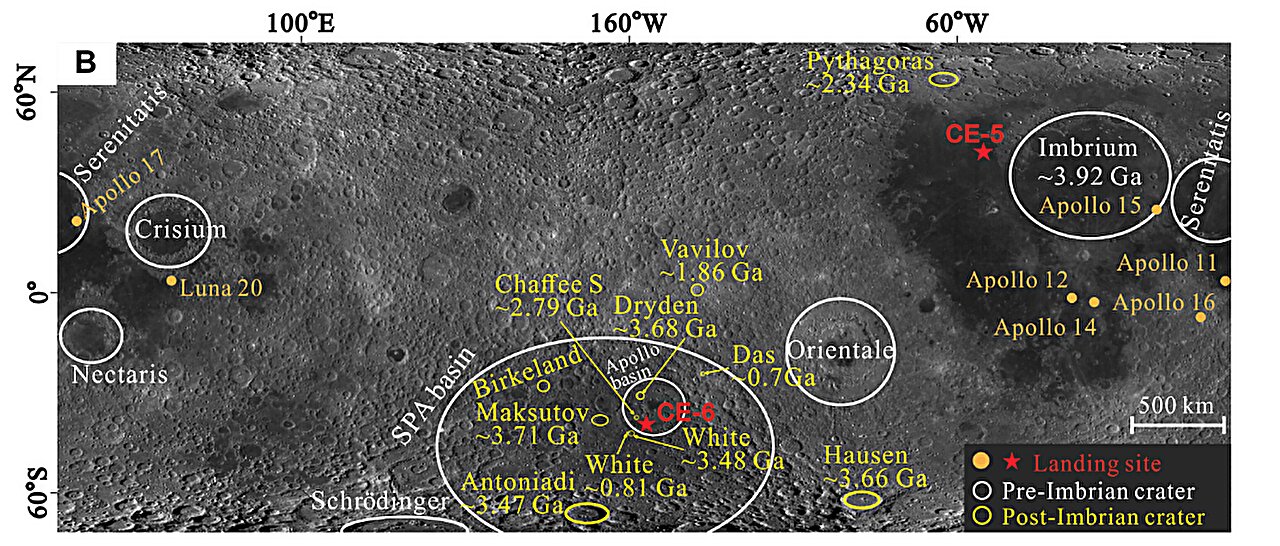
Chang'e-6 moon rocks from the lunar far side are giving scientists a new view of how asteroid impacts shaped the moon and the early solar system. A study published in Science Advances says the impact record in those samples points to a long decline in bombardment rather than one short, extreme episode.
The research used tiny pieces of impact melt rock returned by China’s Chang’e-6 mission, which Curtin University said was the first mission to bring back samples from the moon’s far side. The work was led by the State Key Laboratory of Deep Earth Processes and Resources at the Guangzhou Institute of Geochemistry, Chinese Academy of Sciences.
What did Chang'e-6 moon rocks show?
According to the study, the team identified impact events dating from about 4.33 billion to 1.13 billion years ago. That range allowed the researchers to reconstruct more than three billion years of lunar impact history from material collected on a part of the moon that had not previously been sampled directly.
The findings challenge a long-running view that the moon’s early impact history was dominated by a brief, intense spike of asteroid strikes. Curtin University said the new analysis instead supports a pattern in which impacts decreased gradually over time.
The paper, titled “The bombardment history on the lunar farside revealed by 40Ar/39Ar geochronology of Chang’e-6 impact melt rocks,” used argon geochronology to date the lunar material. The method helped the team connect the rock fragments to ancient impact events recorded in the moon’s crust.
Why the far side of the moon matters
Earth has lost much of its oldest surface record because erosion, volcanism and plate tectonics have repeatedly reworked the planet, according to Curtin University. The moon preserves a much older impact record because it lacks those same active geological processes.
Dr. Fred Jourdan, a study co-author from Curtin University’s School of Earth and Planetary Sciences and the John de Laeter Center, said lunar rocks can serve as an archive of events that occurred soon after the planets formed. He said far-side samples are especially useful because nearly all previous lunar sample knowledge came from the side facing Earth.
Jourdan said the far side offers a cleaner record of early impacts because it was less altered by later geological activity than the near side. That gives scientists a way to compare two different regions of the moon using returned rock samples for the first time, according to Curtin University.
What it says about early Earth
The moon’s impact record also matters for understanding Earth’s first environments. Jourdan said Earth and the moon share an early history, so large impacts preserved on the moon can help researchers infer conditions the young Earth may have experienced.
According to Curtin University, the work could help scientists assess how asteroid impacts affected planetary evolution and the conditions that may have influenced the emergence of life on Earth. The study arrives during a renewed period of lunar exploration, with Chang’e-6 adding the first returned material from the moon’s far side to decades of near-side samples.
The publication lists Wan-Feng Zhang and colleagues as authors. The study appears in Science Advances with DOI 10.1126/sciadv.aee8718.
This story draws on original reporting from Phys.org.