
Betelgeuse companion star imaged in strongest evidence yet
ESO astronomers say VLT images show a likely stellar partner orbiting Betelgeuse, a find that could reshape studies of the red supergiant.
By Lucas Ferreira · Science & Environment Writer
3 min read
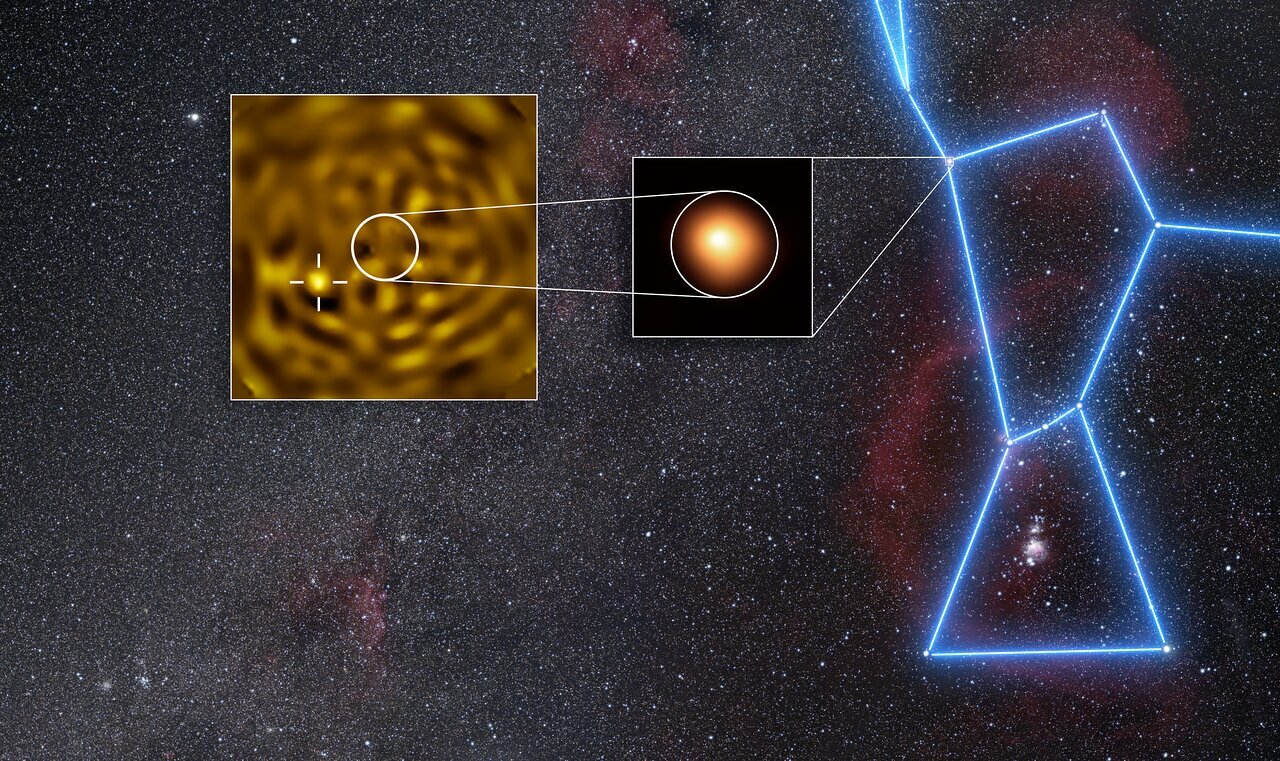
Astronomers using the European Southern Observatory’s Very Large Telescope say they have obtained the clearest image yet of a likely Betelgeuse companion star. The finding matters because Betelgeuse, the bright red supergiant in Orion, has been studied for centuries and is expected one day to explode as a supernova.
The team, led by Miguel Montargès of Observatoire de Paris-PSL, reported the result in a study published in Astronomy & Astrophysics. ESO said the object is consistent with “Betelgeuse B,” a faint star orbiting Betelgeuse.
Montargès said the work brings a long search close to an answer. Astronomers had suspected for about a century that some of Betelgeuse’s recurring brightness changes could be caused by a companion star, but previous searches had not produced evidence this strong.
Does Betelgeuse have a companion star?
ESO said the new VLT observations provide the firmest evidence so far that Betelgeuse is part of a stellar pair. Montargès said the team has shown that Betelgeuse is accompanied by a faint stellar companion, while adding that a follow-up observation is still needed to confirm it beyond remaining doubt.
The likely companion was captured with SPHERE, an instrument on ESO’s VLT in Chile’s Atacama Desert. ESO said the detection was made through direct imaging, meaning astronomers detected light from the object itself rather than inferring its presence only from effects on another star.
Anthony Boccaletti, a co-author at Observatoire de Paris, said SPHERE and advanced image-processing methods, originally developed to search for exoplanets, also proved effective for finding a companion around a massive evolved star.
Why December 2024 was the key observing window
Two studies published in 2024 predicted that the companion would appear farthest from Betelgeuse, as seen from Earth, in December of that year. That separation would make the faint object easier to distinguish from the glare of the much brighter red supergiant.
Montargès and colleagues observed Betelgeuse with the VLT in December 2024 and then spent months processing the data. ESO said the resulting image shows a source at the expected location after Betelgeuse itself was removed from the processed view.
The new observations also suggest Betelgeuse B is more massive than earlier estimates. ESO said the object appears to have about two to three times the mass of the sun, rather than being roughly solar-mass as previously thought.
What the finding could mean for Betelgeuse
Betelgeuse drew wide attention several years ago when it visibly dimmed, prompting speculation that the star might be nearing its final explosion. Montargès and other astronomers later used ESO’s VLT to show that the dimming was caused by a cloud of dust obscuring the star.
The possible identification of Betelgeuse B now gives astronomers another factor to study as they model the red supergiant’s future. Montargès said it remains an open question whether the companion will affect Betelgeuse’s evolution.
ESO said the next check will be to observe the candidate companion about a year later, when it should appear on the opposite side of Betelgeuse. Montargès said that test is needed for certainty, though he said little room for doubt remains.
This story draws on original reporting from Phys.org.