
Atypical atom natural products review maps biomedical promise
A Pusan National University-led review catalogs rare atom-bearing natural products and their possible uses in drugs and biocatalysis.
By Lucas Ferreira · Science & Environment Writer
3 min read
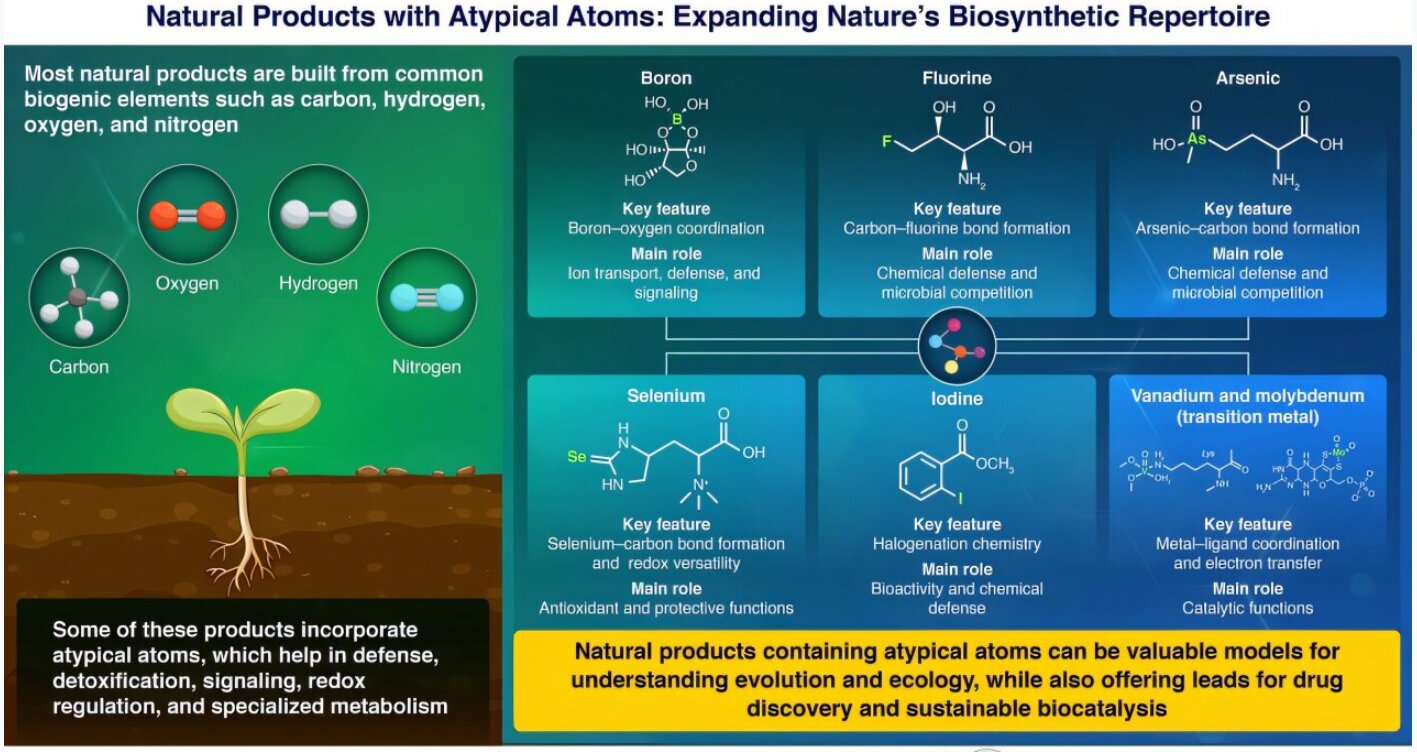
Atypical atom natural products are getting a broad new review as researchers look for chemical routes that could aid drug discovery, biocatalysis and synthetic biology. The review, led by Professor Seoung Rak Lee of Pusan National University and published in Natural Product Reports, brings together reported findings on these compounds from 1944 through 2025.
Natural products are chemicals made by organisms such as microbes, plants and marine life. According to Pusan National University, most are built mainly from carbon, hydrogen, nitrogen and oxygen, but a smaller group includes less common elements such as boron, fluorine, arsenic, selenium, iodine, vanadium and molybdenum.
The review argues that those unusual atoms can change how a molecule behaves, including its solubility in fats, metabolic stability, redox activity, ability to bind metals and biological potency. Lee said the work focuses on how organisms carry out chemical transformations that are difficult under ordinary biological conditions, with special attention to the enzymes involved.
What are atypical atom natural products?
Atypical atom natural products are naturally occurring metabolites that contain elements outside the common core atoms usually found in biomolecules. Their unusual composition can give them distinct biosynthetic pathways, biological roles and chemical reactivity, according to the review.
The compounds are rare, but the review says they appear across several biological functions. Pusan National University said they can contribute to defense, detoxification, signaling, redox control, ion transport, nutrient cycling and wider biogeochemical processes.
How do organisms add rare atoms to natural products?
The review describes several routes used by living systems to incorporate these elements. Fluorine can be added through uncommon biological carbon-fluorine bond formation, while selenium can enter molecules through selenium-carbon bond-forming pathways.
Arsenic-containing metabolites often develop through methylation involving S-adenosyl-L-methionine, followed by other chemical changes, according to the review. Boron is typically added through nonenzymatic boronate or borate complex formation, while iodine can be introduced through reactions mediated by halogenases or haloperoxidases.
The review also covers transition metals. Vanadium and molybdenum mainly act as biological cofactors, supporting processes such as nitrogen fixation, halogenation, nitrate reduction, sulfite detoxification and purine metabolism, according to Pusan National University.
Which compounds did the review highlight?
Boron-containing natural products discussed in the review include boromycin and tartrolons. Pusan National University said members of this group have been associated with antibacterial, antiparasitic, antiviral, immunomodulatory and quorum-sensing activities.
Fluorinated examples include fluoroacetate, 4-fluoro-L-threonine and nucleocidin. The review says these compounds show how rare carbon-fluorine chemistry can produce toxins and antimicrobial substances.
Arsenic-containing metabolites cover a wide range of behavior. Arsenobetaine and arsenosugars can act as relatively inert storage or detoxification forms in marine food webs, while arsenolipids and arsenicin A show stronger bioactivity or toxicity, according to the review.
Selenium-containing compounds such as selenoneine and selenocysteine are linked to antioxidant protection and redox regulation. Iodinated marine metabolites, meanwhile, are described in the review as contributors to antimicrobial and cytotoxic defense.
Why researchers see biomedical potential
The authors say the review is the first comprehensive overview of natural products with atypical atoms. They point to genome mining, metagenomics, enzymology, metalloproteomics, isotope tracing, cryo-EM and machine learning as tools that could speed discovery of additional pathways.
Lee said the findings offer a framework for finding new bioactive natural products and biosynthetic enzymes with possible uses in drug discovery, biocatalysis and synthetic biology. The study also links these mechanisms to possible environmentally friendlier fluorination and selenation strategies, as well as sustainable production of high-value chemicals.
The paper, “Natural products with atypical atoms: unveiling structures, biosynthetic pathways, and bioactivities,” was authored by Yeo Jin Lee and colleagues in Natural Product Reports. Its DOI is 10.1039/d5np00083a.
This story draws on original reporting from Phys.org.