
AT2019ijn optical transient may mark new class of cosmic blast
Astronomers say AT2019ijn’s delayed radio flare may point to a jetted tidal disruption event and a new class of optical transient.
By Tom Brennan · Health & Medicine Correspondent
3 min read
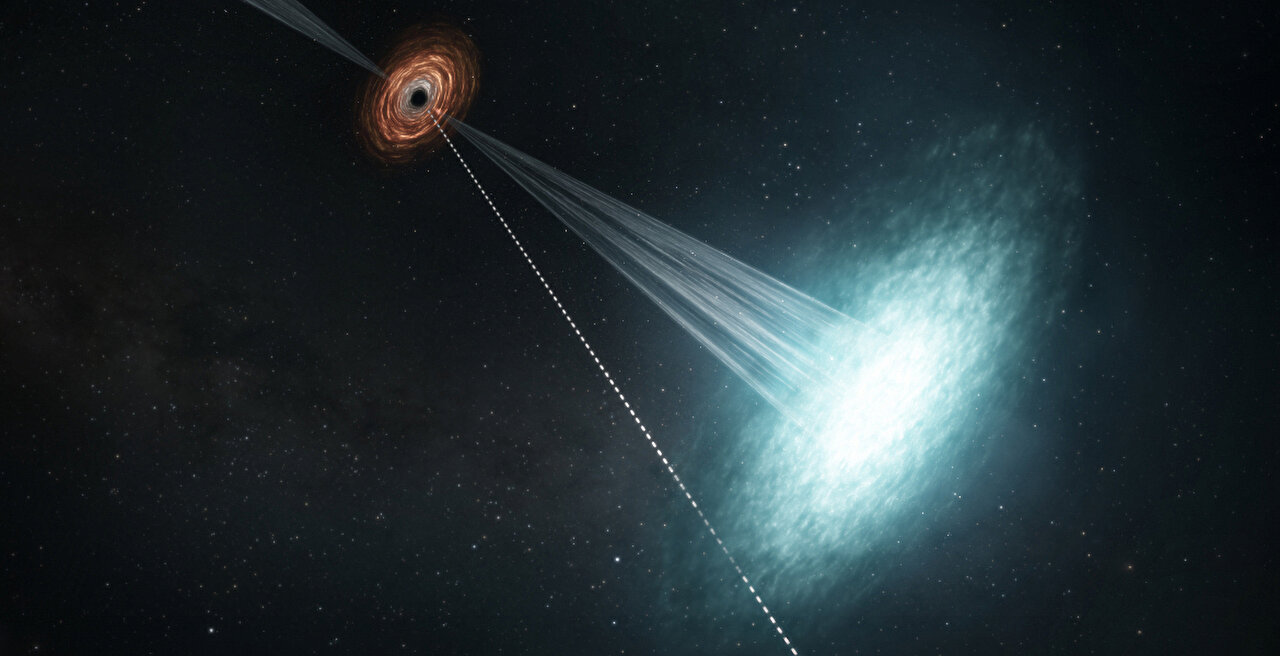
Astronomers studying the AT2019ijn optical transient say the rare blue flare may belong to a new class of cosmic explosions. In a paper published July 6 in The Astrophysical Journal Letters, Hucheng Ding of Anhui Normal University and colleagues reported that the event combined a rapid optical brightening with unusually strong, delayed radio emission.
The transient was first detected on May 31, 2019, by the Zwicky Transient Facility, according to the researchers. The event appeared in the nucleus of a dwarf galaxy at a redshift of 0.27.
Ding’s team classified AT2019ijn as a peculiar fast-evolving blue optical transient, or FBOT. These events are rare astronomical outbursts that brighten quickly, show blue colors near their peak, and then fade on short timescales.
What is the AT2019ijn optical transient?
AT2019ijn is a fast-rising, slow-fading blue optical flare observed at the center of a dwarf galaxy, according to Ding and colleagues. The team’s multiwavelength analysis found that it shares some traits with luminous FBOTs, while its radio behavior resembles events powered by jets from tidal disruption events.
In optical light, the researchers found that AT2019ijn reached a peak brightness of −21.05 magnitude in 5.26 days. They reported that it kept a blue color and then declined for more than a month, slower than typical FBOT behavior.
The paper says that slow fading makes AT2019ijn unlike ordinary luminous FBOTs and more similar in that respect to superluminous supernovae or tidal disruption events. A tidal disruption event occurs when a black hole tears apart a passing star, producing a flare as stellar material falls inward.
Why the radio signal stood out
The strongest clue came later at radio wavelengths, according to the study. The radio emission from AT2019ijn was bright and long-lived, reaching its peak 641 days after the optical discovery.
Ding and colleagues reported that the peak radio luminosity was more than 10 times higher than that of any previously known luminous FBOT or superluminous supernova. They said it was instead comparable to radio emission from jetted tidal disruption events.
The researchers proposed that the delayed radio peak could be explained by an off-axis relativistic jet. In that scenario, a jet initially points away from Earth, then becomes visible as its expanding radio afterglow spreads into our line of sight.
The team estimated the jet’s kinetic energy at 700 sexdecillion ergs. Combined with the bright optical emission, the researchers said that energy points to an active central engine powering the outburst.
What could have caused it?
Ding’s team said the findings favor a tidal disruption event as the most likely explanation. Under that interpretation, AT2019ijn would be a jetted tidal disruption event involving an intermediate-mass black hole of about 132,000 solar masses.
The authors did not fully exclude another possibility: a jetted magnetar. A magnetar is a highly magnetized neutron star that can power energetic transients, though the paper says the observed properties point more strongly toward the tidal disruption scenario.
The researchers concluded that AT2019ijn may represent a new class of relativistic optical transients. They said future statistical studies could combine optical and radio time-domain surveys to find more events with similar behavior.
This story draws on original reporting from Phys.org.