
Skyroot’s Vikram-1 reaches orbit on first flight
The Indian company’s debut orbital launch marks a milestone for the country’s private space sector.
By James Whitfield · Staff Writer
3 min read
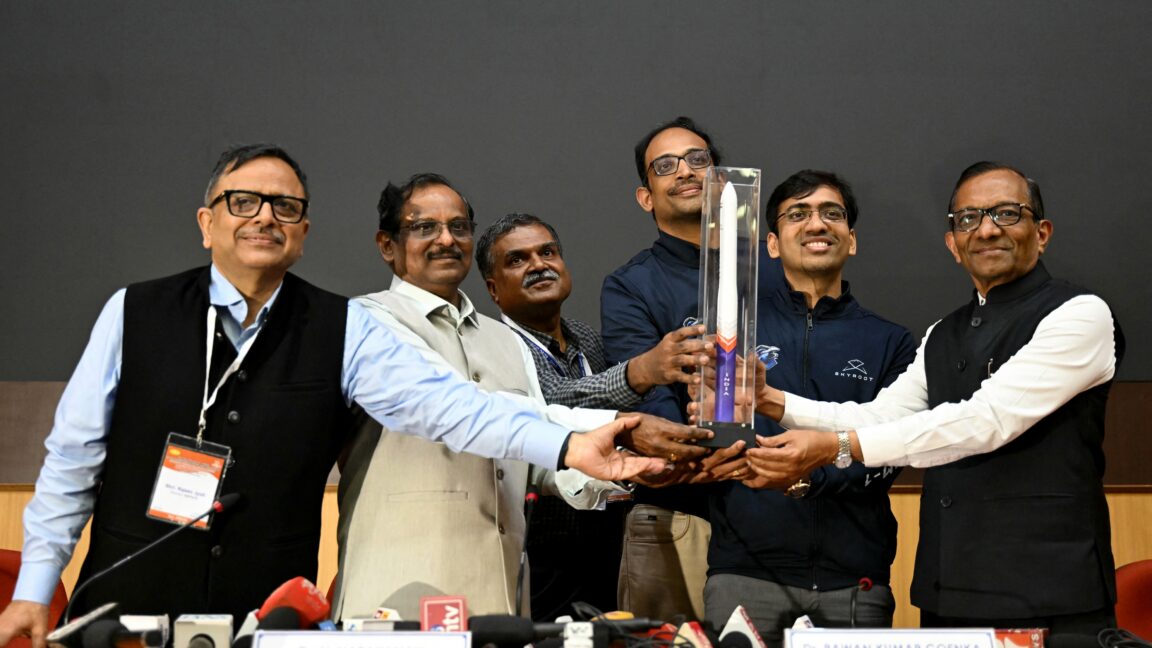
Skyroot Aerospace sent its Vikram-1 rocket into orbit Saturday on the vehicle’s first flight, giving India its first private orbital launch success. The mission advances New Delhi’s push to expand commercial spaceflight and gives small-satellite customers a new Indian-made launcher, according to company and government statements.
The rocket lifted off from the Satish Dhawan Space Center on Sriharikota Island at 06:35 UTC, after a delay of more than 30 minutes to address a late technical issue. Skyroot said the vehicle reached an orbit about 450 kilometers, or 280 miles, above Earth, at a 60-degree inclination.
U.S. military tracking data confirmed the rocket reached orbit, according to Ars Technica. Skyroot said the result was close to its prelaunch target.
A small launcher clears a major test
Vikram-1 is a 22-meter, blue-and-white rocket built from lightweight carbon composite materials. Skyroot says it can carry as much as 350 kilograms to low-Earth orbit, placing it in the market for dedicated small-satellite launches.
The flight used three solid-fueled stages before a liquid-fueled fourth stage pushed the vehicle to orbital speed. Ars Technica reported that onboard video showed the launch sequence, with the only unusual moment appearing during separation between the third and fourth stages, when the spent motor stayed close to the upper stage during a short coast.
The fourth stage still completed its burn using a 3D-printed engine, according to Skyroot. Images from the company showed the upper stage payload deck after orbital insertion; the mission deployed two small CubeSats and carried additional payloads that remained attached to the stage.
Skyroot cofounder and CEO Pawan Kumar Chandana told the launch team that reaching orbit on the first attempt was one of the biggest milestones in India’s space sector. Pawan Goenka, chairman of IN-SPACe, said the stated test goal had been to lift off and clear the launch tower, while the rocket instead flew to 450 kilometers and released the planned satellites.
Government support and private ambitions
ISRO said it supported Skyroot by giving the company access to solid motor casting and test facilities at Sriharikota and by allowing use of one of its active launch pads. The Indian space agency has been working with private companies through policy changes intended to broaden the country’s launch industry.
Prime Minister Narendra Modi congratulated the Skyroot team after the flight. In a statement, Modi called the launch a defining moment for India’s space program and said private-sector participation was opening new opportunities and speeding innovation.
Skyroot was founded in 2018 by Chandana, a former ISRO engineer, and Naga Bharath Daka, another former ISRO scientist. The company previously flew the suborbital Vikram-S rocket to nearly 90 kilometers in November 2022, and Vikram-1 draws on that earlier work.
The company’s plan includes a Vikram-1U variant with strap-on solid boosters and a Vikram-2 rocket with a cryogenic upper stage that would raise low-Earth-orbit capacity to 900 kilograms, according to Skyroot materials cited by Ars Technica. Chandana has also described longer-term plans for larger liquid-fueled reusable rockets.
Ars Technica reported that Skyroot has raised about $160 million, is valued at $1.1 billion and has more than 1,000 employees, mostly in Hyderabad. Chandana said a second Vikram-1 launch could take place before the end of the year.
This story draws on original reporting from Ars Technica.