
NASA Madrid wildfire forces Deep Space Network evacuation
NASA evacuated its Madrid Deep Space Communications Complex as wildfires spread west of the city, shifting spacecraft support to California.
By James Whitfield · Staff Writer
3 min read
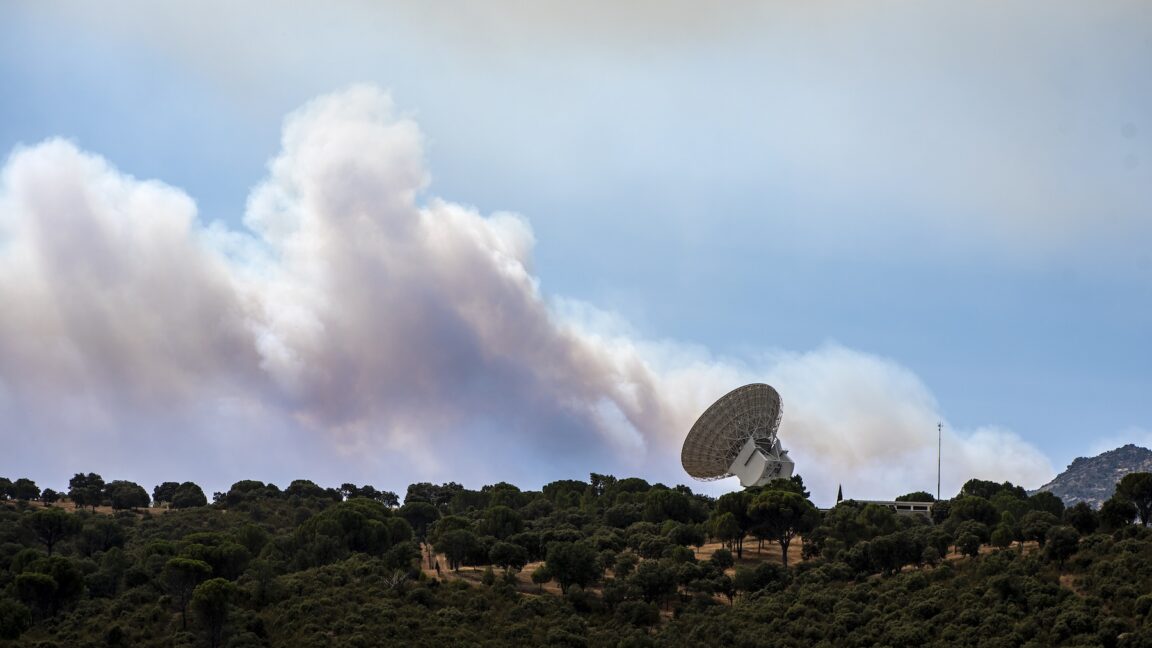
A NASA Madrid wildfire threat forced the evacuation of the agency’s Deep Space Network complex in Spain on Friday, briefly taking one of its key spacecraft tracking sites out of service. NASA said it moved mission support to its Goldstone complex in California to keep communications with spacecraft running.
The Madrid Deep Space Communications Complex sits in hills nearly 40 miles, or 65 kilometers, west of central Madrid. NASA said it was watching the fires with local authorities and the U.S. Embassy, and that any damage to the site would be checked once crews can safely return.
Images and video from the area showed smoke and flames near the antenna field, according to reports from the scene. The site includes a 230-foot, or 70-meter, radio dish and several smaller 112-foot, or 34-meter, antennas.
What is NASA's Deep Space Network?
NASA’s Deep Space Network is the set of large radio antenna complexes the agency uses to send commands to, and receive data from, spacecraft far from Earth. NASA operates the network through three sites in Spain, California and Australia so at least one region can see a spacecraft as Earth rotates.
The network supports more than 40 missions, according to NASA, ranging from lunar programs to probes near the edge of the Solar System. Those missions include Artemis, the James Webb Space Telescope and the two Voyager spacecraft.
NASA typically runs the network on a “follow the Sun” system, with each site’s control center able to operate the full network during its daytime hours. The antennas themselves are used around the clock, NASA says.
A NASA status page showed no activity at the Madrid site on Friday afternoon, while the California and Australia complexes were communicating with spacecraft including Voyager 2 and Juno. Voyager 2 is in interstellar space, and Juno is studying Jupiter.
A nearby deep-space tracking station operated by Spain and the European Space Agency was also evacuated because of the fires, Spanish news reports said. The Cebreros station, part of ESA’s Estrack network, is located a few miles from NASA’s Madrid complex.
Reuters reported that Spanish authorities ordered more than 19,000 people to leave towns in the mountains west of Madrid. More than 2,000 responders and 10 aircraft were sent to fight the fires, Reuters said, as a summer heat wave and long-running drought worsened wildfire conditions in Spain and France.
The Madrid shutdown adds pressure to a network that already has limited capacity for its largest dishes. With Madrid unavailable, NASA has one operating 70-meter Deep Space Network antenna, located in Australia.
The 70-meter antenna at Goldstone in California has been offline since last year after an accident over-rotated the structure, damaging cables and water lines, according to NASA officials. The base was flooded with 200,000 gallons of water containing glycol, creating an environmental cleanup issue.
NASA officials have projected cleanup and repair costs at $4.1 million to $4.6 million and are pairing that work with planned upgrades. The California antenna is expected to stay offline into 2028.
NASA’s next Artemis flight to the Moon is still at least a couple of years away, easing some near-term demand on the network. Artemis missions require added telemetry and image downlink capacity for human spaceflight; Artemis III is now planned as a low-Earth orbit test involving Orion and commercial Moon landers from SpaceX and Blue Origin, while Artemis IV is targeted for no earlier than 2028 as the program’s first planned astronaut lunar landing.
This story draws on original reporting from Ars Technica.