
Mission Robotic Vehicle launch sends satellite servicer toward GEO
Northrop Grumman’s robotic servicer launched on Falcon 9 for a decade-long mission to extend and service satellites in geosynchronous orbit.
By James Whitfield · Staff Writer
4 min read
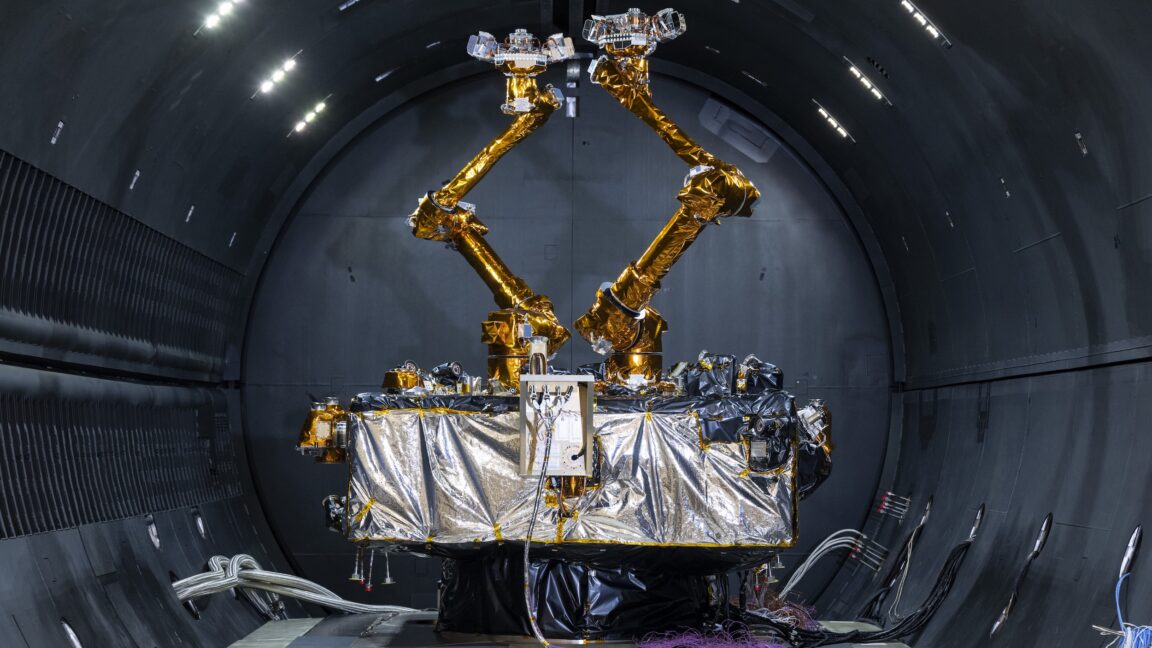
Northrop Grumman’s Mission Robotic Vehicle launch has put a two-armed satellite servicer on a yearlong trip toward geosynchronous orbit. The mission could give the United States a new commercial and military-relevant tool for extending, inspecting and repairing high-value satellites far above Earth.
SpaceX launched the spacecraft Tuesday on a Falcon 9 rocket from Cape Canaveral Space Force Station in Florida, according to Northrop Grumman and SpaceX mission materials. The rocket also carried three Mission Extension Pods, small propulsion units designed to be installed later on client satellites.
SpaceX deployed all four payloads within about an hour of liftoff. The spacecraft must now raise themselves from an elliptical transfer orbit to a circular path more than 22,000 miles, or nearly 36,000 kilometers, above the equator, where they will move at the same rate Earth rotates.
What is the Mission Robotic Vehicle?
The Mission Robotic Vehicle, or MRV, is a Northrop Grumman satellite-servicing spacecraft built to work in geosynchronous orbit. Its main feature is a DARPA-funded robotic payload with two arms, cameras and sensors that allow it to approach, inspect, capture and modify satellites that were not built for servicing.
DARPA spent about $420 million developing the robotics system, while Northrop Grumman invested hundreds of millions of dollars in the broader commercial servicing program, according to Ars Technica. The Naval Research Laboratory developed the Robotic Servicing of Geosynchronous Satellites payload with DARPA, and NASA’s Goddard Space Flight Center later contributed engineering support after NASA canceled its own robotic servicing mission in 2024.
Bernard Kelm, acting director of NRL’s Naval Center for Space Technology, said in an NRL statement that the work grew out of DARPA-funded space robotics studies dating to 2002. Kelm said the RSGS program is meant to move satellites away from a model in which spacecraft are launched and then left without later intervention.
How the satellite servicing mission will work
The three Mission Extension Pods are flying separately to geosynchronous orbit using electric propulsion, according to Northrop Grumman’s mission plan. Each pod is roughly dishwasher-sized and will wait until the MRV retrieves it with its robotic arms.
After grabbing a pod, the MRV is expected to meet a client satellite and attach the pod in its engine compartment. Northrop Grumman says the pod can then provide propulsion for up to eight years, helping keep the client satellite in its assigned orbital slot or moving it as needed.
Jim Shoemaker, DARPA’s RSGS program manager, told Ars Technica that ground crews cannot fly the robotic operation by joystick because of communications delay. He said the spacecraft must run uploaded scripts or execute parts of the job autonomously.
Shoemaker also said the two-arm design gives the system more capability and some redundancy compared with DARPA’s 2007 Orbital Express demonstration, which used one arm in low-Earth orbit. The MRV’s tools include pod-capture hardware and Marman ring tools that can let the servicer directly grab a client spacecraft if needed.
Why the mission has military interest
Geosynchronous orbit contains major civilian communications satellites, military communications platforms, missile-warning spacecraft and intelligence satellites. Those spacecraft are often costly and less numerous than satellites in low-Earth orbit, making repair, relocation and life extension attractive to the Pentagon and commercial operators.
China has already demonstrated related work in geosynchronous orbit. U.S. Space Command chief Gen. Stephen Whiting told Congress last year that China was developing maneuverable on-orbit systems that could use dual-use technologies against U.S. satellites, and he cited China’s SJ-21 mission as an example, according to the congressional testimony described by Ars Technica.
Northrop Grumman and SpaceLogistics have not named the MRV’s first customer. The companies have agreements with SES and Optus for pod installations, and the U.S. Space Force is also expected to use the spacecraft to visit at least one government satellite.
Northrop Grumman took ownership of the government-funded robotics payload at launch, but DARPA will receive performance data through the first servicing demonstration, according to Shoemaker. After that, the Space Force is expected to become the government partner while Northrop Grumman keeps owning and operating the spacecraft.
This story draws on original reporting from Ars Technica.