
Claude voice mode adds Opus and Sonnet for harder tasks
Anthropic is bringing voice mode to Claude’s Opus and Sonnet models and expanding it to apps including Gmail, Slack and Canva.
By Maya Lindqvist · Senior Technology Correspondent
3 min read
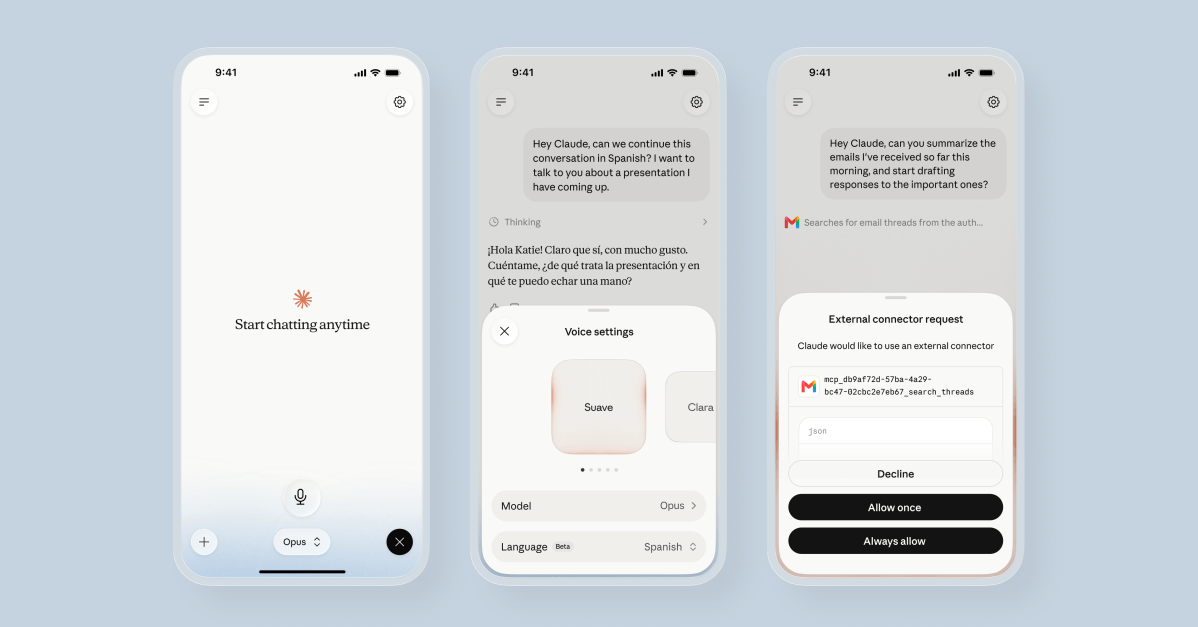
Anthropic is adding Claude voice mode to Opus and Sonnet, giving users spoken access to its more capable models after limiting the feature to Haiku. The change matters because Anthropic says people have been using voice conversations for more involved work than Haiku was built to handle.
The company is also extending voice mode into apps including Gmail, Slack and Canva, according to The Verge. Anthropic described the move as a way for Claude to do more than answer spoken questions, including taking follow-up actions connected to a user’s work.
What can Claude voice mode do with Opus and Sonnet?
Voice mode lets users talk with Claude rather than type, then continue the same exchange by text if they choose. With Opus and Sonnet available, Anthropic says the feature can support more complex reasoning and problem-solving than the faster Haiku model.
Anthropic said voice mode was introduced earlier this year with an emphasis on quick responses and low delay. After launch, the company said users began applying it to business tasks and longer work discussions, not just short questions.
Haiku remains Anthropic’s faster, lighter model, according to the company. Opus and Sonnet are positioned for more difficult work, and Anthropic says they can produce more developed responses and analysis.
How app access changes voice conversations
Anthropic said the expanded app access could allow Claude to turn a spoken discussion into a one-page pitch. The company also gave the example of Claude adjusting calendar appointments if a user’s train is delayed.
The Verge reported that Gmail, Slack and Canva are among the apps included in the expansion. Anthropic did not give additional implementation details in the reported announcement, such as which users will receive access first or what permissions each app connection will require.
Users will also be able to change how they interact with Claude during the same conversation, according to Anthropic. A person can move between voice and text, and can switch models mid-chat, such as starting with Haiku and then moving to Opus for a more involved discussion.
Which languages support Claude voice mode now?
Anthropic is broadening voice mode beyond English. The company says the feature is now available in French, German, Spanish, Hindi, Indonesian, Italian, Japanese, Korean and Portuguese.
Before this update, Anthropic offered non-English voice mode in beta, according to The Verge. The wider language support gives Claude’s voice feature a broader reach as Anthropic tries to make spoken AI interactions useful for work rather than only quick exchanges.
The update also shows how Anthropic is separating Claude’s models by task. Haiku can still serve short, fast conversations, while Opus and Sonnet give voice users access to models Anthropic says are better suited to hard problem-solving.
This story draws on original reporting from The Verge.