
School laptop bans grow as districts rethink classroom Chromebooks
Districts in Kansas, North Carolina and Michigan are cutting classroom screen time after distraction, cost and test-score concerns.
By Hana Yoshida · Markets Reporter
3 min read
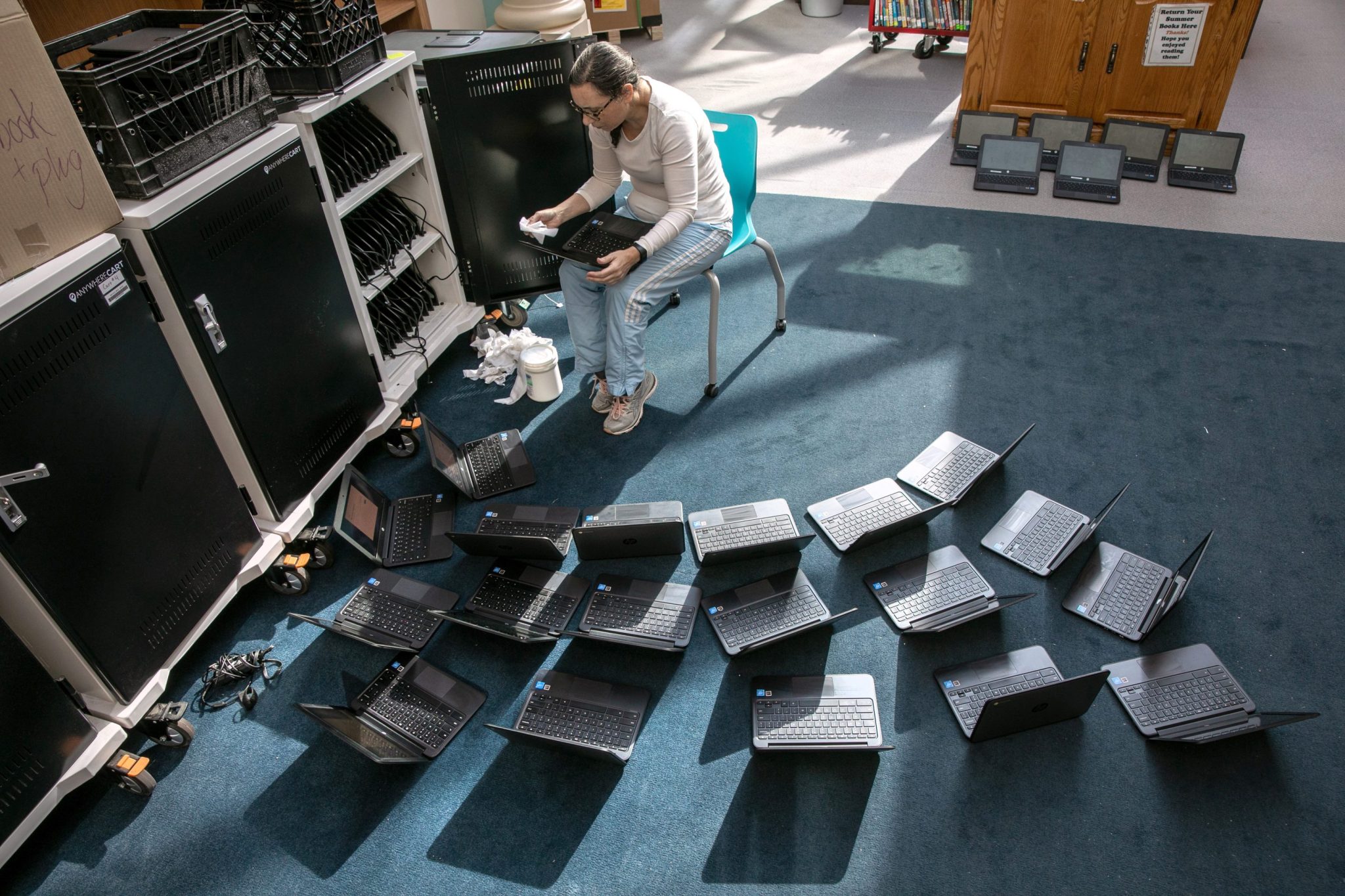
School laptop bans are expanding in some U.S. districts as educators reconsider years of giving every student a device. Reports from the New York Times, NPR and local outlets show schools citing distraction, replacement costs and weak academic results as reasons to reduce screen time.
McPherson Middle School in central Kansas is one example. The New York Times reported that the school, which enrolls 480 students, barred cell phones four years ago but kept school-issued Google Chromebooks in daily use until last December.
Administrators later found that some students were using the laptops for YouTube, games and teasing classmates through school Gmail accounts, according to the Times. McPherson now keeps laptops in classroom carts and uses them only for teacher-directed tasks; students otherwise take notes with paper and pen.
Principal Inge Esping told the Times the devices still have a place in school, but should not be treated as a complete education strategy. Students who need a device for extra work at home can borrow one from the school library, the Times reported.
Why are schools limiting Chromebooks?
Districts are limiting Chromebooks because some educators say constant access creates distractions and has not produced the academic gains promised by technology programs. A one-to-one laptop policy means each student is assigned a device, often for use both in class and at home.
Several states and districts are reassessing those programs after heavy spending on student devices. NPR reported in 2017 that Maine, an early adopter of public-school laptops in 2002, did not see improved test scores after 15 years of its laptop initiative.
Jared Cooney Horvath, a neuroscientist and former teacher, told the U.S. Senate Committee on Commerce, Science and Transportation in written testimony that math and science scores have fallen as classroom technology use has increased. Citing the Trends in International Mathematics and Science Study, Horvath said frequent in-class computer use was associated with lower math and science performance in both high-income and middle-income countries.
The same testimony said fourth- and eighth-grade students who used laptops almost daily tended to score lower than students who almost never used them. The cited evidence describes a correlation, not proof that laptops alone caused the decline.
Google Chromebooks became common in schools partly because they are relatively inexpensive, with devices averaging $300 to $400, and because ChromeOS relies on web tools such as Google Docs rather than installed software such as Microsoft Office, according to the reporting. CommandLinux statistics cited for 2025 put education at 60% of global Chromebook market share and the Chromebook market at $14 billion.
What are districts doing instead?
In North Carolina, schools spent $448 million in pandemic-related federal money on computers and equipment for students and staff, WRAL reported. After that funding ended, districts faced trouble replacing broken or outdated devices, and Robert Taylor, superintendent of Wake County’s school system, said in a 2025 committee meeting that the district needed to move away from one-to-one laptop access, according to Carolina Public Press.
Burke County Public Schools in western North Carolina has also moved toward paper-based instruction. Carolina Public Press reported that the school board approved a resolution encouraging printed materials and limiting screen use to activities with clear, evidence-based instructional benefits.
By February, parents and educators in Burke County reported better reading comprehension, higher test scores and less homework-related stress, according to local reporting cited by Carolina Public Press. In Michigan’s Wexford County, Interlochen Public Radio reported that one district banned screens for elementary students after reading-proficiency concerns, including state test results showing more than 65% of third-, fourth- and fifth-graders at one elementary school were not proficient or only partially proficient.
This story draws on original reporting from Fortune.