
Hadi Matar terrorism trial hears Rushdie describe 2022 stabbing
Salman Rushdie testified in Buffalo as federal prosecutors seek to prove Hadi Matar attacked him as an act of terrorism.
By Hana Yoshida · Markets Reporter
3 min read
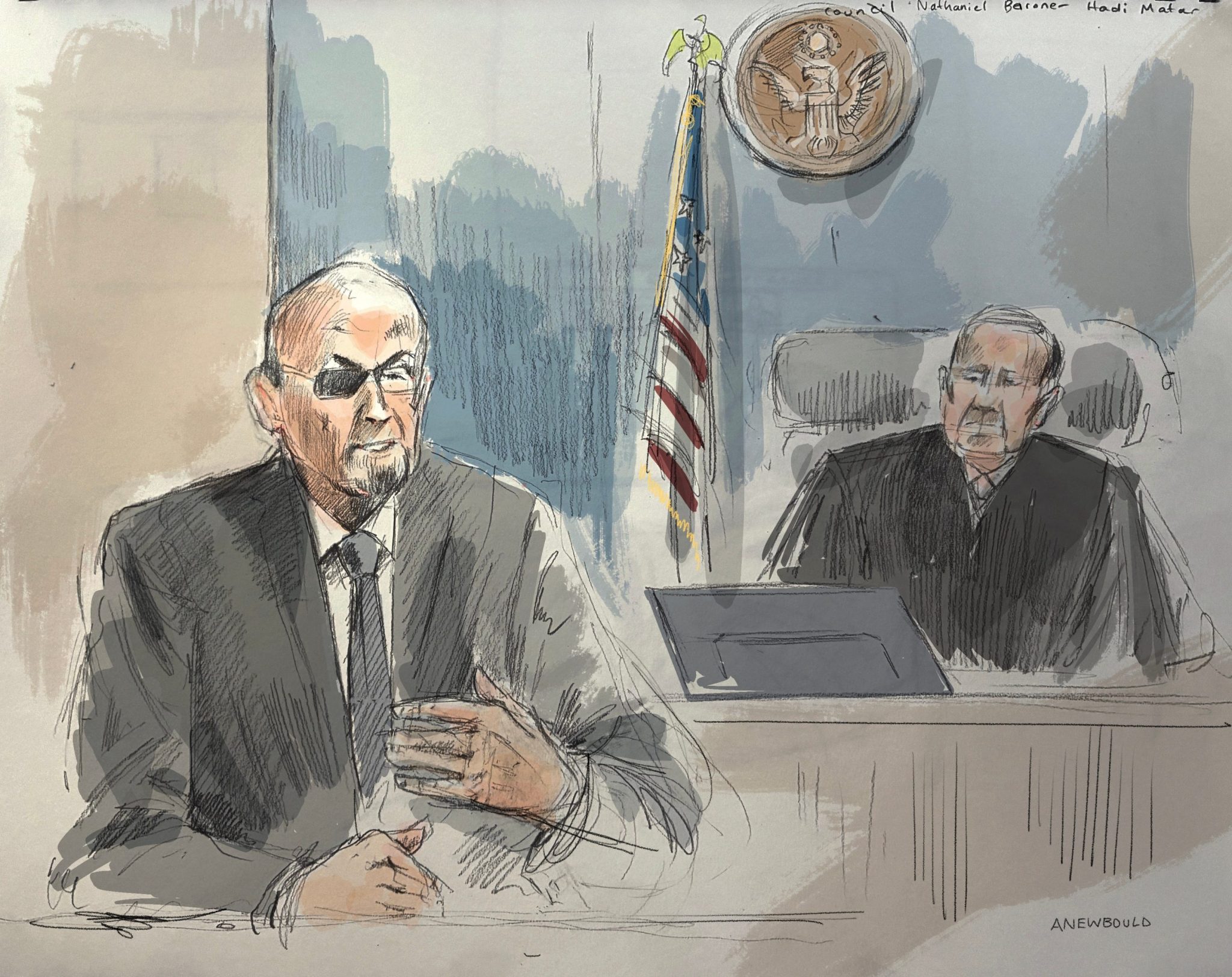
The Hadi Matar terrorism trial turned Thursday to testimony from Salman Rushdie, who described for a federal jury in Buffalo the 2022 stage attack that left him gravely wounded. The testimony matters because prosecutors are trying to prove Matar’s already-prosecuted assault was also a terrorism offense tied to the long-running threat against Rushdie over “The Satanic Verses.”
Rushdie, 79, faced Matar in court for a second time and recounted the moment he was attacked at the Chautauqua Institution, where he had been scheduled to speak about risks faced by writers and artists. He said he first felt what seemed like a blow beneath his chin, then realized blood was coming from his neck.
“I was on the stage, lying down, with an enormous pool of blood all around me,” Rushdie testified, describing it as “an enormous and expansive lake of blood.” He also removed his glasses at one point to show jurors his right eye, which was blinded in the attack.
Why is Hadi Matar on trial again?
Matar was convicted in state court of attempted murder and is serving a 25-year prison sentence, according to court proceedings described by The Associated Press. The federal case is separate: prosecutors say the stabbing was an act of transnational terrorism, and Matar could face life in prison if convicted.
Matar has pleaded not guilty. His lawyer, Nathaniel Barone, has argued that the government cannot prove what Matar intended or believed at the moment of the attack, a central issue in the federal case.
Rushdie told jurors that the knife wounds were spread across his body and said one strike came extremely close to his brain. The attack also damaged his liver, temporarily paralyzed his left hand and put him on a ventilator for a period, according to AP reporting and court testimony.
Witnesses at the 2022 event have said Matar got onto the stage, approached Rushdie from behind and stabbed or slashed him 15 times as people in the audience reacted. Another speaker, Henry Reese, and others helped Rushdie and restrained Matar before law enforcement officers assigned to the event arrested him.
Federal prosecutors have linked the case to the 1989 fatwa issued by Iran’s late Ayatollah Ruhollah Khomeini, who called for Rushdie’s death after publication of “The Satanic Verses.” The novel, which includes a dream sequence involving Islam’s Prophet Muhammad, was condemned by some Muslims as blasphemous and led to years of threats against Rushdie.
Assistant U.S. Attorney Timothy Lynch said in an opening statement that Matar began researching Rushdie in 2020 and wrote to himself, “We need to kill him ASAP.” Lynch also said Matar framed the killing as part of what he viewed as jihad and possessed material showing admiration for Hezbollah, which the U.S. government designates as a terrorist organization.
Prosecutors also cited past remarks about Rushdie and the fatwa by Hassan Nasrallah, the late Hezbollah leader. Matar was born in the United States and also holds Lebanese citizenship; his mother has said that after a 2018 trip to Lebanon, he became withdrawn and moody.
Barone questioned Rushdie about whether he expected a backlash to “The Satanic Verses.” Rushdie answered that he probably did, then added that he did not think the book was on trial; at Barone’s request, the judge ordered that comment removed from the court transcript.
Asked by Barone whether he knew Matar had terrorism ties, Rushdie said he had no knowledge, though he had suspicions. Barone said outside court that Matar, who did not testify during his state trial, may take the stand in the federal case.
Iran’s government denied involvement in the stabbing, while its Foreign Ministry’s then-spokesperson suggested Rushdie had brought trouble on himself by insulting Islam, according to AP. Nasrallah did not comment on the attack.
This story draws on original reporting from Fortune.