
X-ray echoes push Milky Way’s outer arms farther out
Researchers used X-ray rings from three gamma-ray bursts to place two outer Milky Way arms up to 10% farther away than earlier estimates.
By Lucas Ferreira · Science & Environment Writer
3 min read
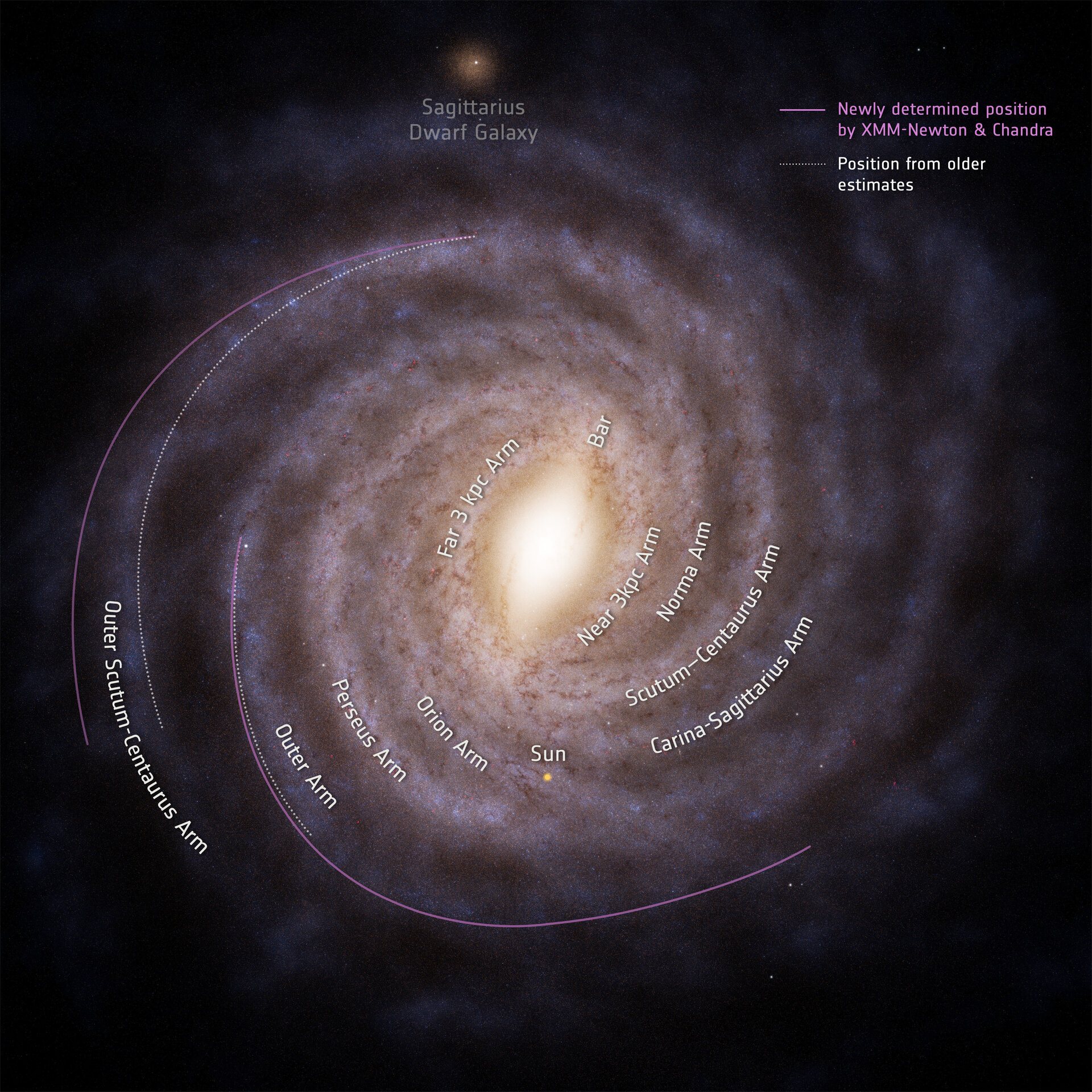
Two outer spiral arms of the Milky Way may sit farther from Earth than previous maps showed, according to research using ESA’s XMM-Newton and NASA’s Chandra X-ray observatories. The result refines astronomers’ picture of the galaxy’s outskirts, a region that remains hard to chart from the solar system’s position inside the galactic disk.
The European Space Agency said the work used X-ray echoes from three gamma-ray bursts, brief bright explosions in distant galaxies, to measure dust clouds in the Milky Way’s outer arms. The study, led by Beatrice Vaia of Italy’s Istituto Nazionale di Astrofisica, was published in Astronomy & Astrophysics.
Echoes from distant explosions
According to ESA, X-rays from the gamma-ray bursts traveled through the Milky Way and scattered off dust grains in spiral-arm clouds. That scattering produced expanding rings of X-ray light seen by XMM-Newton, Chandra or both.
Vaia’s team studied how the rings grew over time to calculate the distance to the dust that scattered the light, ESA said. Because those dust clouds lie within spiral arms, the measurements gave the researchers a direct way to estimate the arms’ locations.
The researchers used observations tied to GRB 221009A, detected in 2022; GRB 160623A, detected in 2016; and GRB 031203, detected in 2003. ESA said the ring-shaped echoes were observed between December 2003 and November 2022.
The analysis confirmed the established distance to the Perseus arm, according to ESA. It also placed the Outer Scutum-Centaurus Arm and the Outer Arm up to 10% farther away than earlier estimates.
Why the Milky Way is difficult to map
Astronomers have long faced a basic problem in mapping the Milky Way: Earth sits inside the galaxy, embedded in its disk, and dust blocks views toward many regions. ESA said models of the outer arms have often relied on indirect information from the galaxy’s rotation, a method that can leave room for error.
ESA’s Gaia mission has greatly improved the map of the Milky Way by measuring star positions and distances. ESA said Gaia data helped settle that the galaxy has four spiral arms, after earlier uncertainty over whether it had two or four.
Gaia’s distance measurements are less precise in the far outer arms, ESA said. The X-ray echo method used by XMM-Newton and Chandra is described by the agency as highly accurate at longer distances, making it useful for checking and revising the outer-galaxy map.
Older missions, new measurements
Erik Kuulkers, ESA’s XMM-Newton project scientist, said the finding shows that long-running observatories can still play a major role in astronomy. XMM-Newton launched in 1999 and is now in its third decade of operations.
ESA said future Milky Way mapping will also draw on Gaia’s fourth data release, planned for December 2026, and a fifth release planned after the end of 2030. The agency said its planned NewAthena X-ray observatory is expected to help scientists study fainter X-ray echoes in the galaxy’s outskirts.
The paper is titled “Accurate distances of the Galactic spiral arms from dust-scattered X-ray emission of gamma-ray bursts.” ESA identified B. Vaia and colleagues as the authors and listed the DOI as 10.1051/0004-6361/202557431.
This story draws on original reporting from Phys.org.