
Mars dust storms could create electrical risks for missions
A UAH study says the 2018 global dust storm may have produced local conditions where strong electric fields could develop near the Martian surface.
By Lucas Ferreira · Science & Environment Writer
3 min read
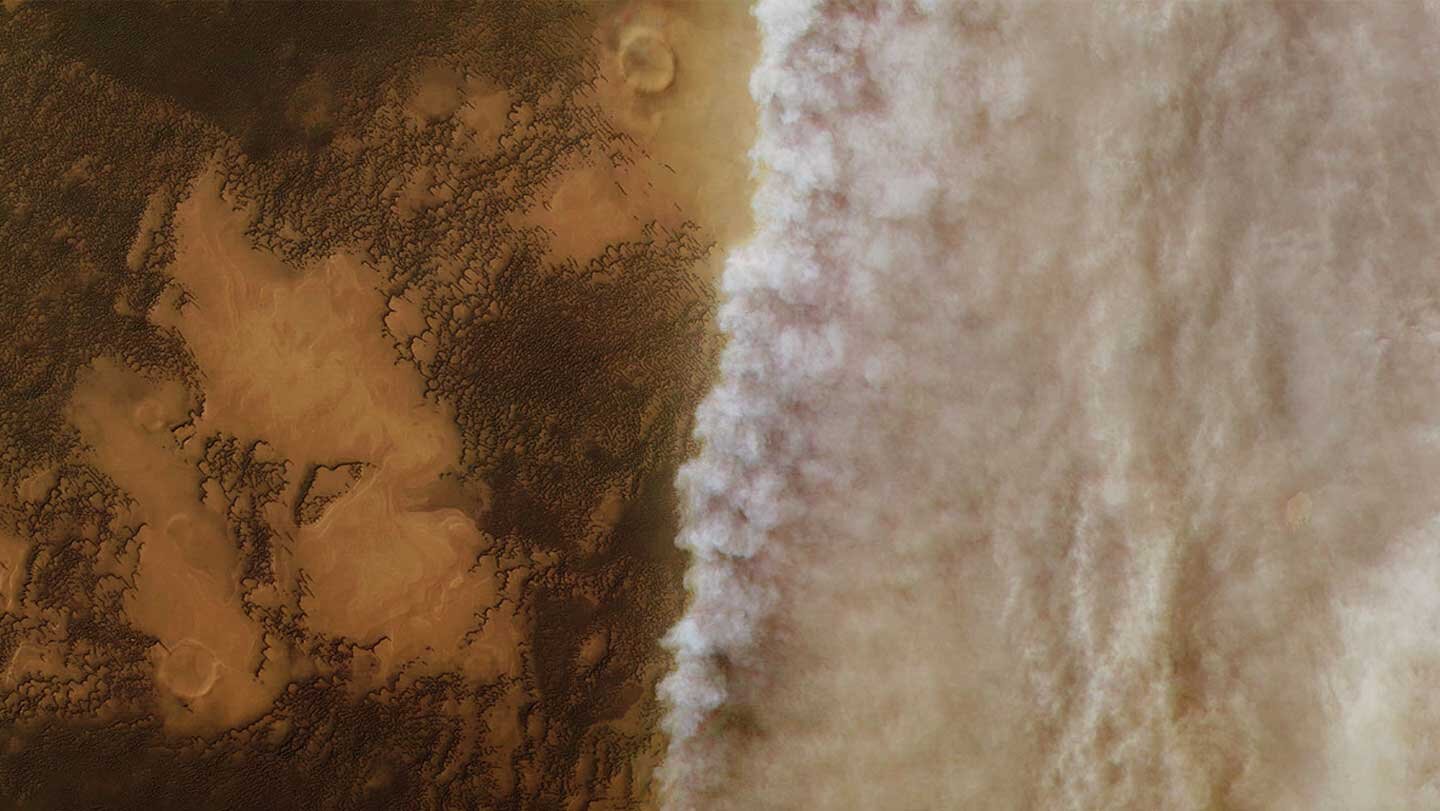
Global dust storms on Mars may create pockets of atmosphere where electrical charge can build, a finding that could affect how future missions protect hardware on the surface. A study led by Chali Idosa Uga, a doctoral researcher at The University of Alabama in Huntsville, says those conditions could increase the chance of electrostatic discharges that interfere with electronics or exposed instruments.
The research, published in The Planetary Science Journal, examined the Martian Year 34 global dust storm, the planet-wide event seen in 2018. According to UAH, that storm is among the best observed on Mars because several orbiters and rovers tracked it at the same time.
Uga studied whether a storm of that scale could shape the lower Martian atmosphere in ways that allow electric fields to approach levels favorable for breakdown, the point at which a discharge such as a spark could occur. UAH said the work was advised by Gary Zank, director of the UAH Center for Space Plasma and Aeronomic Research, and Dennis Gallagher of NASA Marshall Space Flight Center.
Dust as an electrical environment
Mars does not have Earth-like thunderstorms, Uga said in UAH’s account of the work. Its thin carbon dioxide atmosphere can still carry dust during intense storms, and collisions among grains may separate charge while the weak conductivity of the atmosphere allows some of that charge to remain.
The study does not report the detection of lightning on Mars. Uga framed the question more narrowly: where and when a global storm can create the atmospheric setup needed for strong electric fields and possible electrical breakdown.
UAH said the modeled results showed localized, altitude-dependent regions in the lower atmosphere during the 2018 storm where charge separation could persist. Uga said the study does not calculate risk for any specific spacecraft, habitat, instrument or communications system.
Even without a vehicle-specific risk estimate, the findings point to a hazard category mission planners may need to consider. UAH said electrostatic discharges could cause arcing between conductive surfaces, disrupt electronics, or damage exposed spacecraft systems and scientific instruments.
Chemistry and surface operations
The research also has implications for how scientists interpret the chemistry of the Martian near-surface atmosphere. Uga said electrical breakdown, if it occurs in such regions, could change local reactions in the dusty carbon dioxide air.
According to UAH, that matters for studies of oxidants, perchlorate-related chemistry and the preservation of organic molecules, all of which are tied to assessments of Martian habitability. The study does not claim that the modeled electrical conditions prove any specific chemical change occurred during the 2018 storm.
Uga also said charged dust may affect how material settles on or sticks to mission hardware. Under intense storm conditions, dust could act as part of the electrical environment near the surface, with possible effects on dust adhesion, deposition on sensitive surfaces, instrument stability and charge accumulation, according to UAH.
Next tests
UAH said Uga’s findings received an honorable mention this month at the National Science Foundation’s 2026 Coupling, Energetics and Dynamics of Atmospheric Regions conference in Des Moines, Iowa. The meeting brings together researchers who study Earth’s upper atmosphere and its interactions with space weather.
Uga said the next step is to compare model predictions with laboratory experiments, better atmospheric-electrical models and future Mars measurements. The study describes a framework linking dust loading, atmospheric structure, turbulence, conductivity, charge relaxation and breakdown-favorable conditions during a global dust storm.
The paper is titled “Turbulence-coupled Electrodynamics of the Martian Year 34 Global Dust Storm on Mars.” UAH identified Chali Idosa Uga and colleagues as the authors.
This story draws on original reporting from Phys.org.