
Asian mammal fossils point to size-first recovery after dinosaur extinction
A study in eLife says early Asian placental mammals grew larger before their teeth became more specialized for varied diets.
By Lucas Ferreira · Science & Environment Writer
3 min read
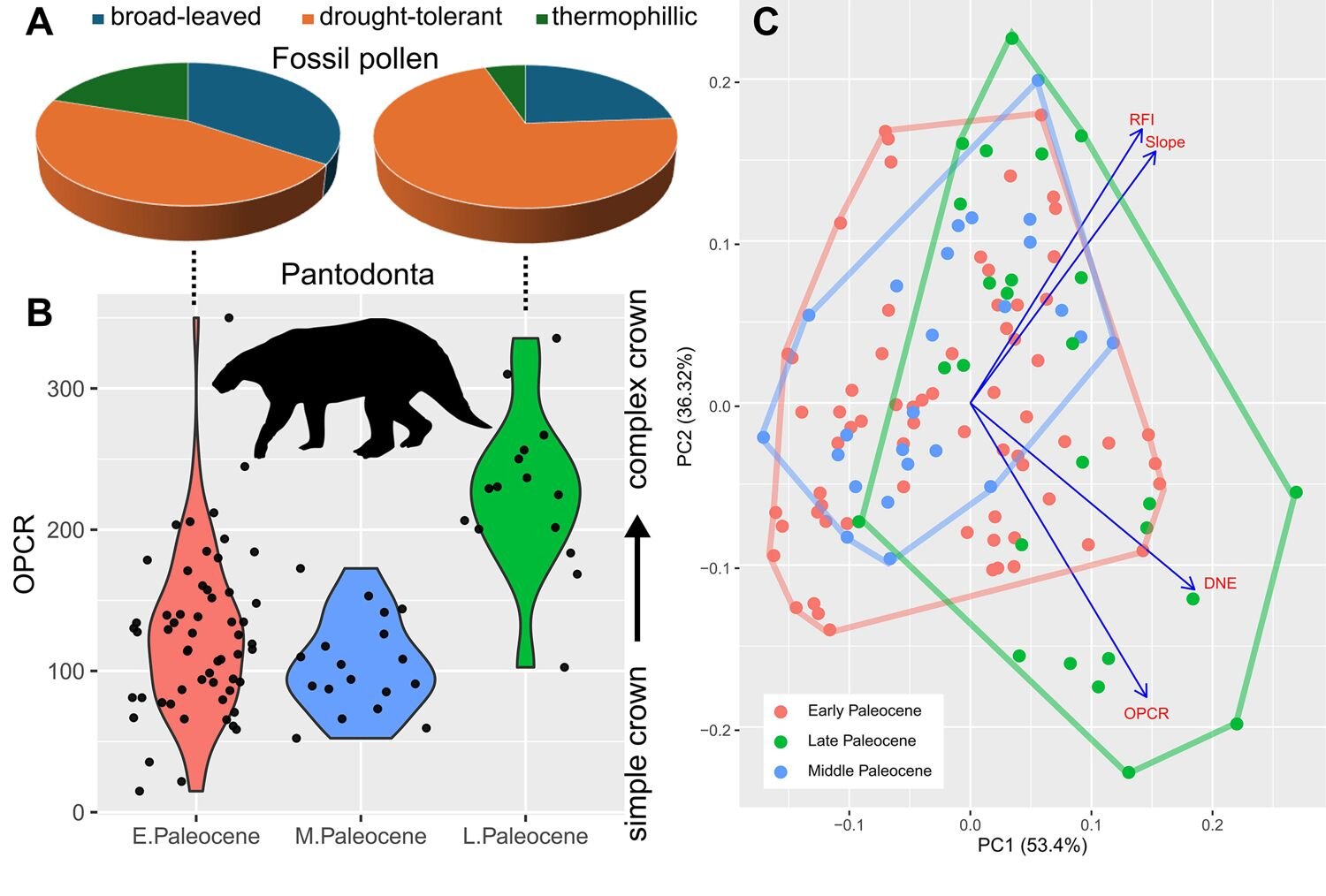
Early placental mammals in Asia appear to have expanded first by body size, then by tooth form and feeding function after the end-Cretaceous extinction, according to a study published in eLife. The finding adds Asian evidence to a recovery story that has relied heavily on North American fossils.
The research, led by Jack Tseng of the University of California, Berkeley, analyzed fossil teeth from mammals that lived in what is now southern China during the Paleocene, the first 10 million years of the Age of Mammals. The study links tooth size, shape and mechanical function to how mammal communities changed after the mass extinction about 66 million years ago, when large dinosaurs disappeared.
According to eLife, fossil evidence for the early Age of Mammals is uneven across the world. Tseng and colleagues said most known sites from this interval are in North America, while Asia accounts for a small share of the record and includes many species not found elsewhere.
To address that gap, the team assembled what eLife described as the largest current dataset of Asian placental mammal samples from the Paleocene. The material came from three fossil-rich sedimentary basins in paleotropical Asia: Nanxiong, Qianshan and Chijiang, all in present-day southern China.
The researchers studied 48 specimens from three mammal groups: Pantodonta, which included large herbivores; Arctostylopidae, described by the authors as stocky herbivorous and omnivorous mammals; and Anagaloidea, a group closely related to rodents. From those fossils, the team built a dataset of 200 teeth representing 37 species endemic to East Asia.
Qian Li of the Chinese Academy of Sciences said in the eLife report that teeth are useful for this question because they directly reflect biting and chewing interactions with food and the environment. The researchers used high-resolution 3D models and simulations to measure differences in tooth form and function.
The analysis found that early Paleocene East Asian mammals were relatively large and had high average tooth size, while their teeth showed limited variation in height and sharpness, according to the study. Over the next roughly five million years, variation in tooth traits increased and reached a high point near the middle of the Paleocene.
The authors said that shift suggests teeth became more specialized for different types of chewing and food processing. They interpreted the pattern as evidence that diets and ecological roles diversified as mammal communities developed after the extinction.
The study also reported that rising dental complexity and curvature occurred alongside an increase in drought-tolerant plants in southern China, including paleoenvironmental evidence from the Nanxiong Basin. Suyin Ting, formerly of Louisiana State University’s Museum of Natural Science, said in the eLife report that tooth form and function changed as ecosystems recovered and transformed.
The researchers described the sequence as a “brawn before bite” pattern: size increased before stronger links appeared among tooth shape, function and ecological specialization. eLife’s editors said the pattern resembles earlier findings from studies of mammal jaws in North America and Europe, raising the possibility of a broader recovery pattern after the end-Cretaceous extinction.
The paper also noted limits to the evidence. According to eLife’s editors, the analysis gives only limited dietary interpretation and focuses mostly on herbivorous mammals, which narrows how broadly the conclusions can be applied.
Tseng and colleagues said further work could test Paleocene dietary trends, environmental links and the evolution of dental traits in more detail. The authors also said the findings may help researchers build models for how modern animals could respond to future biodiversity crises.
This story draws on original reporting from Phys.org.