
Stonehenge Altar Stone glacier theory points to Dogger Bank route
Researchers say ice may have carried Stonehenge’s six-tonne Altar Stone from Scotland to Dogger Bank before humans moved it south.
By Tom Brennan · Health & Medicine Correspondent
3 min read
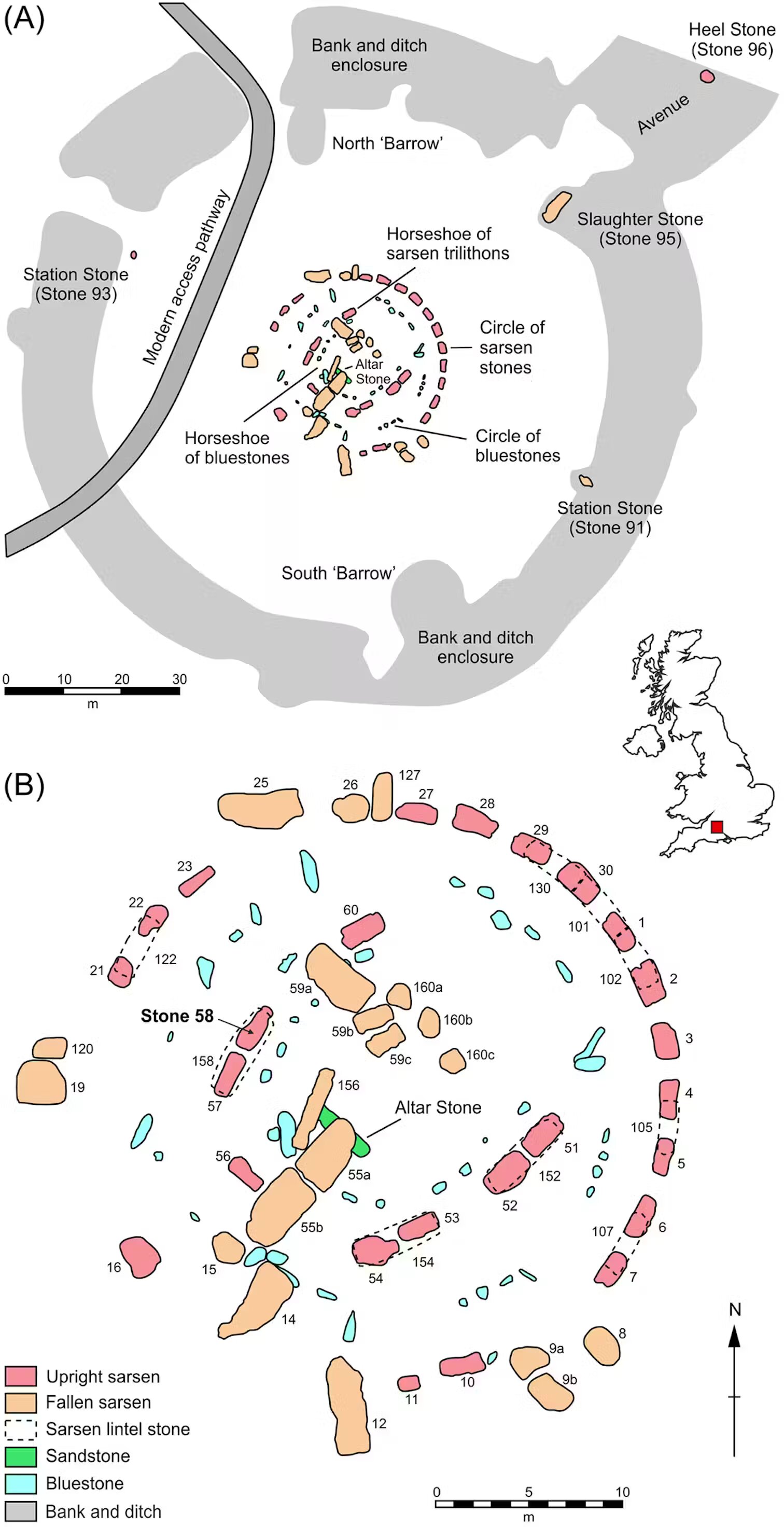
A new Stonehenge Altar Stone glacier theory suggests the monument’s most distant stone may have been carried part of the way from northeast Scotland by ice before people moved it toward Salisbury Plain. Remy Veness, writing in The Conversation, said work with Curtin University geochemist Anthony Clarke tested whether a glacier could have transported the six-tonne sandstone block to what is now the southern North Sea.
The Altar Stone has been traced in earlier research to the Orcadian Basin in northeast Scotland, about 700 km from Stonehenge. That basin was once occupied by Lake Orcadie, whose sediments formed the sandstone from which the stone came, according to the research cited by Veness.
The stone is the largest and heaviest of Stonehenge’s bluestones, the group of transported rocks that arrived before the larger arch-forming stones, Veness said. It is about 4 meters long and weighs 6 tonnes.
How did the Stonehenge Altar Stone get to Stonehenge?
Veness said a numerical model developed to estimate where glacier-carried rocks could be deposited indicates that material from the Orcadian Basin could have reached Dogger Bank. Dogger Bank is now submerged off England’s east coast, but it was once part of Doggerland, the low-lying area that linked Britain to continental Europe after the last ice age.
The theory does not remove people from the story. Instead, it proposes that ice may have shortened the human transport problem by moving the rock from Scotland to Dogger Bank, leaving Neolithic communities to move it onward to Salisbury Plain through one or more later stages.
Northern Britain was covered by ice until roughly 15,000 years ago, Veness wrote. Thick ice sheets can move like slow rivers, carrying rocks and debris and leaving them behind as erratics when the ice melts.
Dogger Bank is partly made from a glacial moraine, a ridge of material dropped by ice, according to Veness. He said that would have made the area a place where many unusual northern rocks were exposed together, which could help explain why people selected the Altar Stone.
Veness linked that possibility to archaeological evidence that Neolithic people knew rocks well and chose particular stones for tools. The research does not identify the exact reason the Altar Stone was chosen, but it raises the possibility that its unusual origin or qualities made it meaningful.
Why would Dogger Bank matter?
Dogger Bank stood above sea level when people were moving through the region after the climate warmed, Veness said. Doggerland was gradually flooded as ice sheets melted, remaining above water until about 8,000 to 9,000 years ago, and perhaps as late as 7,000 years ago.
Because Doggerland was underwater before Stonehenge was built, the Altar Stone would have needed to be moved away from its first resting place before its final use at the monument, Veness said. That implies at least one intermediate stop between Dogger Bank and Stonehenge.
Once the stone had reached England’s east coast, the remaining journey to Salisbury Plain would have been about 400 km, Veness wrote. He said that distance is comparable to the travel distance of other bluestones, though still far greater than the route for the more local sarsen stones.
Veness also noted that east-west travel was taking place during the period of Stonehenge’s construction along the Berkshire Ridgeway, a Neolithic route leading toward Salisbury Plain. The study leaves open whether rising seas helped push people to move the stone from Doggerland before it disappeared beneath the water.
This story draws on original reporting from Phys.org.