
Newly found spider uses silk catapult to catch green tree ants
Researchers say the Queensland spider builds a spring-loaded web that ants trigger themselves, firing them upward into silk.
By Lucas Ferreira · Science & Environment Writer
3 min read
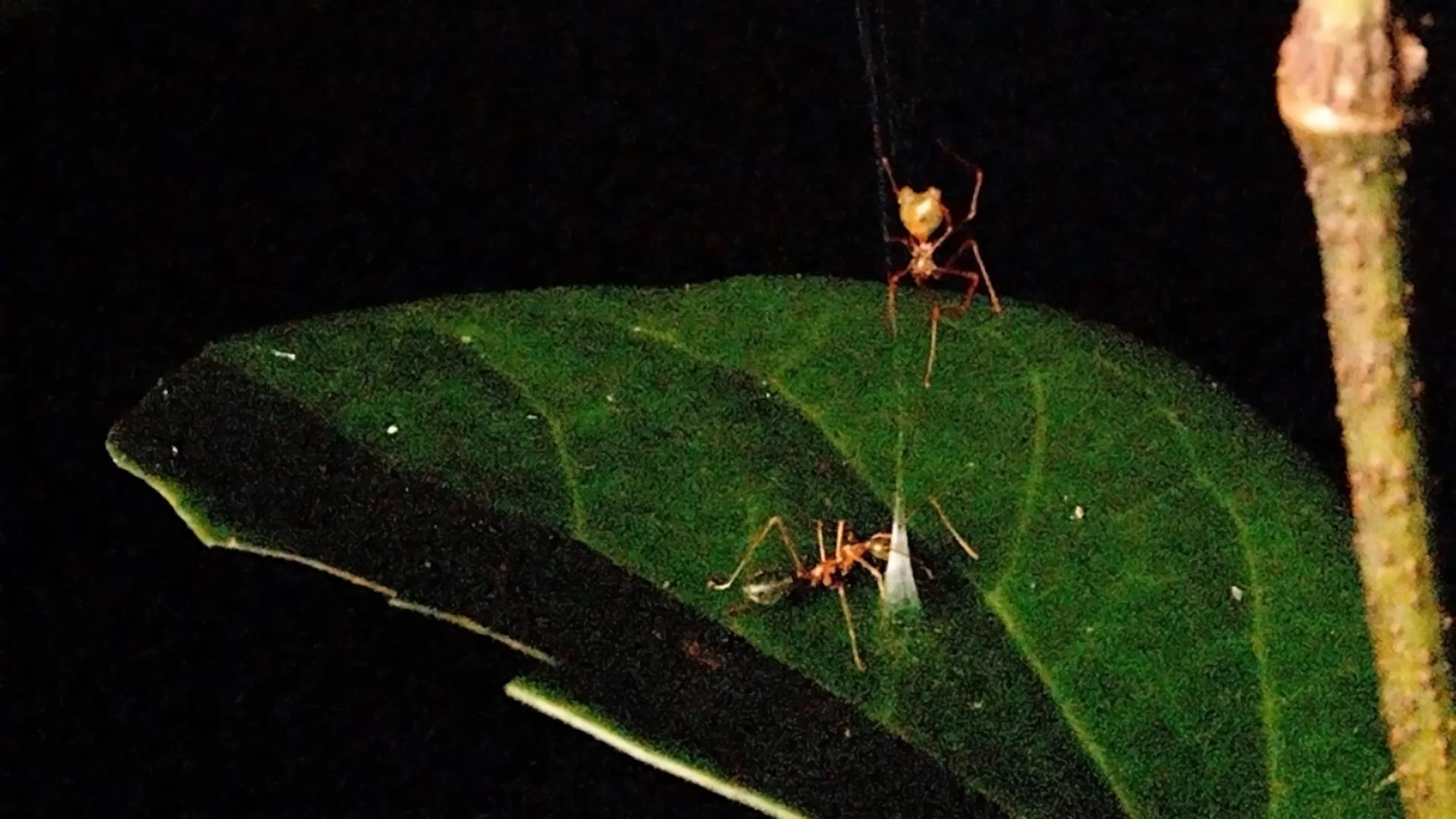
Researchers have described a newly discovered spider in northern Queensland that uses a spring-loaded silk snare to capture green tree ants. The finding matters because the spider appears to target one dangerous ant species with a web mechanism triggered by the prey itself, according to Macquarie University.
The spider, not yet formally named, belongs to the genus Propostira and has been nicknamed the ballista spider after an ancient tension-powered weapon, Macquarie University said. The research team reported its observations in Current Biology.
Macquarie University said Professor Greg Anderson, a biomedical researcher who is also a spider taxonomist and photographer, first spotted the animal. Professor Ajay Narendra and postgraduate student Pranav Joshi led fieldwork near Cooktown in far north Queensland, where researchers spent 10 days and nights searching rainforest sites and recording the spiders with high-speed and infrared cameras.
A trap built for risky prey
According to the university, the spider hunts the green tree ant, Oecophylla smaragdina, a species known for aggressive defenses. Narendra said ant-eating is uncommon among spiders because ants can be dangerous, and he said specialization on one ant species is more unusual.
Macquarie University said the risks include chemical defenses, stings in some ant species and alarm signals that can summon large numbers of nestmates. The ballista spider’s method appears to let it take individual ants away from trails and nests before feeding, the researchers said.
By day, the spider hides under a leaf above places where green tree ants forage, according to the team. At night, Macquarie University said, it drops more than 50 centimeters and fixes silk to a leaf, branch or the ground before spending up to four hours assembling a vertical snare.
The structure includes 15 to 60 tightened silk strands arranged in a cone near the ground, the researchers said. The spider then covers the cone with finer silk and retreats upward.
How the snare fires
Macquarie University said a green tree ant approaching the trap bites the cone, detaching it from its anchor and releasing the stored tension. The snare then shoots the ant more than 30 centimeters into the spider’s main web.
The researchers measured acceleration above 1,300 meters per second squared during the launch, according to the university. Once the ant is tangled and restrained, the spider moves in and wraps it in silk.
Narendra said the team suspects the spider may add a pheromone during the final stage of construction that attracts worker ants and prompts them to attack the cone. He also said the researchers believe this is the only known case in which a spider web is designed for one prey species and is set off by the prey rather than the spider.
Silk under tension
Dr. Jonas Wolff, a co-senior author and specialist in spider-silk biomechanics, traveled to Australia to observe the spider and later analyzed silk samples at the University of Greifswald in Germany, Macquarie University said. The work included scanning electron microscopy.
Narendra said the snare stores elastic energy in silk and releases it quickly, producing greater instantaneous power density than other specialized silk-based biological catapults known to the team. He said the trap must also overcome the adhesive pads on the ants’ feet, which can hold with forces many times the ant’s body weight.
The study, by Ajay Narendra, Pranav Joshi, Daniele Liprandi, Gregory J. Anderson and Jonas O. Wolff, was published in Current Biology under the title “Ballistic high-powered spider webs overcome dangerous prey defenses.”
This story draws on original reporting from ScienceDaily.