
Study says Earth impacts may have sent microbes toward Venus
Researchers modeled whether impact debris from Earth could reach Venus' clouds and found that billions of microbial cells may have made the trip.
By Tom Brennan · Health & Medicine Correspondent
3 min read
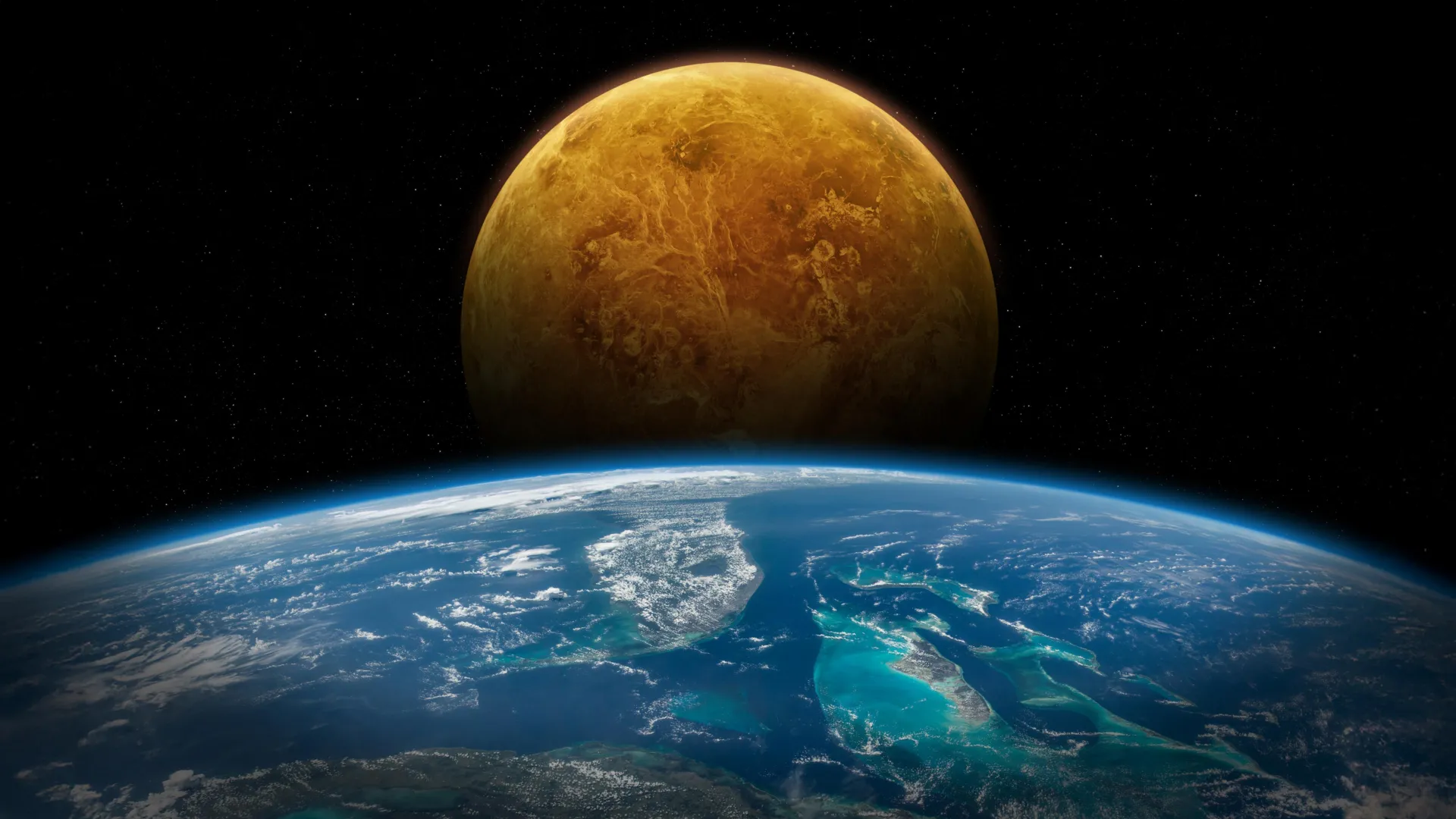
Asteroid impacts on Earth may have launched microbe-bearing debris toward Venus for much of the solar system’s history, according to research reported by Universe Today. The finding matters because any future detection of life in Venus’ clouds may need to account for an origin on Earth, not only a native Venusian biosphere.
The study, presented at the 2026 Lunar and Planetary Science Conference, was conducted by researchers from the Johns Hopkins University Applied Physics Laboratory and Sandia National Laboratories. The team examined whether material ejected from Earth or Mars could reach Venus and remain in its cloud layers, where recent astrobiology discussions have focused on the possibility of microbial life.
The work draws on panspermia, the idea that life or its chemical building blocks can move between worlds inside rocks blasted into space by impacts. Scientists have often considered that possibility for Earth and Mars, Universe Today reported, but interest in Venus has grown because its thick atmosphere includes cloud layers that have been discussed as a possible refuge for microbes.
How the researchers modeled the transfer
The researchers used the Venus Life Equation, a framework developed by Noam Izenberg and colleagues in 2021, to estimate the odds that life could exist on Venus. The equation combines factors for life’s origination, the resilience of a biosphere, and the continuity of habitable conditions.
Before applying that framework, the team looked at whether organic material or organisms could survive the route from one planet to another. According to Universe Today, prior simulations and meteorite studies have indicated that organic material can withstand ejection from a planet and travel through interplanetary space, despite shock, heat, vacuum exposure, radiation and temperature swings.
The harder step is arrival at Venus. Material entering Venus’ atmosphere would have to break apart in a way that leaves some fragments suspended in or above the clouds, rather than falling too deep into hostile conditions.
To test that stage, the researchers modeled fireball meteorites, also called bolides, as they entered Venus’ atmosphere. They used a semi-analytic method known as the pancake model, which describes how an incoming object breaks apart, spreads outward after an airburst and forms flattened fragments the team described as cells.
Large numbers, large uncertainties
Using that model and values from earlier studies, the researchers estimated that hundreds of billions of cells from Earth or Mars may have reached Venus’ clouds. Their preferred estimate found that about 100 cells could be spread through Venus’ clouds each Earth year, Universe Today reported.
Over the past 1 billion years, the calculations suggest roughly 20 billion cells may have been transferred from Earth to Venus. The researchers also found that life delivered from Earth could potentially survive in Venus’ clouds for at least a few days per century.
The team cautioned that the model does not include every detail of how bolides behave in Venus’ atmosphere. They also noted that the Venus Life Equation, like the Drake Equation it resembles, depends on parameters with significant uncertainty.
Even with those limits, the study supports the possibility that Earth-to-Venus panspermia could occur. If a future mission reports life in Venus’ atmosphere, the researchers’ work points to one possible explanation: some of it may be descended from organisms carried there by impact debris from Earth.
This story draws on original reporting from ScienceDaily.